A chorus of voices is beginning to call for substantive reform to this year's farm bill.
In just the past forty-eight hours I have heard or seen it on:
Ethicsdaily.com
Sojourners Magazine
and On Point with Tom Ashbrook
Wednesday, July 18, 2007
Thursday, July 12, 2007
Mourning Marlette
"Welcome to Kudzu"
Those were the first words of welcome I heard when I showed up for my first church job. I was in my third year of divinity school and had been assigned to an academic year of youth ministry at a small church in North Carolina. It was an assignment I was not particularly interested in and had I known what was meant by "Welcome to Kudzu" it might well have been enough to send me packing the first day.
The pastor was of course referring to the comic strip "Kudzu" by Doug Marlette which both honored and made light of the mid-twentieth century South and its way of life. Marlette was raised a Southern Baptist and the preacher in his comicstrip, Will B. Dunn, was modeled after famed Baptist minister, Will Campbell. A central theme in his work was the South's struggle to overcome what Jimmy Carter called "dead weight" of its racist past.
Marlette died Tuesday evening in a tragic car accident. Michael Westmoreland-White has written a nice piece about Marlette's life and work. Marlette was one of the best satirists of his era and earned a Pulitzer Prize for his work in 1988.
In many ways Marlette's death embodies the death of a whole generation of Southern Baptists who were first-hand witnesses to (and participants in) the civil rights movement dramatically altered the Southern way of life for good.
Marlette's work was an artifact of a time that still very much shapes the Southern identity today. Marlette helped us to remember the sins and sanctimony of our forebears in a way that neither canonized nor demonized, but simply told the truth.
That memory will be missed.


Tuesday, July 10, 2007
 Burying the N-Word
On Monday the NAACP buried the enemy.
The N-Word is no more.
I commend Julian Bond and the rest of NAACP for having the courage to say that the N-Word is simply not going to be tolerated - out of the mouth of anybody.
This seems like a no-brainer. But for a long time an argument has been made (by some prominent African Americans, including luminaries like Dick Gregory) that by taking the hate-filled word and appropriating it into new contexts something subversively redemptive can take place. This happened, in an admittedly much simpler and less painful case, at my parents' high school alma mater where the Plainsmen of Monterey High School came to proudly embrace the once-belittling moniker "Peons".
Those who argue that using the N-Word in new contexts are basically saying there is no power in the the word save the power that it has been given. The charge that it has is not in its phonetic syllables in and of themselves, but rather in its context of use. This is the tricky thing about language. It is pregnant with meaning. Historically the N-Word has represented more than just a word; instead it has been a verbal symbol of a whole history of hatred, oppression and violence.
I am sympathetic to this line of reasoning. There is a certain logic to it. It is the same logic that many were using in the Apostle Paul's day to justify eating meat sacrificed to other gods. Here was the syllogism: "If there are no other gods, then in reality this meat has not been sacrificed at all. So let us eat" Well, yes. Logically true. But the way we communicate meaning as humans is, though not illogical, not altogether syllogistic either. Paul was not concerned about logical argument. He was concerned about people's faith and creating a kind of community that would sustain that faith. If someone with "weaker" faith is bothered by meat that is said to have been sacrificed to other gods, then we best not eat. Even if other gods have no ontological being, they certainly have a conceptual being. And that is enough to make a brother fall.
Part of the justification for keeping the N-Word alive is an appeal to "rights". This word has been used against us for so long, now we have a "right" to take the word and use it on our own terms. Fair enough. But I am stuck on Paul's point: what is most paramount in determing what to do is not "rights" but rather community.
I think it is best for our community that the N-word was buried.
Ashes to ashes and dust to dust.
A Recent Self-Revelation
I have a responsibility to talk about race. I have a responsibility to tell my story and my family's story. I have a responsibility to speak because I have been graced (burdened?) with (figurative and literal) pulpit.
How did I come to this pulpit? Oh, if I only knew how such things happen in this world. When I was a child grown-ups told me that marrying a black lady was a lot like driving a Ford - "there may not be anything wrong with it, but you'll always feel a little funny about it." When I was a child I thought like a child. I spoke like a child. When I was a child I learned to speak like a grown-up.
But when I became an adult I put away the grown-up ways. I became a child again. When I became an adult I married a black lady.
And here is the irony. I do sometimes feel a little funny about it some times. I feel a little funny like W.E.B. DuBois felt a little funny when he looked through the looking glass of double-consciousness and read the world's mind: "How does it feel to be a problem?"
Thursday, June 28, 2007
Time for A New Baptist Covenant
As I have written before, President Jimmy Carter has initiated a number of other Baptist leaders from across the theological and political spectrum to begin what is being called a New Baptist Covenant. The hope is that the New Baptist Covenant will serve as a venue for Baptists in North America to join together in affirming traditional Baptist principles. In January Atlanta will play host to a convocation for Baptists from around the world to come and celebrate the new covenant.
I am excited about the prospect of Baptists coming together to witness to what I hope is a budding culture of grace and goodwill, as opposed to the culture of rancor which has defined Baptists in the public eye for too long. On the night Jesus was betrayed he prayed that his disciples might all be one. I do not know if we will see that prayer answered in our lifetime. But I do know that January’s meeting will mark the closest we Baptists have come since before the Civil War. If, as the old preachers used to say, "the Lord is willin’ and the creek don’t rise," I will be truly delighted to be there in Atlanta.
It is interesting to note how many of the Baptist denominations which will be represented at the New Baptist Covenant meeting in January have names that derive from either geographical or nationalistic sources. Just a cursory glance at the participating organizations reveals all sorts of place names: American Baptists Churches, USA (formerly the Northern Baptist Convention), Canadian Baptist Ministries, National Baptist Convention of America, Inc., National Baptist Convention USA, Inc., Progressive Baptist National Convention. In addition to these officially participating organizations there looks to be a heavy contingency of Southern Baptist participants as well.
These fixed place names contrast markedly with the Biblical text the New Baptist Covenant has chosen as the key scripture for the convocation. In the Luke 4 story Jesus has come home to visit the synagogue in his hometown of Nazareth. He opens the scroll of the Hebrew Scriptures and reads from the book of Isaiah. “The Spirit of the Lord is upon me, because he has anointed me to bring good news to the poor, and declare deliverance to the captives, to let the prisoners go free and to declare the year of the Lord’s favor.”
The text is unique in that it does not talk about the blessing of geographical place, which is exclusionary. Rather the text refers to the blessing of a time, which is liberally expansive and all-inclusive. The year of the Lord’s is the time acceptable to the Lord when no one is left out. When Jesus comes to proclaim the year of the Lord’s favor he comes to baptize all geographies and nationalities into the flaming fire of the all-consuming Holy Spirit.
It is really quite a magnanimous statement and the people receive it with much cheerfulness. Jesus is unimpressed by their enthusiasm however. Immediately he goes into a story about Elijah who, though there were many widows in Israel at the time, went instead to minister outside of Israel at Zeraphath in Sidon. “No doubt about it,” he tells the crowd, “you are going to say, ‘Do here also in your hometown the things that we have heard you did at Capernaum.’” The inference is clear. Jesus is going to do what Elijah did. Suddenly the cheers turned to jeers. The idolatry of a particular place and people over all others was the original sin that caused the people at Nazareth to reject Jesus.
Next Wednesday most of the members of my church will stand outside on the front yard and wave and watch as a throng of cars and floats make their way down Main St here in the heart of Colchester Village. It will be a great day just like last year. And just like last year I will be decked out in red, white and blue. Yet in the back of my mind I will do my best to remember that though my country ’tis of thee, but it is not Thee.
At the very core of the Baptist identity is what is in every generation the radical notion that one simply cannot equate church and state. I applaud the many participating organizations listed above, and a dozen or so others, which have recognized that geographic and nationalistic identities must all be subsumed under the Lordship of the anointed Christ.
Jesus has come to inaugurate the year of the Lord’s favor. And all nations shall, in the end, bow down in the fullness, wonder and magnanimity of that time and be blessed.
Saturday, June 23, 2007
Racialism
On both Thursday and Friday I got a chance to watch one of the most provocative and productive social change-agents in the last quarter of the last century and the first quarter of this century. Who am I talking about? Oprah.
Oprah's subtlety and endearing staying power has given her a platform amongst both white and black Americas that is unparalleled. I do not know the demographics but suspect that women still form the vast majority of her viewership. However, Oprah is a phenonemon to be contended with. When she talks we all listen.
I don't know if it was a set of reruns or not, but Oprah hosted a twod-day "town hall" forum to discuss the whole Imus scandal. She amassed a number of movers and shakers in the black community including Stanley Crouch, Russell Simmons, India Arie, Common, Al Sharpton, Diane Weathers and Ben Chavis.
Everyone agreed that there is "a problem" but none of the representatives from hip hop were willing to admit that they themselves are in some way responsible for the mysogeny we hear in rap lyrics. Instead, Russell Simmons kept pointing a fingure at poverty as the real culprit. I agree to some extent that economic oppression fosters environments where exploitation takes root.
But as Stanley Crouch said, on the whole "I'm not buying it."
For too long black scholars and public intellectuals have been relunctant to speak out because they have been afraid of being accused of not understanding/supporting young black culture. In essence they have accepted a culturally/morally relativistic argument ("I'm poor and black and couldn't help but sing about what I know") because they have not wanted to be seen as further diving an already fractured community. This is what Cornell West calls "racialism" which basically means giving a pass to people because they belong to your race community.
No more passes. True black culture is not pimps and hoes and should not be represented as such. It is too bad it took a white man to show us that.
Friday, June 22, 2007
Preaching Ourselves
 I just gave Irie Parker Palmer's book The Courage to Teach. In the inscription I wrote, "In honor of your courage to teach and to love."
I've enjoyed sneaking a peek at the book here and there. Palmer's thesis - that teachers must not only teach subject material but in some way teach their own lives also - is causing me to reflect some on the meaning, not only of teaching, but of preaching also.
Palmer says that good teaching takes a variety of forms, but invariably bad teaching can be pretty well summarized by the picture of a lecturer with a big bubble coming out of his mouth: Blah, Blah, Blah, Blah, Blah.
Bad teaching is essentially words abstracted from personhood. The heresy undergirding this is gnostic dualism. The false hope that ideas can save us.
I am realizing that as a preacher I cannot simply preach the text. "The Bible says. . ." Ultimately that leads to a flattened conception of both the text and of God. Instead as a preacher I must learn to stand in the gap between ideas (Scripture/text) and people. I have nothing but my own story and the witnessing story of the Church to stand there with me.
Palmer's book has many convergences with what John Claypool called "confessional preaching". The basic assumption of both these individuals is that words alone have no power to save. Words must instead be embodied. Words must be told through the character and story of the proclaimer. This is why Palmer says it takes "courage" to teach, because it is inherently risky business to offer one's body to the world.
It is inherently risky business when the word becomes flesh and dwells among us.
Tuesday, June 19, 2007
Nifong's Excuses
On his blog today one of my former professors Mike Broadway has an interesting quote from a Duke law professor who says that what Mike Nifong, the former district attorney of Durham, NC, did in the Duke Lacrosse case was really not that unusual for a district attorney.
Here is the quote from Duke U. law professor James Coleman:
Here is the quote from Duke U. law professor James Coleman:
Everybody wants to say that Mike Nifong is some kind of rogue prosecutor, but in
fact, what he did is not that different from what other prosecutors do on a
regular basis in cases out of the spotlight.
One of the things Nifong did that people are upset about is the way he came out and publically called the accused students a bunch of "hooligans." The thing is that these kinds of public statements are made all the time by district attorneys. And certainly those public comments do much to shape public opinion long before the facts are in.
But I'm not as concerned about what Nifong said as what he did not say. He was not forthcoming with DNA evidence that favored the defendants. NPR reported this weekend that Nifong blamed an overburdensome caseload. Of course, that excuse didn't hold water because this was THE Duke Lacrosse Case. But if it wasn't THE Duke Lacrosse case then the public may very well have accepted that kind of excuse without much question.
Which brings up another point. . .
If Nifong was not prevaricating when he said he didn't have adequate time or staff to give sufficient attention to THE Duke Lacrosse Case, then what does that tell us about the kind of attention being given to less high profile cases?
Sobering.
Thursday, June 14, 2007
I've Got a Fever and the Only Cure is More Farm Bill!

On Wednesday we attended a House Party hosted by our friend Debby and her friend Brendan (with yellow dog). We watched a PBS video about how US farm policy is having a detrimental effect in the developing world.
When I start talking about the Farm Bill and all that is at stake eyes begin to glaze over. I don't really think its that people don't care. They do by and large. Very few people I know are blatantly callous enough simply not to give a rip about people in the developing world going hungry.
But eyes do glaze over nonetheless. I think that is because we have been so trained not to have to pay attention that anything complex that comes along just goes right over our heads. After years of sitting back and taking in easy-to-consume television we just don't know how to pay attention.
And the dark principalities of this world love that because it means that their power can remain hidden.
So, if you care about people not being hungry here is a crash course in how US farm policy is contributing to global insecurity. Pay attention:
1. Our goverment gives lots of money to US farmers to produce crops like wheat and cotton
2. This creates incentives to produce lots. And I mean lots
3. We take what we don't use and sell it at basement prices
4. We sell our crops for less than it costs farmers in the developing world to produce theirs
5. This means they make next to nothing (like a buck or two a day)
So, that wasn't too bad. Now go and pay attention to the video to learn more.
The (Politcally Active) Christian Citizen; Or: "That's right, IceMan, I am dangerous."
The latest issue of the Christian Citizen has just come out. The Christian Citizen is a magazine put out by ABCUSA focusing on issues of justice and faith-informed social action.
In his editorial "The Church and Politics" Curtis Ramsey-Lucas writes, "Simply because politics is dangerous does not mean that Christians have the luxury of opting out of the Process." He points to various political movements in our nation's history - the Civil Rights movement, the struggle to end apartheid in South Africa, etc. - and underscores the fact that the Baptist denomination was intimately involved. (Of course, the Baptist denomination was intimately involved on both sides of the struggle for Civil Rights.)
What I find interesting is the fact that many who would say we ought not to "mix politics and religion" are oftentimes the very same people who will take great pride in the heroes of our faith who did just that. A case in point is the burgeoning interest in William Wilberforce and his role in putting an end to the British slave trade. The truth is that, when pressed, most of us will admit that the distinction between what is political in nature and what is religious is at best arbitrary and oftentimes altogether false.
I think that Ramsey-Lucas' statement about politics being "dangerous" may shed some light on what we as Christians really think. For something to be dangerous means that it may cost us something truly valuable - our job, our reputation and in some cases our very life. When we say something is "political" and therefore choose not to enter into the fray, what we are really saying is that we are not passionate enough about the cause to risk losing anything very meaningful.
Ramsey-Lucas closes his essay by saying that as Christians we have the "opportunity" to let our faith speak by asking those who want our vote in the 2008 election to tell us what they are going to do about poverty, hunger and educational inequality here and abroad. These are indeed the kinds of questions we as people of faith ought to be asking. But in order for these questions to be truly "political" in nature then we as Christian citizens are going to have to learn to ask them in risky or - to borrow a word from Ramsey-Lucas -"dangerous" ways.
I suppose this means that if we are going to ask a question that matters then we are going to have to put our own selves in the hot seat. We are going to have to ask these questions when others are telling us we ought to be asking or doing other things. It means we ought to ask them in a public forum when we could have gone home and watched reruns of "Friends" instead. It means we ought to ask them when it would be a lot nicer not to ask anything at all but just smile and get along and let the market do its thing.
Wednesday, June 13, 2007
The Power of an Indestructible Life
On Sunday we honored our two graduating high school seniors during church. It was a fun day with lots of smiles and a couple of stories and some very meaningful words spoken by parents to their children.
These girls were of course badgered with the requisite graduating senior question. "Now that you've graduated, what are you going to do with your life?" That is, of course, the wrong question. The question everyone ought to be asking is instead, "Now that you've graduated, who are you going to be?" It is the difference between being a fisher in the world and a fisher of men in the kingdom.
During the sermon I said that being a Christian is going to mean choosing a path which will often diverge from the status quo. As Flannery O'Connor wrote, "You shall know the truth and the truth shall make you odd."
When I graduated from high school someone said pretty much the same thing to me. "Being a Christian means you are different. It means you are going to have to live differently from your friends." I heard that and, whether it was intended or not, pretty much thought everything that was being said was referring to sex. "Being a Christian means not doing it till you're married," which would indeed mean being pretty odd in today's world.
Being a Christian certainly means our sexual practices should look very different from the world's (sadly, they often don't). But a lot more is at stake than just sex.
In Hebrews the writer talks about the "power of [Jesus'] indestructible life." Jesus lived such a profoundly counter-cultural life that he was able in death to transfigure the shame of the cross into the glory of the heavens.
As Christians we are to share in that profound power. Yet the only way to do so is to ourselves join in Christ's suffering.
As I write this I realize how domesticated my Christianity really is. I am richer than ninety-nine percent of all the people who have ever lived on earth. That is a daunting thought when I consider the Scriptures word for the rich.
The power of Jesus' indestructible life has laid a claim to all of me. Not just my sex life, but also my bank account and my free time. That is why being a Christian is so incredibly difficult and so incredibly, well, "odd".
So today, eleven years ahead of these girls, I am doing exactly what I hope they are doing. I'm wondering who it is that I'm going to be.
Thursday, June 07, 2007
Mystery Meat Ministry

I've been kicking the story of Aaron and the Golden Calf around in my head for about a week now and have decided it is a great metaphor for the life of ministry.
Aaron is in charge because Moses has gone up the mountaintop to speak with God. Moses is taking longer than anyone is expecting, so the people start clamoring for Aaron to do something. "Make us some gods," they yell.
From a reader's persective it is pretty obvious that Aaron is just winging it. He really has no idea what he is doing. Anxious, and perhaps even a little scared, he goes with the first thing he sees. "Your earrings, give me your earrings," he says. The Hebrew women all take off their earrings and drop them in the cauldron Aaron is mixing up. Aaron then makes a molten calf out of the melted earrings. His eureka borders on the ridiculous: "This is the god, O Israel, that brought you out of Egypt."
Rrright.
The first casuality in a time like this is always intentionality. People want God or gods, whichever they can have right now. So, like Aaron before us, we wing it. I call it mystery meat ministry, because it reminds me a lot of whatever they served on Fridays in my elementary school - a mixed bag of whatever was available all thrown together and then nuked for safety's sake. This is how blended worship services and hydra-headed youth pastors and scary Jesus pictures made their way into the church. "This is what will lead our struggling little church out of Egypt. This be your god, O Church of America."
The alternative is of course much more unsettling. The alternative is to move slowly and carefully. The alternative is to attend to the ancient spiritual practices. To fast. To pray. To break bread with one another. The alternative is to wait on God.
I covet your prayers. Our church has come out of Egypt but we haven't quite made it to the Promised Land. And Moses is nowhere in sight.
Pray that we will resist the temptation to make ourselves some false gods. Pray that we will instead have the patience to wait on the real one.
Tuesday, June 05, 2007
More Farm Bill
Today the Burlington Free Press printed an Op Ed piece I wrote calling attention to all that is at stake in this year's Farm Bill.
Lurkers, I cannot stress to you enough how important this legislation is for rural America and for farmers in the developing world. Please write your congressmen and tell them that you would like to see change in this year's legislation. Go to Oxfam America or Bread for the World to learn what needs to be fixed.
Advocacy is a hidden, romanceless, thankless job. But it is how the world will be changed.
Friday, June 01, 2007
Food Stamp Challenge
 When I was doing Young Life we would sometimes take off a week or two during the winter and go and work at Wilderness Ranch. We did the dishes for a hundred or so ski trip campers in exchange for a place to shack and a couple of lift tickets.
Hovering over the kitchen was the ultimate of dares called the Pit Challenge. Only the most courageous or stupid would even consider taking up the Pit Challenge. For those bold enough to accept the dare required one to scrape into a single glass all of the food (and God knows what else) from the bottom of the Hobart, add water and then chug.
The reward, we were told, was immortality.
Well, we young evangelicals have grown since then and now some of us are taking on more meaningful challenges. One of Bread for the World's regional organizers and her husband have accepted The Food Stamp Challenge.
Elise and Mark are limiting themselves to $3 a day in food expenditures - the average amount of assistance Food Stamps recipients actually receive. They have some great stories recorded on the BreadBlog.
I suppose the point of the Food Stamp Challenge is two-fold. First it is raising awareness about how little assistance Food Stamps recipients are actually receiving. (Here in VT the per meal amount is about 87 cents.) But more than that, The Food Stamp Challenge also shows us how much the rest of us actually overconsume.
I never felt bad about not taking the Pit Challenge. Other peoples' wet seconds was never my idea of a good time.
But it is only with a severe sense of discomfort that I look at what Mark and Elise are doing and say not for me. I have read the words of the prophet Ezekiel too many times for it to be any other way:
"And this was the sins of your sisters Sodom and her daughters: They had pride and excess of food and prosperous ease, but did not aid the poor and hungry."
Wednesday, May 30, 2007
Remembering the Anonymous

I came up to the church for a little while on Memorial Day and saw dozens of people coming to pay respects to their dead in the cemetary out back of the church. Quietly they would step out of the car as a family and carry a half dozen petunias past the gate into the church yard. Younger children would trail behind with a small American flag in their hands. I watched them from the window in my study as they would bend down on all fours and dig small holes and plant the flowers and then groom the earth. As I watched them I hoped that whoever it was that they were coming to see knows that they were dearly loved and deeply missed.
In response to that Memorial Day ritual, I thought that I might do a little remembering of my own. Pictured above is the tombstone for the Rev. Ansel Nash, the first pastor of our church, and his wife. "His wife". Now that I think says a lot about the tough job pastor's wives have had over these past several centuries. In life they are subject to a lot of gossip and carping and seldom if ever get recognized for the importance they played in keeping their husbands sane. Then, in death, they are served with the sentence of total anonymity.
"There were five thousand men fed that day, not counting women and children."
Well today women and children do count. So thank you Mrs. Nash. And thank you Irie. And thank you Gabrielle Zipporah. God will not forget the sacrifices that you have made for this Gospel.
Tuesday, May 29, 2007
New Baptist Covenant
I must have been no more than five or six. Mom was driving the Buick. We called it the Blue Bomb. I can tell you exactly where we were too. We were driving through Tech Terrace, right by Tom Sawyer's house. Somewhere out from the backseat came my question.
"If it were old timey days, would we have been on the Confederate side or the Union side?"
Mom's answer was the one I was hoping for and knew I would get. "I guess we would be on the Confederate's side," she said with some uncertainty in her voice.
A rush of warmth came over me. "Ahh, blessed assurance."
Twenty-five years later I know that my mom was right. Unless we had been bold abolitionists we would have been on the Confederate side. Even if we did not own slaves (two-thirds of whites did not) we would have agreed that the Southern way of life was being threatened. And as Baptists in 1845 we would most certainly have been in favor of withdrawing our covenant with northern baptists and taking part in the establishment of the new covenant between southern baptists which came to be known as the Southern Baptist Convention.
It is no longer blessed assurance that rushes over me when I think of what side of history we as a family might have been on in the years leading up to the Civil War. It is instead, pure, unalloyed holy terror.
President Jimmy Carter is putting together a new initiative to bring a wide body of Baptists - black and white, southern and northern, conservative and liberal - together. The initiative is aptly called the New Baptist Covenant. It is President Carter's hope, and the hope of many others, that this new covenant of Baptists will witness to the Christ who cares deeply about issues of race and poverty and the systems of economic injustice which continue to keep masses of people in de facto slavery even today.
As a boy raised in a Southern Baptist household I have to look honestly at my own history and admit that it was my forebears who broke the first Baptist covenant. And being even more candid and personal I have to admit that if I had been there I would have done the same. Now we have been given an opportunity to renew the covenant - to pick up the pieces of our earthen vessel and put them back togehter again. This New Baptist Covenant is a chance for southern Baptist boys like me to grow up and become more than southern Baptist men. It is a chance for us to grow up and become Christians.
Wednesday, May 23, 2007
Confounding Calculus

Last week on Speaking of Faith I heard George Ellis, a quaker from South Africa, speaking about the struggle against apartheid in his country. He says that what happened in South Africa "confounded the calculus of rationality." By this I suppose he means a miracle happened.
I was thinking about what it must have been like to be sitting in Sowetto in the mid-1980s or Selma in the late-1940s, having no idea that freedom was right at the doorstep. Then suddenly, the sound of many waters can be heard thundering its way through and the world is turned upside down.
It is the Saints who sit and wait in darkness and dare to imagine a new world where the rationality of our present calculus will no longer hold sway.
There are a few of those Saints at the United Church of Colchester - folks who sat and prayed through dark hours and just simply refused to let the doors be closed. There are a couple of those Saints beating the pavement on the east side of Lubbock High School in the name of Jesus the Incarnate - just daring enough to believe that being faithful is more important than being big. And there are a few Saints who gather every month in the youth room at First Baptist Church of Burlington to sing and pray and create a space for grace to work its way through the chinks of the panoply of a region at war.
The Saints teach me to confound the calculus of my own rationality and hope in the day to come.
Tuesday, May 22, 2007
Farm Bill 2007

Some of you know I have been working with Oxfam America and Bread for the World trying to raise awareness about what is at stake in the 2007 Farm Bill.
I have written an article at ethicsdaily.com.
I ask you to read it and then write your congressional representatives.
They actually read those letters!
Friday, May 18, 2007
Wonder

I look at this picture and think about what the Psalmist says about us being wonderfully made. I usually take that word wonderful to describe God's activity - God's creative action. But seeing this picture of my kid I have to think it describes more than God. It also describes us. Think about it. We were wonderfully made. In other words, wonder was on hand when we were being made in secret and woven in the depths of the earth. Wonder is a basic part of our genetic makeup. We are quite literally "wonder full".
Part of the tragedy of the human fall was our loss of wonder. When we ate the fruit, and began knowing things that only God had beforehand known, we grew smarter but lost that sense of absolute awe that makes us so giddy that we can do nothing but break out into doxology:
O the depths and the riches and wonder of God. Who has known his mind and who has been his counselor?
James Baldwin once wrote that the purpose of art is to lay bear the questions that have been hidden by the answers. Looking at this picture of Gabrielle I long for that lost womb of God's imagination, where I knew nothing and all was possible.
Monday, May 14, 2007
Dismas House
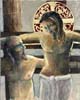
Saint Dismas
Last night Irie, Gabs and I attended the Dismas House of Vermont annual dinner. I delivered the invocation - which means that I provided the first awkward moment of the evening. "And now, let us pause from the fun we are having and remember that God is still watching. . ."
Our church has been sending a troop of six or so people over to Dismas every month or so for a while now. (Props to Mary Lynch for taking on the organization of that.) Dismas is a transitional home for people who are re-entering our community following a jail or prison term. I have had a great time every time I've gone and have discovered that I am willing to fight for dinner rolls just as much as the felon sitting next to me.
Olin Robison, professor emeritus of Middlebury College, gave the keynote address. That didn't impress me much. But the fact that he was a Baylor alumni made me think he might actually have something of substance to say. I'm glad I listened. His speech was shorter than I would have liked, but his thoughts imaginative.
Robison talked about the request by James and John to sit with Jesus, one on his left and one on his right, when he came into his kingdom. "That is not mine to grant," Jesus said. Robison made the point that James and John assumed Jesus would be draped in royal garments and seated on a throne of glory when he came into his kingdom. They were wrong. When he came into his kingdom he was hanging naked from a cross - not so very becoming for a king.
For whatever reason, James and John were spared the agony of having to die with Jesus. Instead, two common criminals held the places next to Jesus when Jesus came into his kingdom.
I think what Robison was getting at was this: It could have been James. It could have been John. It could have been them hanging naked next to Jesus. And except for grace, it could have been us too.
Catholic tradition has it that a man named Dismas was one of the two criminals next to Jesus when he came into his kingdom. It was Dismas who turned to Jesus and begged him to remember him when he came into his royal power. Dismas' request stands the request of James and John on its head. They were asking out of a desire for glory; Dismas was asking out of a longing for grace.
A lot of politicians and talking heads on TV earn their living by getting some people riled up about needing to be tougher on crime, etc. They make anyone who has ever served time out to be less than human. Its bread and butter for them.
But places like the Dismas House keep reminding me that convicts and felons are human also. I know that because I keep bumping elbows with them as we pass the dinner rolls around.
And I look up from my plate and think, "You know, it could of been me. But for grace, it could have been me."
Subscribe to:
Posts (Atom)


