Ethicsdaily has a provocative article on comments made by Melissa Snarr, an ethicist at Vanderbilt Divinity School. Snarr says that American Christians have lost their ultimate allegiance to the person and work of Jesus and have instead replaced it with false allegiances.
Her argument crystallizes around the issue of immigration. She says that Christians have lost what earlier Christian generations knew to be true - that we are all pilgrims in a strange land (to borrow the tag line from a certain blog I really enjoy a lot).
I found her comments very interesting coming on the heals of a talk I gave last night at UVM's Intervarsity Fellowship. I spoke about the Christian witness and race and made the point that racism is really about ultimate allegiances. It is about fidelity to blood (or color or hair type or whatever else race is supposed to be) superceding all other fidelities. The biblical word for this is idolatry.
During the question and answer period one person in the group asked why it was that those who grew up in Sunday School (I didn't) never talked about this stuff. I don't know what exactly I said but I should have said it is because the church has been so thoroughly corrupted by Constantianism that the early witness of the church superceding all class, racial, and ethnic identities has been altogether lost.
This saddens me deeply because I believe that the Gospel that Christians have to proclaim is the one power in this world that can bring an end to the war and hostility and mutual-exclusion of the nations. In the resurrection of Jesus Christ the dividing wall of hostility has been put to shame and a new humanity has been born. All adjectives (black, white, American, Iraqi, Mexican, Texan, Vermonter) have been put back into their rightful place - as secondary to our most primal identity which is not an adjective, but a noun - children of God.
Tuesday, October 02, 2007
Thursday, September 27, 2007
Oh really, O'Reilly?
Radio and TV host Bill O'Reilly is in hot water for saying what some are claiming were racially insensitive remarks.
He was talking about a rather pleasant experience he had during recent visit to a restaurant in Harlem named Sylvia's. Here's a quote from the Washington Post article:
"There wasn't one person in Sylvia's who was screaming, '[Expletive], I want some more ice tea.' It was like going into an Italian restaurant in an all-white suburb in the sense of people were sitting there ordering and having fun and there wasn't any craziness at all."
O'Reilly seemed to be trying to be positive and emphasize the fact that in spite of what a lot of white America might think most of black America is civilized. But how he said that came off sounding a lot like a back-handed compliment. No craziness? In a black restaurant? Oh really, O'Reilly?
What he said was silly. Worse, it hurt people. He deserves to be told that. Straight up.
He does not deserve to be harshly chastened however. If we are going to get serious and start having some frank dialogue about race in this country (which I applaud O'Reilly for attempting to do) then we are going to have to give each other some grace. All we have are these words and we are trying to put very complicated and very pregnant feelings into those words. If we continue to jump on someone the moment they say something that isn't quite right then we will soon discover that most people will not feel like its worth the risk of talking at all.
That's the tragedy of political correctness. It started off as a boundary for what is exceptable in discussion but ended up eliminating discussion altogether. I hear it all the time. Someone will say, "Well, you know these days you gotta be PC." And they quit right there. Nothing ventured, nothing gained.
The truth is most people don't know how to be PC. They're not PC at home around the dinner table with their kids. They're not PC in bed with their spouses. So when they get out in the public sphere and something heated like race comes up they simply don't know how to talk. And that's the end of discussion.
And the end of reconciliation also.
So, let's tell Bill we don't like what he said. But let's don't tell him to shut up.
He was talking about a rather pleasant experience he had during recent visit to a restaurant in Harlem named Sylvia's. Here's a quote from the Washington Post article:
"There wasn't one person in Sylvia's who was screaming, '[Expletive], I want some more ice tea.' It was like going into an Italian restaurant in an all-white suburb in the sense of people were sitting there ordering and having fun and there wasn't any craziness at all."
O'Reilly seemed to be trying to be positive and emphasize the fact that in spite of what a lot of white America might think most of black America is civilized. But how he said that came off sounding a lot like a back-handed compliment. No craziness? In a black restaurant? Oh really, O'Reilly?
What he said was silly. Worse, it hurt people. He deserves to be told that. Straight up.
He does not deserve to be harshly chastened however. If we are going to get serious and start having some frank dialogue about race in this country (which I applaud O'Reilly for attempting to do) then we are going to have to give each other some grace. All we have are these words and we are trying to put very complicated and very pregnant feelings into those words. If we continue to jump on someone the moment they say something that isn't quite right then we will soon discover that most people will not feel like its worth the risk of talking at all.
That's the tragedy of political correctness. It started off as a boundary for what is exceptable in discussion but ended up eliminating discussion altogether. I hear it all the time. Someone will say, "Well, you know these days you gotta be PC." And they quit right there. Nothing ventured, nothing gained.
The truth is most people don't know how to be PC. They're not PC at home around the dinner table with their kids. They're not PC in bed with their spouses. So when they get out in the public sphere and something heated like race comes up they simply don't know how to talk. And that's the end of discussion.
And the end of reconciliation also.
So, let's tell Bill we don't like what he said. But let's don't tell him to shut up.


Tuesday, September 25, 2007
Sermon: The Lost and the Found
I haven't posted in a while. Sometimes I think I'm just going to quit this thing. Then I'll get a random email from someone saying I should write more or an old friend will call out ofthe blue and say they found me here and enjoy reading about my life. That gets me to wondering about calling - like does this thing honor God and edify others enough to keep putting blood, sweat and tears in? If it does then I probably ought to pour more in. So that' were I am today.
Anyway, today I am posting a sermon I preached a couple of Sundays ago. I think it says a lot of important things about church and community and God's longing desire for the lost. I pray that it does indeed honor God and edify someone.
Sometime last month I marked my fourteenth anniversary of being a Christian. It’s never really a big deal. The day just comes and goes with little fanfare. No note from Billy Graham. No card from the Pope. Jesus doesn’t come down and take me out to eat at the Outback Steakhouse.
Nevertheless, sometime around the first of August each year I remember back to when I made a profession of faith in Jesus Christ and my life changed forever. It was a great week at Frontier Ranch Camp just outside Buena Vista, Colorado. We were in the Rockies and I don’t know, perhaps it was the Rocky Mountain high, but I fell in love seven times that week. That’s once per day. That’s enough to give even Bill Jocelyn a run for his money. The first six didn’t work out — thankfully. But the seventh did. The last night of camp we had a party and dozens of kids stood up to share about what happened to them at camp. I stood up too. “This week I fell in love with Jesus Christ,” I said. When it was all done I remember what the camp preacher said to us. “Tonight,” he said, “the angels in heaven are rejoicing.”
I remember exactly what it was that got me that week. I’ve told you before. I was circled up with a group of guys from my hometown and Scott Travis our leader had us reading a passage from the book of Matthew. Jesus was having dinner at a tax collector’s house and there were all kinds of people there who didn’t quite have their lives together. The Pharisees, the religious authorities of the day, took exception. They began to grumble. “This man eats with tax collectors and sinners,” they said. Jesus discerned their thoughts. “It is not the healthy who need a doctor, but the sick,” he told them. “I have come to call not the righteous, but the sinners.” I remember reading that and then looking up with a grin on my face and twinkle in my eye. “Jesus has come to call sinners? That means he’s has come to call me.”
The gospel got me that night and though I have read the story of Jesus over and over it has been getting me again and again over these last fourteen years. The gospel got me in a new and fresh way this week and I want to share that experience with you.
Today’s story sounds a lot like that story in Matthew that I read for the first time in that circle fourteen years ago. Luke says that Jesus had amassed large crowds that among those gathered around Jesus were some tax collectors and so-called sinners. Again the religious leaders began to grumble. “This man not only has attracted sinners and tax collectors, but he lets them stay. He welcomes them.”
This time Jesus did not answer with a story about doctors coming for the sick. Instead he answered them with two parables. The first is a story about a lost sheep. “Which of you,” Jesus said, “if he had a hundred sheep and lost one, would not leave the ninety-nine in the wilderness and go in search of the one that was lost. And when he has found it, he lays it on his shoulders and rejoices and returns home. Upon his return, he calls together his friends and his neighbors, saying to them, ‘Rejoice with me,’ for I have found my sheep that was lost.”
Then Jesus tells his followers a second parable. It is a parable of a woman with ten silver drachma coins, who loses one. Jesus says, “Will this woman not light a lamp and sweep the house and search diligently until she finds that lost coin?” And when she finds it, Jesus says, she runs and calls all the neighbors. “Rejoice with me, for I have found the coin that I have lost.”
I read these stories and think, “My goodness, these people Jesus dreams up really need help.” First the woman. I see her lighting the lamp and sweeping the floor and digging inside the trash. She’s really quite eccentric. Finally she puts her hand down one of the corners of the couch. “Is that my lost drachma? No that’s a stale Post-Toastie flake.” Then, when she finally finds the coin she loses her sense. She runs and tells all the neighbors in her apartment. Knock-knock-knock. “Hey. . .I just want you to know that I lost my drachma, but now. . .I found it.” Finally she throws a party and gives everyone a t-shirt. “Shirley found her drachma, and all I got was this stupid t-shirt.”
And the shepherd. The one who leaves the ninety-nine others in the wilderness, where they are not quite safe and sound, and goes out to look for the one that is lost. He leaves ninety-nine to go and find one? Is he just really remedial in math or is he absolutely crazy?
Crazy I think is the answer. They’re both crazy. And that is Jesus’ point. If a woman can be this crazy about one lost coin, and a shepherd this crazy about one lost sheep, then how much more crazy is God about one lost child? And so, Jesus says, the angels rejoice more over one sinner who repents, then over ninety-nine who need no repentance.
Jesus is saying something really profound about the economy of God’s kingdom. There is an incredible extravagance about Jesus, the good shepherd, who leaves the found in order to go and find the lost. That means we as a church should do some pretty extravagant things for those among us who are on the margins. Yet here is where the gospel got me this week. I have always read that to mean that there are times when one is more important than the rest. But it is not so much that the one lost sheep is greater than the other ninety-nine, but that rather ninety-nine is less than the one hundred. What Jesus is trying to communicate about the kingdom of God is that it as a place where everyone is valued, not because they are special or good or deserving, but because they belong.
Belonging to each other is not always easy. On Tuesday I was talking with a friend in our church and he described the people here as a bunch of individual puzzle pieces. I imagined large jigsaw puzzle spread across a table in someone’s living room. There were all kinds of pieces of assorted sizes and shapes, yet they came together seamlessly. Where one zigged the other zagged, where one curved in another curved out. In my mind I could see one breathtakingly beautiful picture of Jesus Christ. He was carrying a lamb upon his shoulders and an angelic chorus was welcoming them both home. It was perfect. But before I could fully take it all in my friend added an odd twist. “Except,” he said, “all of the pieces are from separate puzzles.” The picture suddenly became a lot less breathtaking. It was . Very postmodern, but not exactly perfect. And then it hit me, that was just the point. This church, the United Church of Colchester, is really just a big box of spare puzzle pieces. The lost and found of puzzle pieces. Put us together and we’re not very beautiful. Certainly not perfect. We’re really not sure how we ended up here really. But we are here, and that’s the important thing. We’re all here — together.
We come from different backgrounds and different viewpoints. Today in these pews next to you there are conservatives and there are liberals. Some voted for Bernie and some voted for Rich. And some didn’t vote at all. Some of us here were born and raised Baptist. Some are died in the wool Congregationalists. I think of Joyce Sweeney who had me and Irie over to dinner the first week we were in town. “Now, Joyce,” I said, “You were a Congregationalist is that right?” “I still am a Congregationalist,” she said. OKAY. There are also Episcopalians here. And Catholics. And some who wouldn’t consider themselves anything, but who are just interested in this man Jesus, who welcomed sinners.
You know what this all means don’t you? If that image is at all true it means we’re headed for T-R-O-U-B-L-E. We aren’t all going to get along always. Even your pastor is going to have a hard time coming together with some of these pieces he has wound up in the same box with.
Pastor Robert McCracken told of the young minister who could not make peace with one woman in the church. The two argued about everything from the meaning of justification by faith alone to the color of the altar cloth. Finally, when she just quit returning his phone calls, he decided to pay her a visit at home. He knocked three times and could hear her making all sorts of noise inside, but the door remained shut. Finally the young minister decided to peek through the keyhole and there was another eyeball staring right back. “Well, Mrs. Smith,” the minister said, “I see we have finally come eye to eye on something.”
We aren't always going to see eye to eye. Earlier this month I was in a meeting here at church. Because Irie had class I had Gabby and unfortunately I was unable to coordinate a sitter for the night so Gabby had to tag along. As everyone piled in I told each of them, “Tonight, we are kid friendly.” We were real friendly until about halfway through the meeting I said something that someone disagreed with. A semi-tense cloud fell over the rest of the meeting. Things suddenly felt about fifteen degrees cooler in the room. It seemed like the perfect prescription for global warming.
After the meeting adjurned I followed the person who had disagreed with me out to the door. We both argued our points for awhile when suddenly we heard a loud scream from within my study. It was Gabs. “Well,” I said, “I gotta go.” I took a half dozen steps toward the study, paused at the door, and turned back around. Tears flushed to my eyes. “I want you to know that I love you,” I said. “I really do love you.”
We embraced and then I made my way back toward the screams. I walked into the study and there Gabs was standing up on the conference table, completely bottomless. A host of church people were huddled over her working on changing her diaper. Tears were flowing in her eyes too. And then the person with whom I had disagreed came in also.
So there we were. The old and the young. The saints and sinners. The Pharisees and the tax collectors. The lost and the found. We were all there. Ninety-nine plus one. We were all there. And we all belonged there together.
And the angels were rejoicing.
Anyway, today I am posting a sermon I preached a couple of Sundays ago. I think it says a lot of important things about church and community and God's longing desire for the lost. I pray that it does indeed honor God and edify someone.
Sometime last month I marked my fourteenth anniversary of being a Christian. It’s never really a big deal. The day just comes and goes with little fanfare. No note from Billy Graham. No card from the Pope. Jesus doesn’t come down and take me out to eat at the Outback Steakhouse.
Nevertheless, sometime around the first of August each year I remember back to when I made a profession of faith in Jesus Christ and my life changed forever. It was a great week at Frontier Ranch Camp just outside Buena Vista, Colorado. We were in the Rockies and I don’t know, perhaps it was the Rocky Mountain high, but I fell in love seven times that week. That’s once per day. That’s enough to give even Bill Jocelyn a run for his money. The first six didn’t work out — thankfully. But the seventh did. The last night of camp we had a party and dozens of kids stood up to share about what happened to them at camp. I stood up too. “This week I fell in love with Jesus Christ,” I said. When it was all done I remember what the camp preacher said to us. “Tonight,” he said, “the angels in heaven are rejoicing.”
I remember exactly what it was that got me that week. I’ve told you before. I was circled up with a group of guys from my hometown and Scott Travis our leader had us reading a passage from the book of Matthew. Jesus was having dinner at a tax collector’s house and there were all kinds of people there who didn’t quite have their lives together. The Pharisees, the religious authorities of the day, took exception. They began to grumble. “This man eats with tax collectors and sinners,” they said. Jesus discerned their thoughts. “It is not the healthy who need a doctor, but the sick,” he told them. “I have come to call not the righteous, but the sinners.” I remember reading that and then looking up with a grin on my face and twinkle in my eye. “Jesus has come to call sinners? That means he’s has come to call me.”
The gospel got me that night and though I have read the story of Jesus over and over it has been getting me again and again over these last fourteen years. The gospel got me in a new and fresh way this week and I want to share that experience with you.
Today’s story sounds a lot like that story in Matthew that I read for the first time in that circle fourteen years ago. Luke says that Jesus had amassed large crowds that among those gathered around Jesus were some tax collectors and so-called sinners. Again the religious leaders began to grumble. “This man not only has attracted sinners and tax collectors, but he lets them stay. He welcomes them.”
This time Jesus did not answer with a story about doctors coming for the sick. Instead he answered them with two parables. The first is a story about a lost sheep. “Which of you,” Jesus said, “if he had a hundred sheep and lost one, would not leave the ninety-nine in the wilderness and go in search of the one that was lost. And when he has found it, he lays it on his shoulders and rejoices and returns home. Upon his return, he calls together his friends and his neighbors, saying to them, ‘Rejoice with me,’ for I have found my sheep that was lost.”
Then Jesus tells his followers a second parable. It is a parable of a woman with ten silver drachma coins, who loses one. Jesus says, “Will this woman not light a lamp and sweep the house and search diligently until she finds that lost coin?” And when she finds it, Jesus says, she runs and calls all the neighbors. “Rejoice with me, for I have found the coin that I have lost.”
I read these stories and think, “My goodness, these people Jesus dreams up really need help.” First the woman. I see her lighting the lamp and sweeping the floor and digging inside the trash. She’s really quite eccentric. Finally she puts her hand down one of the corners of the couch. “Is that my lost drachma? No that’s a stale Post-Toastie flake.” Then, when she finally finds the coin she loses her sense. She runs and tells all the neighbors in her apartment. Knock-knock-knock. “Hey. . .I just want you to know that I lost my drachma, but now. . .I found it.” Finally she throws a party and gives everyone a t-shirt. “Shirley found her drachma, and all I got was this stupid t-shirt.”
And the shepherd. The one who leaves the ninety-nine others in the wilderness, where they are not quite safe and sound, and goes out to look for the one that is lost. He leaves ninety-nine to go and find one? Is he just really remedial in math or is he absolutely crazy?
Crazy I think is the answer. They’re both crazy. And that is Jesus’ point. If a woman can be this crazy about one lost coin, and a shepherd this crazy about one lost sheep, then how much more crazy is God about one lost child? And so, Jesus says, the angels rejoice more over one sinner who repents, then over ninety-nine who need no repentance.
Jesus is saying something really profound about the economy of God’s kingdom. There is an incredible extravagance about Jesus, the good shepherd, who leaves the found in order to go and find the lost. That means we as a church should do some pretty extravagant things for those among us who are on the margins. Yet here is where the gospel got me this week. I have always read that to mean that there are times when one is more important than the rest. But it is not so much that the one lost sheep is greater than the other ninety-nine, but that rather ninety-nine is less than the one hundred. What Jesus is trying to communicate about the kingdom of God is that it as a place where everyone is valued, not because they are special or good or deserving, but because they belong.
Belonging to each other is not always easy. On Tuesday I was talking with a friend in our church and he described the people here as a bunch of individual puzzle pieces. I imagined large jigsaw puzzle spread across a table in someone’s living room. There were all kinds of pieces of assorted sizes and shapes, yet they came together seamlessly. Where one zigged the other zagged, where one curved in another curved out. In my mind I could see one breathtakingly beautiful picture of Jesus Christ. He was carrying a lamb upon his shoulders and an angelic chorus was welcoming them both home. It was perfect. But before I could fully take it all in my friend added an odd twist. “Except,” he said, “all of the pieces are from separate puzzles.” The picture suddenly became a lot less breathtaking. It was . Very postmodern, but not exactly perfect. And then it hit me, that was just the point. This church, the United Church of Colchester, is really just a big box of spare puzzle pieces. The lost and found of puzzle pieces. Put us together and we’re not very beautiful. Certainly not perfect. We’re really not sure how we ended up here really. But we are here, and that’s the important thing. We’re all here — together.
We come from different backgrounds and different viewpoints. Today in these pews next to you there are conservatives and there are liberals. Some voted for Bernie and some voted for Rich. And some didn’t vote at all. Some of us here were born and raised Baptist. Some are died in the wool Congregationalists. I think of Joyce Sweeney who had me and Irie over to dinner the first week we were in town. “Now, Joyce,” I said, “You were a Congregationalist is that right?” “I still am a Congregationalist,” she said. OKAY. There are also Episcopalians here. And Catholics. And some who wouldn’t consider themselves anything, but who are just interested in this man Jesus, who welcomed sinners.
You know what this all means don’t you? If that image is at all true it means we’re headed for T-R-O-U-B-L-E. We aren’t all going to get along always. Even your pastor is going to have a hard time coming together with some of these pieces he has wound up in the same box with.
Pastor Robert McCracken told of the young minister who could not make peace with one woman in the church. The two argued about everything from the meaning of justification by faith alone to the color of the altar cloth. Finally, when she just quit returning his phone calls, he decided to pay her a visit at home. He knocked three times and could hear her making all sorts of noise inside, but the door remained shut. Finally the young minister decided to peek through the keyhole and there was another eyeball staring right back. “Well, Mrs. Smith,” the minister said, “I see we have finally come eye to eye on something.”
We aren't always going to see eye to eye. Earlier this month I was in a meeting here at church. Because Irie had class I had Gabby and unfortunately I was unable to coordinate a sitter for the night so Gabby had to tag along. As everyone piled in I told each of them, “Tonight, we are kid friendly.” We were real friendly until about halfway through the meeting I said something that someone disagreed with. A semi-tense cloud fell over the rest of the meeting. Things suddenly felt about fifteen degrees cooler in the room. It seemed like the perfect prescription for global warming.
After the meeting adjurned I followed the person who had disagreed with me out to the door. We both argued our points for awhile when suddenly we heard a loud scream from within my study. It was Gabs. “Well,” I said, “I gotta go.” I took a half dozen steps toward the study, paused at the door, and turned back around. Tears flushed to my eyes. “I want you to know that I love you,” I said. “I really do love you.”
We embraced and then I made my way back toward the screams. I walked into the study and there Gabs was standing up on the conference table, completely bottomless. A host of church people were huddled over her working on changing her diaper. Tears were flowing in her eyes too. And then the person with whom I had disagreed came in also.
So there we were. The old and the young. The saints and sinners. The Pharisees and the tax collectors. The lost and the found. We were all there. Ninety-nine plus one. We were all there. And we all belonged there together.
And the angels were rejoicing.
Thursday, August 16, 2007
Diversity
This is a really provocative article passed along to me today by a parishioner. The article is an op-ed from the Wall Street Journal which basically calls into question the value diversity gives to our society.
The article raises a lot of interesting questions about what diversity means and why we should value it as a society. I am afraid that some readers will see this as suggesting that the call for a more diverse society is what is fragmenting our society. That is certainly not the case. Rather it is the mandate for greater public diversity absent of substantive connection in our private lives that sometimes leads to disjuncture and frustration. To say that we have diversity in our schools and our work places without having any diversity at our dinner tables calls into question what it is that is valuable about diversity in the first place.
St. Paul said that we can have faith so as to move mountains but if we have not love we are nothing. So it is with diversity. We can have a lot blacks and whites in the same classroom but if they aren't loving one another then we have not yet reached our goal. My heart weeps for a world full of so much richness that cannot take the final and hard step toward love.
But, as Dr. King said, "I've been to the mountaintop." I've seen the promised land. I've read books like Chris Rice's Grace Matters. I was at our wedding when two families as different as night and day came together and celebrated what God had brought together. There were white people there and black people there and men in traditional African dress and others in Western boots.
And a mariachi band played the theme music...
The article raises a lot of interesting questions about what diversity means and why we should value it as a society. I am afraid that some readers will see this as suggesting that the call for a more diverse society is what is fragmenting our society. That is certainly not the case. Rather it is the mandate for greater public diversity absent of substantive connection in our private lives that sometimes leads to disjuncture and frustration. To say that we have diversity in our schools and our work places without having any diversity at our dinner tables calls into question what it is that is valuable about diversity in the first place.
St. Paul said that we can have faith so as to move mountains but if we have not love we are nothing. So it is with diversity. We can have a lot blacks and whites in the same classroom but if they aren't loving one another then we have not yet reached our goal. My heart weeps for a world full of so much richness that cannot take the final and hard step toward love.
But, as Dr. King said, "I've been to the mountaintop." I've seen the promised land. I've read books like Chris Rice's Grace Matters. I was at our wedding when two families as different as night and day came together and celebrated what God had brought together. There were white people there and black people there and men in traditional African dress and others in Western boots.
And a mariachi band played the theme music...
Thursday, August 02, 2007
The Contemplative Gift
Contemplative experience is not arrived at by the accumulation of grandiose thoughts and visions or by the practice of heroic mortifications. It is not "something you buy" with any coin, however spiritual it might seem to be. It is a pure Gift of God, and it has to be a gift, for that is part of its very essence.
I have been thinking all morning about these words from Merton and how they speak to me right now.
There is nothing like fatherhood to ruin one's spiritual life. Really, I mean it. There is no time to pray or think or write. There is no time for contemplation. I have to be at the pediatrician's office instead.
For four months now I have been wrestling with this and I have found myself becoming increasingly bitter about it all. I carve out a little time when I am going to be intentional and, what do you know, the kiddo just won't stop crying and Irie is having a breakdown and if I don't help then I'm a dead man.
But Merton's words gave me pause this morning. Maybe I'm too consumed with making contemplation. Maybe becoming a true contemplative means learning to let God make it happen instead.
Learning to view life with God as a gift, rather than something that can be manufactured, means learning to see it as we see the dress of the birds of the air. The cardinal neither toils nor spins for his crimson. It was his from the beginning and will be his in the end. So too is our portion of God - ours in the beginning, ours in the end, and ours right now. If we would only receive it.
Somewhere in his journals Merton uses the imagery of the cup as a metaphor for life with God. We are drunkards and we swing wildly at the cup in impetuous desperation. The wine spills everywhere. The object of our desire lost to the avarice of the human heart. If we would only be still and open our mouths and close our eyes and the drink of life would be ours.
Tuesday, July 31, 2007
An Exercise in Prayer

Not long ago I went down to visit Harlene Monta at the Ethan Allen Assisted Living home. I showed up unannounced and Harlene was just washing up for dinner. I told her to take her time and that I would be back in a few minutes. I left Harlene’s room and decided to spend the time moseying around the place, saying hi to the residents there.
I walked into the central living room and visited with a couple of women sitting on the couches. Neither of them seemed to pay much attention to my arrival. “Nice weather out there,” I said. “Yep,” one replied automatically. “Nice weather.” I waited for more commentary but none was forthcoming. “Nice bird,” I said pointing to the cage up above their heads. “Parakeet,” the same woman corrected as if I should have known better. “Parakeet, beautiful parakeet,” I said. “Yep, beautiful parakeet,” she said.
It was obvious that I had worn out the welcome that I never had so I excused myself and made my way back toward Holly’s room. Her door was still closed so I wondered down Holly’s hallway reading the signs on hers and her neighbors’ doors. On each door was a picture of the resident along with a cute little saying. Holly Monta — “Plant seeds of friendship.” Lenny Polow – “Imagination is intelligence having fun.” John Baker – “Gone fishing.”
As I made my way down the hallway reading doors I came to another communal area where a woman was sitting by herself. I had a seat in the chair next to the one she was seated in and introduced myself. “Hi, I’m Ryon.” She smiled largely and said her name was Elizabeth and that she had been a resident at Ethan Allen for six years. “Six years. . .well I guess you about got it down,” I said. She giggled. “Yeah, just about.” I asked Elizabeth if she knew Holly. “Holly,” she said, “yeah, she’s cool.” Now I have to tell you that when I showed up that afternoon about the last thing in the world that I thought I would be hearing was one of these residents call another of the residents “cool.”
“Holly Monta,” I thought to myself. ‘“Planting seeds of friendship’ — that is pretty cool.
When Holly came out of her room she told me that she had just taken another fall — the most recent in a series of falls she has been having for some time now. I looked down and saw that her arm was black and blue. I laid my hand on her arm and paused. I looked from her arm back up into her face. “I’m going to have to pray to God to send you a guardian angel,” I said. “That, or a padded room.” She looked back at me and grinned. “Both,” she said, “pray for both.”
Both, pray for both. Pray for it all; I think that is what Jesus is telling the disciples in today’s text from Luke.
They have come to him and want him to teach them to pray just as John taught his disciples to pray. First Jesus responds by telling the disciples to pray in the words that we say here every week and have come to know as the Lord’s Prayer. “When you pray,” Jesus tells them, “Pray like this:
Our Father, hallowed be thy name,
Your kingdom come
Give us each day our daily bread
And forgive us our sins,
As we ourselves forgive everyone indebted to us
And do not bring us to the time of trial.
Then Jesus launches into a story. It is a story about a knock at midnight. “Suppose,” Jesus says, “that someone comes to you at midnight and is weary and in need of food. You have none, so you go next door to ask of your neighbor. ‘Friend,’ you say, ‘an unexpected guest has just arrived and I have nothing to set before him.’ He answers from within, ‘Go away, do not bother me. I was asleep and my children are all tucked in with me. It is a very inconvenient time.’ Truly I tell you,” Jesus says, “even if your neighbor will not get up out of bed for friendship’s sake, surely he will get up because you will not stop pounding on that door.”
“Ask,” Jesus says, “and it will be given you. Seek and you shall find. Knock and the door shall be open. For I tell you whoever asks receives, whoever seeks finds. Whoever knocks, she shall find.”
The disciples have come asking how to pray. Perhaps they are a little nervous about religion. Perhaps talking to God scares them a little. So they ask Jesus to teach them the right words. But Jesus isn’t concerned about the right words. They don’t have to have the right words. He wants them to see that they can pray simply and honestly, like a child talking to his daddy.
We say the Lord’s Prayer every week and we have ritualized it enough that it often sounds formal and stilted. But in reality it is a prayer that a child would pray. In fact, if you think about it, it is modeled on the kind of request that a child might bring to his father wants something. “Father,” “Daddy,” “Hallowed be thy name.” “You know I think you are such a cool, dad. The coolest in the neighborhood.” Then the kicker that needs no modern translation: “Give.”
And here is the thing about daddies — we secretly want to be givers. Our kids know this. At a very early age our kids learn that we dads are the biggest suckers around. Gabrielle has discovered this over the course of these last four months of life with me. I mean, you would not believe the things that a grown man will do to get a smile from his child. It’s pathetic. Downright shameful.
And it doesn’t stop when their infants. We keep on. We keep on because we want desperately for our children to know that we love them. I think of Christmas 2004. Irie and I had been dating for nearly a year and I had just begun what I now consider to be my militant vegetarian phase. I was passionate about not killing animals for the sake of mere style or comfort. I was even shopping for pleather shoes online. But my daddy in Texas didn’t quite get it. Under the tree was the biggest present you ever saw with the tag, “To Ryon, Love, Dad” on it. Imagine my surprise when I opened it. A full-quill ostrich brief case. “Now listen Ryon,” he said, “I want you to know, that it took a whole ostrich to make that brief case.” He must have told me that three or four times. “A whole ostrich.” “A mean a big ’en too.”
I still have that briefcase. I don’t use it much. But I have to admit I love it. I love it, not because a whole ostrich went into it, but because my dad’s whole heart went into also. And for that I’d have to say it was one of the best gifts I’ve ever been given.
“Which one of you if your child asks for a fish will give him a snake?” Jesus says. “And who of you if your child asks for an egg will give a scorpion? If you then who are evil know how to make good gifts, then how much more will your father who is in heaven give you the Holy Spirit to those who ask him.”
And there is the surprise. The disciples wanted to know how to pray, but in the end it is really not us who pray at all. It is God who prays through us with the Holy Spirit. We have only to be open to that and God will give it, because it is in God’s nature to give good gifts and it is in our nature to receive them.
I titled today’s sermon “An Exercise in Prayer.” Like with most other forms of exercise, things happen when we find the discipline to show up. That’s why Paul said pray at all times. Show up and pray and offer the world to the movement of the Holy Spirit and let God do the rest.
We let the Holy Spirit have the residents at the Ethan Allen home, especially those two funny ladies on the couch. We pray for them. We pray for their parakeet also. We ask that his song will bring a small note of the kingdom to somebody today. On earth as it is in heaven. We pray for Lenny Polow also, thanking him for helping us to see what fun God’s intelligence was having when God imagined us into being. We pray for John Baker, who has gone fishing. We pray that he might continue to be a fisher not only of fish, but of men. We pray for Elizabeth and ask that God would let her know that in our eyes she’s pretty cool too. And finally, we pray for Holly Monta. We pray that she continues to plant seeds of friendship wherever she goes. And we pray also for that guardian angel or padded room or both.
In the name of the Father and of the Son and through the Holy Spirit. Amen.
Sunday, July 29, 2007
Dr. Jim: Intelligence Having Fun
"Imagination is intelligence having fun."
That was one of the quotes hanging on one of the resident's doors when I visited the Ethan Allen assisted living home the other day (I preached a sermon on that today that maybe I'll share here tomorrow.). It was Lenny Polow's door and next to the quote was a picture of Lenny. And he certainly did look to be having a lot of fun in that picture.
I want to introduce to you someone else out there who seems to be having a lot of fun with his intelligence. His name is Dr. Jim Somerville. Jim is pastor of the First Baptist Church of Washington, DC and he has just begun posting audio links to all of his sermons at the FBCDC mychurch website.
In the summer of 2004 I showed up in DC set to begin law school that August. By then end of July I had come to the conclusion that I was about to make the biggest mistake of my life and that I needed a giant course correction in life if I was going to save my soul.
Now I have to confess. I really have no idea whether or not the sermons I heard Jim Somerville preach that summer were what saved me. But let's say that right now you are about to make the biggest mistake of your life (some of you are). And let's go even one step further. Let's say that this summer you are where I was three summers ago and that you may very well be in jeopardy of losing your soul (some of you are). Don't you think it just makes sense to play it safe and go hear Dr. Jim?
That was one of the quotes hanging on one of the resident's doors when I visited the Ethan Allen assisted living home the other day (I preached a sermon on that today that maybe I'll share here tomorrow.). It was Lenny Polow's door and next to the quote was a picture of Lenny. And he certainly did look to be having a lot of fun in that picture.
I want to introduce to you someone else out there who seems to be having a lot of fun with his intelligence. His name is Dr. Jim Somerville. Jim is pastor of the First Baptist Church of Washington, DC and he has just begun posting audio links to all of his sermons at the FBCDC mychurch website.
In the summer of 2004 I showed up in DC set to begin law school that August. By then end of July I had come to the conclusion that I was about to make the biggest mistake of my life and that I needed a giant course correction in life if I was going to save my soul.
Now I have to confess. I really have no idea whether or not the sermons I heard Jim Somerville preach that summer were what saved me. But let's say that right now you are about to make the biggest mistake of your life (some of you are). And let's go even one step further. Let's say that this summer you are where I was three summers ago and that you may very well be in jeopardy of losing your soul (some of you are). Don't you think it just makes sense to play it safe and go hear Dr. Jim?
Wednesday, July 25, 2007
Horse Race
I am following the Farm Bill like a Derby horserace (where are the julips?). It's neck and neck but I really do think there is enough momentum being pushed for reform.
Here is where the breaking action can be followed: Mulch
This morning Diane Rehm dedicated an hour to the Farm Bill. They had a guy on from the South Plains Cotton Growers Association, which is headquartered in Lubbock. It was nice to finally hear from somebody who doesn't speak with a funny accent.
Too bad he what he said was so misguided. Basically he kept on saying the the Farm Bill is too complex to understand and that those calling for major reform just don't appreciate the nuances. In other words: this is our business, stay out!
People all around the nation are waking to the fact that the Farm Bill affects more than farmers. It affects everyone and it ought to reflect the things that we care about and, above all, it ought to be just.
The Farm Bill is complicated. Very. But here is the bottom line. The way we are subsidizing cotton and a lot of other crops right now is driving small farms to extinction and creating desperate farming conditions abroad.
Complicated or not, as it stands the way we subsidize farming is not working. For that alone we ought to try a new way of doing things.
Here is where the breaking action can be followed: Mulch
This morning Diane Rehm dedicated an hour to the Farm Bill. They had a guy on from the South Plains Cotton Growers Association, which is headquartered in Lubbock. It was nice to finally hear from somebody who doesn't speak with a funny accent.
Too bad he what he said was so misguided. Basically he kept on saying the the Farm Bill is too complex to understand and that those calling for major reform just don't appreciate the nuances. In other words: this is our business, stay out!
People all around the nation are waking to the fact that the Farm Bill affects more than farmers. It affects everyone and it ought to reflect the things that we care about and, above all, it ought to be just.
The Farm Bill is complicated. Very. But here is the bottom line. The way we are subsidizing cotton and a lot of other crops right now is driving small farms to extinction and creating desperate farming conditions abroad.
Complicated or not, as it stands the way we subsidize farming is not working. For that alone we ought to try a new way of doing things.
Tuesday, July 24, 2007
Farm Bill Fairness Amendment
Oxfam America and Bread for the World are urging us to immediately contact our congressional representatives and ask them to vote in favor of the Fairness in Farm and Food Policy Amendment.
Go here for details on this amendment.
Rep. Welch's support for this legislation is critical.
Contact him today:
Vermont Office
30 Main Street
Third Floor, Suite 350
Burlington, VT 05401
Phone: (888) 605-7270 (toll free in Vermont)
(802) 652-2450
Go here for details on this amendment.
Rep. Welch's support for this legislation is critical.
Contact him today:
Vermont Office
30 Main Street
Third Floor, Suite 350
Burlington, VT 05401
Phone: (888) 605-7270 (toll free in Vermont)
(802) 652-2450
Wednesday, July 18, 2007
Saying Goodbye
Last Thursday a friend of our church was killed in a tragic diving accident. Kurtis McKinstry was only 23 years old and we were all terribly shocked to learn of his death.
Words fail at a tragic time like this. Yet I remember hearing Charlie Johnson speaking about the first time he had to preach a funeral while in seminary. He was overcome with the weight of the assignment and went and visited one of his professors. He said he cried like a baby. Then that seminary professor got out of his chair walked around his desk and literally shook Charlie. "Listen to me, young man. You are going to go out there and tell that family that Jesus Christ rose from the grave because that is our Gospel and that is what we are called to proclaim."
Into the darkness of death the preacher is called to speak the light of life. Here is what I shared at Kurtis' memorial. May it bring comfort to us all. And may Kurtis rest in peace.
I begin with a story from when Brad and Kurt were very young boys, just five or six years old. The two brothers were playing outside in the yard when the next thing Ruth, the boys’ mother, knew Kurt burst inside the house. He was breathless. “Brad gone cross the hay,” he said. That was six-year-old speak for Brad had gone beyond the natural boundaries of the property and ventured into territory they both knew they were not supposed to go. “Yeah,” Brad said on Saturday, “he was always the one tattling on me.”
Kurtis P. McKinstry.
“A brother.”
Here are some other words and phrases that I have heard used to describe Kurt over this weekend: “A free spirit.” “A good dancer.” “A partier.” “An artist.” “Humble, but cocky” (that one’s from Brad). “A real ladies’ man” (that one’s from his grandma). “A person who loved life.”
Only 23 years old it was a life that was just too short. His was truly a tragic death, and as the preacher charged with coming to you with a message this morning I wish I could tell you I knew the reason why. But I have to confess I don’t. I can only say that I can be here to help us all to mourn well. I pray that that is enough.
When a young person like Kurtis dies we mourn two things. First, we mourn the loss of who he was. We mourn his strength and vitality and zest for life. We mourn his smile and the smiles he gave us. We mourn his presence. We know that the absence of that presence will leave a terrible void in our lives.
But there is something else we mourn also. We mourn not only who Kurtis was, but also who he was becoming. We mourn the fact that he never had a chance to fully know and appreciate the unique gift that he was to the world. Kurtis was still in many ways an adolescent. He was just beginning to become the person he was created to be. Kurt had hopes and dreams and we had hopes and dreams for him. So in that respect we are mourning not only the past we lost, but also the future we never had.
Mourning well is a really important thing. In this culture we are taught to bottle things up and not show any emotion. Men have to be men. No crying allowed.
But let’s don’t forget that Jesus himself cried. Jesus wept at the tomb of Lazarus in the story that was read earlier by Kurt’s grandpa. What does that tell us? Death saddened Jesus just like it saddens us, and he gave himself permission to feel that sadness. We should give ourselves permission to feel that sadness also. We should give ourselves permission to feel the things that we are feeling. Anger, frustration, grief, regret, guilt, bitterness. We should be honest with each other about the things we are feeling. And the person we should be most honest with is God. God can handle our honesty. God can handle our grief and our pain and our questioning. God is big enough to handle all those things.
Mourning well also means remembering. On Thursday night when we found out about Kurt many of us gathered up at the hospital. As we sat in the room Ruth said something that I don’t think I’ll ever forget. She said that the day she found out she was pregnant with Kurt she drove back from the doctor’s office singing, “I’m the happiest girl in the whole USA.” Pain and loss are a part of the risk of loving. Yet the grace of remembering well is learning to realize that in spite of our loss and our pain we would do it all over again. Ruth and Kevin would have Kurt again. And in spite of the pain today, we too would allow him to come into our lives once more.
Another thing I heard Kurt described as this week was a Good Samaritan. As I gathered with the family and a couple of his friends on Saturday it was decided that it would be appropriate to pay tribute to Kurt by reading that story that Jesus gives us in the Gospel of Luke. Kurt, it was said, was just the kind of guy who would stop and help someone if they needed a hand. He would do anything for anybody. I imagine he got that from his daddy. Whether it was helping out on the farm or at his uncle Jerry’s or uncle Tim’s houses, Kurt was indeed the kind of guy who would take time out to give a hand. I think this sunk in most for me last night when I stopped and read what someone had written on one of the poster boards put out in memory of Kurtis. “Thank you for helping me learn how to ride my bike,” signed Jen. A Good Samaritan, yes, and a hero also in some little girl’s eyes also.
How will you remember Kurt? Some of us will remember him as the guy who always gave hugs. Some of us will remember him as a great football player. Some of us will remember him as the friend who stuck closer than a brother. A few of us will remember him as the son and brother who camped out under the stars and wondered if there was life out there. We will all remember him for proudly living up to the slogan on his own t-shirt: “Mr. Lizard never looked both ways.” He lived and died that way, going for it at full throttle.
I for one am going to remember Kurt just the way I saw him on Wednesday, July 4th. After the parade in Colchester Village a dozen or so of us gathered on the front lawn of the church and played a game of waffle ball. Now we all know that Kurt was tall and strapping and quite the athlete. But he had no qualms playing in the front yard of the church with a few old geezers, a Baptist preacher and a bunch of eight year old church girls.
Kurt was a kid at heart.
Yet he was more than that. He was becoming more than that anyway. There was something deeper stirring inside of him. Some of us saw glimpses of that. After he left the church on the Fourth he took a ride with Kevin and Jill and began asking questions about church. Under that I really do believe he was asking questions about the meaning of life. Just what was happening inside that head and heart of his? I wondered that as I preached on Easter Sunday and saw something coming visibly to life on his face as he heard and wrestled with the Easter message? Just who was Kurt becoming? His grandmother Barb wondered that when just last Wednesday Kurt left a message on her machine and told her that he loved her for the very first time.
I sure wish I knew what was going on inside of Kurt. What was God up to? We’ll never really be sure, but I have a vague notion that something profound was taking place just below the surface.
When a young person like Kurtis dies we pause to look and see what is going on below the surface in us. In the face of life’s fragility it behooves each of us to look beyond the surface of our own flesh see what God is doing down deep inside. It is a time for asking questions — ultimate questions, like who am I? Why was I created? What good will I do in this world? What difference will I make? How will I be remembered?
Last night when we got home from Kurt’s wake I went downstairs and began writing this message. After a while Irie came down. She could tell that I under some stress but nevertheless she sat down right in my lap. She said she was sad because of Kurt’s loss. She said she needed me to hold her. “Love on me,” she said. “Love on me like you have all the time in the world.” I got to thinking about that. We need to love on each other like we have all the time in the world, because the fact of the matter is we don’t. We don’t have all the time in the world. We just have a short time. We just have right now.
Our right now with Kurt has ended. He has gone on to another place — a place that Jesus tells us we should not fear. “Let not your hearts be troubled,” he said. “Believe in God. Believe also in me. In my father’s house there are many rooms. If it were not so would I have told you that I go there to prepare a place for you? I am going there to prepare a place for you. I will come back and take you to be with me so that where I am you may be also.”
In the Lazarus story, after Lazarus has been dead for four days, Jesus finally arrives in Bethany. Everyone is weeping and wailing and mourning the loss of their friend. Mary and Martha are mourning the loss of their brother. Upon seeing Jesus Martha says, “Lord, if you had been here, my brother would not have died.”
I imagine Jesus looking at her as tears streak down her face. He wants her to know something — something about Lazarus and himself and the resurrecting power of God. “Martha,” he says, “your brother will rise again.”
Brad, brother will rise again. Kevin, Ruth your son will rise again.
Kurt gone cross the hay.
But we ain’t seen the last of him.
Amen.
Words fail at a tragic time like this. Yet I remember hearing Charlie Johnson speaking about the first time he had to preach a funeral while in seminary. He was overcome with the weight of the assignment and went and visited one of his professors. He said he cried like a baby. Then that seminary professor got out of his chair walked around his desk and literally shook Charlie. "Listen to me, young man. You are going to go out there and tell that family that Jesus Christ rose from the grave because that is our Gospel and that is what we are called to proclaim."
Into the darkness of death the preacher is called to speak the light of life. Here is what I shared at Kurtis' memorial. May it bring comfort to us all. And may Kurtis rest in peace.
I begin with a story from when Brad and Kurt were very young boys, just five or six years old. The two brothers were playing outside in the yard when the next thing Ruth, the boys’ mother, knew Kurt burst inside the house. He was breathless. “Brad gone cross the hay,” he said. That was six-year-old speak for Brad had gone beyond the natural boundaries of the property and ventured into territory they both knew they were not supposed to go. “Yeah,” Brad said on Saturday, “he was always the one tattling on me.”
Kurtis P. McKinstry.
“A brother.”
Here are some other words and phrases that I have heard used to describe Kurt over this weekend: “A free spirit.” “A good dancer.” “A partier.” “An artist.” “Humble, but cocky” (that one’s from Brad). “A real ladies’ man” (that one’s from his grandma). “A person who loved life.”
Only 23 years old it was a life that was just too short. His was truly a tragic death, and as the preacher charged with coming to you with a message this morning I wish I could tell you I knew the reason why. But I have to confess I don’t. I can only say that I can be here to help us all to mourn well. I pray that that is enough.
When a young person like Kurtis dies we mourn two things. First, we mourn the loss of who he was. We mourn his strength and vitality and zest for life. We mourn his smile and the smiles he gave us. We mourn his presence. We know that the absence of that presence will leave a terrible void in our lives.
But there is something else we mourn also. We mourn not only who Kurtis was, but also who he was becoming. We mourn the fact that he never had a chance to fully know and appreciate the unique gift that he was to the world. Kurtis was still in many ways an adolescent. He was just beginning to become the person he was created to be. Kurt had hopes and dreams and we had hopes and dreams for him. So in that respect we are mourning not only the past we lost, but also the future we never had.
Mourning well is a really important thing. In this culture we are taught to bottle things up and not show any emotion. Men have to be men. No crying allowed.
But let’s don’t forget that Jesus himself cried. Jesus wept at the tomb of Lazarus in the story that was read earlier by Kurt’s grandpa. What does that tell us? Death saddened Jesus just like it saddens us, and he gave himself permission to feel that sadness. We should give ourselves permission to feel that sadness also. We should give ourselves permission to feel the things that we are feeling. Anger, frustration, grief, regret, guilt, bitterness. We should be honest with each other about the things we are feeling. And the person we should be most honest with is God. God can handle our honesty. God can handle our grief and our pain and our questioning. God is big enough to handle all those things.
Mourning well also means remembering. On Thursday night when we found out about Kurt many of us gathered up at the hospital. As we sat in the room Ruth said something that I don’t think I’ll ever forget. She said that the day she found out she was pregnant with Kurt she drove back from the doctor’s office singing, “I’m the happiest girl in the whole USA.” Pain and loss are a part of the risk of loving. Yet the grace of remembering well is learning to realize that in spite of our loss and our pain we would do it all over again. Ruth and Kevin would have Kurt again. And in spite of the pain today, we too would allow him to come into our lives once more.
Another thing I heard Kurt described as this week was a Good Samaritan. As I gathered with the family and a couple of his friends on Saturday it was decided that it would be appropriate to pay tribute to Kurt by reading that story that Jesus gives us in the Gospel of Luke. Kurt, it was said, was just the kind of guy who would stop and help someone if they needed a hand. He would do anything for anybody. I imagine he got that from his daddy. Whether it was helping out on the farm or at his uncle Jerry’s or uncle Tim’s houses, Kurt was indeed the kind of guy who would take time out to give a hand. I think this sunk in most for me last night when I stopped and read what someone had written on one of the poster boards put out in memory of Kurtis. “Thank you for helping me learn how to ride my bike,” signed Jen. A Good Samaritan, yes, and a hero also in some little girl’s eyes also.
How will you remember Kurt? Some of us will remember him as the guy who always gave hugs. Some of us will remember him as a great football player. Some of us will remember him as the friend who stuck closer than a brother. A few of us will remember him as the son and brother who camped out under the stars and wondered if there was life out there. We will all remember him for proudly living up to the slogan on his own t-shirt: “Mr. Lizard never looked both ways.” He lived and died that way, going for it at full throttle.
I for one am going to remember Kurt just the way I saw him on Wednesday, July 4th. After the parade in Colchester Village a dozen or so of us gathered on the front lawn of the church and played a game of waffle ball. Now we all know that Kurt was tall and strapping and quite the athlete. But he had no qualms playing in the front yard of the church with a few old geezers, a Baptist preacher and a bunch of eight year old church girls.
Kurt was a kid at heart.
Yet he was more than that. He was becoming more than that anyway. There was something deeper stirring inside of him. Some of us saw glimpses of that. After he left the church on the Fourth he took a ride with Kevin and Jill and began asking questions about church. Under that I really do believe he was asking questions about the meaning of life. Just what was happening inside that head and heart of his? I wondered that as I preached on Easter Sunday and saw something coming visibly to life on his face as he heard and wrestled with the Easter message? Just who was Kurt becoming? His grandmother Barb wondered that when just last Wednesday Kurt left a message on her machine and told her that he loved her for the very first time.
I sure wish I knew what was going on inside of Kurt. What was God up to? We’ll never really be sure, but I have a vague notion that something profound was taking place just below the surface.
When a young person like Kurtis dies we pause to look and see what is going on below the surface in us. In the face of life’s fragility it behooves each of us to look beyond the surface of our own flesh see what God is doing down deep inside. It is a time for asking questions — ultimate questions, like who am I? Why was I created? What good will I do in this world? What difference will I make? How will I be remembered?
Last night when we got home from Kurt’s wake I went downstairs and began writing this message. After a while Irie came down. She could tell that I under some stress but nevertheless she sat down right in my lap. She said she was sad because of Kurt’s loss. She said she needed me to hold her. “Love on me,” she said. “Love on me like you have all the time in the world.” I got to thinking about that. We need to love on each other like we have all the time in the world, because the fact of the matter is we don’t. We don’t have all the time in the world. We just have a short time. We just have right now.
Our right now with Kurt has ended. He has gone on to another place — a place that Jesus tells us we should not fear. “Let not your hearts be troubled,” he said. “Believe in God. Believe also in me. In my father’s house there are many rooms. If it were not so would I have told you that I go there to prepare a place for you? I am going there to prepare a place for you. I will come back and take you to be with me so that where I am you may be also.”
In the Lazarus story, after Lazarus has been dead for four days, Jesus finally arrives in Bethany. Everyone is weeping and wailing and mourning the loss of their friend. Mary and Martha are mourning the loss of their brother. Upon seeing Jesus Martha says, “Lord, if you had been here, my brother would not have died.”
I imagine Jesus looking at her as tears streak down her face. He wants her to know something — something about Lazarus and himself and the resurrecting power of God. “Martha,” he says, “your brother will rise again.”
Brad, brother will rise again. Kevin, Ruth your son will rise again.
Kurt gone cross the hay.
But we ain’t seen the last of him.
Amen.
The Heat is On
A chorus of voices is beginning to call for substantive reform to this year's farm bill.
In just the past forty-eight hours I have heard or seen it on:
Ethicsdaily.com
Sojourners Magazine
and On Point with Tom Ashbrook
In just the past forty-eight hours I have heard or seen it on:
Ethicsdaily.com
Sojourners Magazine
and On Point with Tom Ashbrook
Thursday, July 12, 2007
Mourning Marlette
"Welcome to Kudzu"
Those were the first words of welcome I heard when I showed up for my first church job. I was in my third year of divinity school and had been assigned to an academic year of youth ministry at a small church in North Carolina. It was an assignment I was not particularly interested in and had I known what was meant by "Welcome to Kudzu" it might well have been enough to send me packing the first day.
The pastor was of course referring to the comic strip "Kudzu" by Doug Marlette which both honored and made light of the mid-twentieth century South and its way of life. Marlette was raised a Southern Baptist and the preacher in his comicstrip, Will B. Dunn, was modeled after famed Baptist minister, Will Campbell. A central theme in his work was the South's struggle to overcome what Jimmy Carter called "dead weight" of its racist past.
Marlette died Tuesday evening in a tragic car accident. Michael Westmoreland-White has written a nice piece about Marlette's life and work. Marlette was one of the best satirists of his era and earned a Pulitzer Prize for his work in 1988.
In many ways Marlette's death embodies the death of a whole generation of Southern Baptists who were first-hand witnesses to (and participants in) the civil rights movement dramatically altered the Southern way of life for good.
Marlette's work was an artifact of a time that still very much shapes the Southern identity today. Marlette helped us to remember the sins and sanctimony of our forebears in a way that neither canonized nor demonized, but simply told the truth.
That memory will be missed.
Those were the first words of welcome I heard when I showed up for my first church job. I was in my third year of divinity school and had been assigned to an academic year of youth ministry at a small church in North Carolina. It was an assignment I was not particularly interested in and had I known what was meant by "Welcome to Kudzu" it might well have been enough to send me packing the first day.
The pastor was of course referring to the comic strip "Kudzu" by Doug Marlette which both honored and made light of the mid-twentieth century South and its way of life. Marlette was raised a Southern Baptist and the preacher in his comicstrip, Will B. Dunn, was modeled after famed Baptist minister, Will Campbell. A central theme in his work was the South's struggle to overcome what Jimmy Carter called "dead weight" of its racist past.
Marlette died Tuesday evening in a tragic car accident. Michael Westmoreland-White has written a nice piece about Marlette's life and work. Marlette was one of the best satirists of his era and earned a Pulitzer Prize for his work in 1988.
In many ways Marlette's death embodies the death of a whole generation of Southern Baptists who were first-hand witnesses to (and participants in) the civil rights movement dramatically altered the Southern way of life for good.
Marlette's work was an artifact of a time that still very much shapes the Southern identity today. Marlette helped us to remember the sins and sanctimony of our forebears in a way that neither canonized nor demonized, but simply told the truth.
That memory will be missed.
Tuesday, July 10, 2007
 Burying the N-Word
On Monday the NAACP buried the enemy.
The N-Word is no more.
I commend Julian Bond and the rest of NAACP for having the courage to say that the N-Word is simply not going to be tolerated - out of the mouth of anybody.
This seems like a no-brainer. But for a long time an argument has been made (by some prominent African Americans, including luminaries like Dick Gregory) that by taking the hate-filled word and appropriating it into new contexts something subversively redemptive can take place. This happened, in an admittedly much simpler and less painful case, at my parents' high school alma mater where the Plainsmen of Monterey High School came to proudly embrace the once-belittling moniker "Peons".
Those who argue that using the N-Word in new contexts are basically saying there is no power in the the word save the power that it has been given. The charge that it has is not in its phonetic syllables in and of themselves, but rather in its context of use. This is the tricky thing about language. It is pregnant with meaning. Historically the N-Word has represented more than just a word; instead it has been a verbal symbol of a whole history of hatred, oppression and violence.
I am sympathetic to this line of reasoning. There is a certain logic to it. It is the same logic that many were using in the Apostle Paul's day to justify eating meat sacrificed to other gods. Here was the syllogism: "If there are no other gods, then in reality this meat has not been sacrificed at all. So let us eat" Well, yes. Logically true. But the way we communicate meaning as humans is, though not illogical, not altogether syllogistic either. Paul was not concerned about logical argument. He was concerned about people's faith and creating a kind of community that would sustain that faith. If someone with "weaker" faith is bothered by meat that is said to have been sacrificed to other gods, then we best not eat. Even if other gods have no ontological being, they certainly have a conceptual being. And that is enough to make a brother fall.
Part of the justification for keeping the N-Word alive is an appeal to "rights". This word has been used against us for so long, now we have a "right" to take the word and use it on our own terms. Fair enough. But I am stuck on Paul's point: what is most paramount in determing what to do is not "rights" but rather community.
I think it is best for our community that the N-word was buried.
Ashes to ashes and dust to dust.
A Recent Self-Revelation
I have a responsibility to talk about race. I have a responsibility to tell my story and my family's story. I have a responsibility to speak because I have been graced (burdened?) with (figurative and literal) pulpit.
How did I come to this pulpit? Oh, if I only knew how such things happen in this world. When I was a child grown-ups told me that marrying a black lady was a lot like driving a Ford - "there may not be anything wrong with it, but you'll always feel a little funny about it." When I was a child I thought like a child. I spoke like a child. When I was a child I learned to speak like a grown-up.
But when I became an adult I put away the grown-up ways. I became a child again. When I became an adult I married a black lady.
And here is the irony. I do sometimes feel a little funny about it some times. I feel a little funny like W.E.B. DuBois felt a little funny when he looked through the looking glass of double-consciousness and read the world's mind: "How does it feel to be a problem?"
I have a responsibility to talk about race. I have a responsibility to tell my story and my family's story. I have a responsibility to speak because I have been graced (burdened?) with (figurative and literal) pulpit.
How did I come to this pulpit? Oh, if I only knew how such things happen in this world. When I was a child grown-ups told me that marrying a black lady was a lot like driving a Ford - "there may not be anything wrong with it, but you'll always feel a little funny about it." When I was a child I thought like a child. I spoke like a child. When I was a child I learned to speak like a grown-up.
But when I became an adult I put away the grown-up ways. I became a child again. When I became an adult I married a black lady.
And here is the irony. I do sometimes feel a little funny about it some times. I feel a little funny like W.E.B. DuBois felt a little funny when he looked through the looking glass of double-consciousness and read the world's mind: "How does it feel to be a problem?"
Thursday, June 28, 2007
Time for A New Baptist Covenant
As I have written before, President Jimmy Carter has initiated a number of other Baptist leaders from across the theological and political spectrum to begin what is being called a New Baptist Covenant. The hope is that the New Baptist Covenant will serve as a venue for Baptists in North America to join together in affirming traditional Baptist principles. In January Atlanta will play host to a convocation for Baptists from around the world to come and celebrate the new covenant.
I am excited about the prospect of Baptists coming together to witness to what I hope is a budding culture of grace and goodwill, as opposed to the culture of rancor which has defined Baptists in the public eye for too long. On the night Jesus was betrayed he prayed that his disciples might all be one. I do not know if we will see that prayer answered in our lifetime. But I do know that January’s meeting will mark the closest we Baptists have come since before the Civil War. If, as the old preachers used to say, "the Lord is willin’ and the creek don’t rise," I will be truly delighted to be there in Atlanta.
It is interesting to note how many of the Baptist denominations which will be represented at the New Baptist Covenant meeting in January have names that derive from either geographical or nationalistic sources. Just a cursory glance at the participating organizations reveals all sorts of place names: American Baptists Churches, USA (formerly the Northern Baptist Convention), Canadian Baptist Ministries, National Baptist Convention of America, Inc., National Baptist Convention USA, Inc., Progressive Baptist National Convention. In addition to these officially participating organizations there looks to be a heavy contingency of Southern Baptist participants as well.
These fixed place names contrast markedly with the Biblical text the New Baptist Covenant has chosen as the key scripture for the convocation. In the Luke 4 story Jesus has come home to visit the synagogue in his hometown of Nazareth. He opens the scroll of the Hebrew Scriptures and reads from the book of Isaiah. “The Spirit of the Lord is upon me, because he has anointed me to bring good news to the poor, and declare deliverance to the captives, to let the prisoners go free and to declare the year of the Lord’s favor.”
The text is unique in that it does not talk about the blessing of geographical place, which is exclusionary. Rather the text refers to the blessing of a time, which is liberally expansive and all-inclusive. The year of the Lord’s is the time acceptable to the Lord when no one is left out. When Jesus comes to proclaim the year of the Lord’s favor he comes to baptize all geographies and nationalities into the flaming fire of the all-consuming Holy Spirit.
It is really quite a magnanimous statement and the people receive it with much cheerfulness. Jesus is unimpressed by their enthusiasm however. Immediately he goes into a story about Elijah who, though there were many widows in Israel at the time, went instead to minister outside of Israel at Zeraphath in Sidon. “No doubt about it,” he tells the crowd, “you are going to say, ‘Do here also in your hometown the things that we have heard you did at Capernaum.’” The inference is clear. Jesus is going to do what Elijah did. Suddenly the cheers turned to jeers. The idolatry of a particular place and people over all others was the original sin that caused the people at Nazareth to reject Jesus.
Next Wednesday most of the members of my church will stand outside on the front yard and wave and watch as a throng of cars and floats make their way down Main St here in the heart of Colchester Village. It will be a great day just like last year. And just like last year I will be decked out in red, white and blue. Yet in the back of my mind I will do my best to remember that though my country ’tis of thee, but it is not Thee.
At the very core of the Baptist identity is what is in every generation the radical notion that one simply cannot equate church and state. I applaud the many participating organizations listed above, and a dozen or so others, which have recognized that geographic and nationalistic identities must all be subsumed under the Lordship of the anointed Christ.
Jesus has come to inaugurate the year of the Lord’s favor. And all nations shall, in the end, bow down in the fullness, wonder and magnanimity of that time and be blessed.
I am excited about the prospect of Baptists coming together to witness to what I hope is a budding culture of grace and goodwill, as opposed to the culture of rancor which has defined Baptists in the public eye for too long. On the night Jesus was betrayed he prayed that his disciples might all be one. I do not know if we will see that prayer answered in our lifetime. But I do know that January’s meeting will mark the closest we Baptists have come since before the Civil War. If, as the old preachers used to say, "the Lord is willin’ and the creek don’t rise," I will be truly delighted to be there in Atlanta.
It is interesting to note how many of the Baptist denominations which will be represented at the New Baptist Covenant meeting in January have names that derive from either geographical or nationalistic sources. Just a cursory glance at the participating organizations reveals all sorts of place names: American Baptists Churches, USA (formerly the Northern Baptist Convention), Canadian Baptist Ministries, National Baptist Convention of America, Inc., National Baptist Convention USA, Inc., Progressive Baptist National Convention. In addition to these officially participating organizations there looks to be a heavy contingency of Southern Baptist participants as well.
These fixed place names contrast markedly with the Biblical text the New Baptist Covenant has chosen as the key scripture for the convocation. In the Luke 4 story Jesus has come home to visit the synagogue in his hometown of Nazareth. He opens the scroll of the Hebrew Scriptures and reads from the book of Isaiah. “The Spirit of the Lord is upon me, because he has anointed me to bring good news to the poor, and declare deliverance to the captives, to let the prisoners go free and to declare the year of the Lord’s favor.”
The text is unique in that it does not talk about the blessing of geographical place, which is exclusionary. Rather the text refers to the blessing of a time, which is liberally expansive and all-inclusive. The year of the Lord’s is the time acceptable to the Lord when no one is left out. When Jesus comes to proclaim the year of the Lord’s favor he comes to baptize all geographies and nationalities into the flaming fire of the all-consuming Holy Spirit.
It is really quite a magnanimous statement and the people receive it with much cheerfulness. Jesus is unimpressed by their enthusiasm however. Immediately he goes into a story about Elijah who, though there were many widows in Israel at the time, went instead to minister outside of Israel at Zeraphath in Sidon. “No doubt about it,” he tells the crowd, “you are going to say, ‘Do here also in your hometown the things that we have heard you did at Capernaum.’” The inference is clear. Jesus is going to do what Elijah did. Suddenly the cheers turned to jeers. The idolatry of a particular place and people over all others was the original sin that caused the people at Nazareth to reject Jesus.
Next Wednesday most of the members of my church will stand outside on the front yard and wave and watch as a throng of cars and floats make their way down Main St here in the heart of Colchester Village. It will be a great day just like last year. And just like last year I will be decked out in red, white and blue. Yet in the back of my mind I will do my best to remember that though my country ’tis of thee, but it is not Thee.
At the very core of the Baptist identity is what is in every generation the radical notion that one simply cannot equate church and state. I applaud the many participating organizations listed above, and a dozen or so others, which have recognized that geographic and nationalistic identities must all be subsumed under the Lordship of the anointed Christ.
Jesus has come to inaugurate the year of the Lord’s favor. And all nations shall, in the end, bow down in the fullness, wonder and magnanimity of that time and be blessed.
Saturday, June 23, 2007
Racialism
On both Thursday and Friday I got a chance to watch one of the most provocative and productive social change-agents in the last quarter of the last century and the first quarter of this century. Who am I talking about? Oprah.
Oprah's subtlety and endearing staying power has given her a platform amongst both white and black Americas that is unparalleled. I do not know the demographics but suspect that women still form the vast majority of her viewership. However, Oprah is a phenonemon to be contended with. When she talks we all listen.
I don't know if it was a set of reruns or not, but Oprah hosted a twod-day "town hall" forum to discuss the whole Imus scandal. She amassed a number of movers and shakers in the black community including Stanley Crouch, Russell Simmons, India Arie, Common, Al Sharpton, Diane Weathers and Ben Chavis.
Everyone agreed that there is "a problem" but none of the representatives from hip hop were willing to admit that they themselves are in some way responsible for the mysogeny we hear in rap lyrics. Instead, Russell Simmons kept pointing a fingure at poverty as the real culprit. I agree to some extent that economic oppression fosters environments where exploitation takes root.
But as Stanley Crouch said, on the whole "I'm not buying it."
For too long black scholars and public intellectuals have been relunctant to speak out because they have been afraid of being accused of not understanding/supporting young black culture. In essence they have accepted a culturally/morally relativistic argument ("I'm poor and black and couldn't help but sing about what I know") because they have not wanted to be seen as further diving an already fractured community. This is what Cornell West calls "racialism" which basically means giving a pass to people because they belong to your race community.
No more passes. True black culture is not pimps and hoes and should not be represented as such. It is too bad it took a white man to show us that.
Oprah's subtlety and endearing staying power has given her a platform amongst both white and black Americas that is unparalleled. I do not know the demographics but suspect that women still form the vast majority of her viewership. However, Oprah is a phenonemon to be contended with. When she talks we all listen.
I don't know if it was a set of reruns or not, but Oprah hosted a twod-day "town hall" forum to discuss the whole Imus scandal. She amassed a number of movers and shakers in the black community including Stanley Crouch, Russell Simmons, India Arie, Common, Al Sharpton, Diane Weathers and Ben Chavis.
Everyone agreed that there is "a problem" but none of the representatives from hip hop were willing to admit that they themselves are in some way responsible for the mysogeny we hear in rap lyrics. Instead, Russell Simmons kept pointing a fingure at poverty as the real culprit. I agree to some extent that economic oppression fosters environments where exploitation takes root.
But as Stanley Crouch said, on the whole "I'm not buying it."
For too long black scholars and public intellectuals have been relunctant to speak out because they have been afraid of being accused of not understanding/supporting young black culture. In essence they have accepted a culturally/morally relativistic argument ("I'm poor and black and couldn't help but sing about what I know") because they have not wanted to be seen as further diving an already fractured community. This is what Cornell West calls "racialism" which basically means giving a pass to people because they belong to your race community.
No more passes. True black culture is not pimps and hoes and should not be represented as such. It is too bad it took a white man to show us that.
Friday, June 22, 2007
Preaching Ourselves
 I just gave Irie Parker Palmer's book The Courage to Teach. In the inscription I wrote, "In honor of your courage to teach and to love."
 I've enjoyed sneaking a peek at the book here and there. Palmer's thesis - that teachers must not only teach subject material but in some way teach their own lives also - is causing me to reflect some on the meaning, not only of teaching, but of preaching also.
Palmer says that good teaching takes a variety of forms, but invariably bad teaching can be pretty well summarized by the picture of a lecturer with a big bubble coming out of his mouth: Blah, Blah, Blah, Blah, Blah.
Bad teaching is essentially words abstracted from personhood. The heresy undergirding this is gnostic dualism. The false hope that ideas can save us.
I am realizing that as a preacher I cannot simply preach the text. "The Bible says. . ." Ultimately that leads to a flattened conception of both the text and of God. Instead as a preacher I must learn to stand in the gap between ideas (Scripture/text) and people. I have nothing but my own story and the witnessing story of the Church to stand there with me.
Palmer's book has many convergences with what John Claypool called "confessional preaching". The basic assumption of both these individuals is that words alone have no power to save. Words must instead be embodied. Words must be told through the character and story of the proclaimer. This is why Palmer says it takes "courage" to teach, because it is inherently risky business to offer one's body to the world.
It is inherently risky business when the word becomes flesh and dwells among us.
Tuesday, June 19, 2007
Nifong's Excuses
On his blog today one of my former professors Mike Broadway has an interesting quote from a Duke law professor who says that what Mike Nifong, the former district attorney of Durham, NC, did in the Duke Lacrosse case was really not that unusual for a district attorney.
Here is the quote from Duke U. law professor James Coleman:
Here is the quote from Duke U. law professor James Coleman:
Everybody wants to say that Mike Nifong is some kind of rogue prosecutor, but in
fact, what he did is not that different from what other prosecutors do on a
regular basis in cases out of the spotlight.
One of the things Nifong did that people are upset about is the way he came out and publically called the accused students a bunch of "hooligans." The thing is that these kinds of public statements are made all the time by district attorneys. And certainly those public comments do much to shape public opinion long before the facts are in.
But I'm not as concerned about what Nifong said as what he did not say. He was not forthcoming with DNA evidence that favored the defendants. NPR reported this weekend that Nifong blamed an overburdensome caseload. Of course, that excuse didn't hold water because this was THE Duke Lacrosse Case. But if it wasn't THE Duke Lacrosse case then the public may very well have accepted that kind of excuse without much question.
Which brings up another point. . .
If Nifong was not prevaricating when he said he didn't have adequate time or staff to give sufficient attention to THE Duke Lacrosse Case, then what does that tell us about the kind of attention being given to less high profile cases?
Sobering.
Thursday, June 14, 2007
I've Got a Fever and the Only Cure is More Farm Bill!

On Wednesday we attended a House Party hosted by our friend Debby and her friend Brendan (with yellow dog). We watched a PBS video about how US farm policy is having a detrimental effect in the developing world.
When I start talking about the Farm Bill and all that is at stake eyes begin to glaze over. I don't really think its that people don't care. They do by and large. Very few people I know are blatantly callous enough simply not to give a rip about people in the developing world going hungry.
But eyes do glaze over nonetheless. I think that is because we have been so trained not to have to pay attention that anything complex that comes along just goes right over our heads. After years of sitting back and taking in easy-to-consume television we just don't know how to pay attention.
And the dark principalities of this world love that because it means that their power can remain hidden.
So, if you care about people not being hungry here is a crash course in how US farm policy is contributing to global insecurity. Pay attention:
1. Our goverment gives lots of money to US farmers to produce crops like wheat and cotton
2. This creates incentives to produce lots. And I mean lots
3. We take what we don't use and sell it at basement prices
4. We sell our crops for less than it costs farmers in the developing world to produce theirs
5. This means they make next to nothing (like a buck or two a day)
So, that wasn't too bad. Now go and pay attention to the video to learn more.
The (Politcally Active) Christian Citizen; Or: "That's right, IceMan, I am dangerous."
The latest issue of the Christian Citizen has just come out. The Christian Citizen is a magazine put out by ABCUSA focusing on issues of justice and faith-informed social action.
In his editorial "The Church and Politics" Curtis Ramsey-Lucas writes, "Simply because politics is dangerous does not mean that Christians have the luxury of opting out of the Process." He points to various political movements in our nation's history - the Civil Rights movement, the struggle to end apartheid in South Africa, etc. - and underscores the fact that the Baptist denomination was intimately involved. (Of course, the Baptist denomination was intimately involved on both sides of the struggle for Civil Rights.)
What I find interesting is the fact that many who would say we ought not to "mix politics and religion" are oftentimes the very same people who will take great pride in the heroes of our faith who did just that. A case in point is the burgeoning interest in William Wilberforce and his role in putting an end to the British slave trade. The truth is that, when pressed, most of us will admit that the distinction between what is political in nature and what is religious is at best arbitrary and oftentimes altogether false.
I think that Ramsey-Lucas' statement about politics being "dangerous" may shed some light on what we as Christians really think. For something to be dangerous means that it may cost us something truly valuable - our job, our reputation and in some cases our very life. When we say something is "political" and therefore choose not to enter into the fray, what we are really saying is that we are not passionate enough about the cause to risk losing anything very meaningful.
Ramsey-Lucas closes his essay by saying that as Christians we have the "opportunity" to let our faith speak by asking those who want our vote in the 2008 election to tell us what they are going to do about poverty, hunger and educational inequality here and abroad. These are indeed the kinds of questions we as people of faith ought to be asking. But in order for these questions to be truly "political" in nature then we as Christian citizens are going to have to learn to ask them in risky or - to borrow a word from Ramsey-Lucas -"dangerous" ways.
I suppose this means that if we are going to ask a question that matters then we are going to have to put our own selves in the hot seat. We are going to have to ask these questions when others are telling us we ought to be asking or doing other things. It means we ought to ask them in a public forum when we could have gone home and watched reruns of "Friends" instead. It means we ought to ask them when it would be a lot nicer not to ask anything at all but just smile and get along and let the market do its thing.
In his editorial "The Church and Politics" Curtis Ramsey-Lucas writes, "Simply because politics is dangerous does not mean that Christians have the luxury of opting out of the Process." He points to various political movements in our nation's history - the Civil Rights movement, the struggle to end apartheid in South Africa, etc. - and underscores the fact that the Baptist denomination was intimately involved. (Of course, the Baptist denomination was intimately involved on both sides of the struggle for Civil Rights.)
What I find interesting is the fact that many who would say we ought not to "mix politics and religion" are oftentimes the very same people who will take great pride in the heroes of our faith who did just that. A case in point is the burgeoning interest in William Wilberforce and his role in putting an end to the British slave trade. The truth is that, when pressed, most of us will admit that the distinction between what is political in nature and what is religious is at best arbitrary and oftentimes altogether false.
I think that Ramsey-Lucas' statement about politics being "dangerous" may shed some light on what we as Christians really think. For something to be dangerous means that it may cost us something truly valuable - our job, our reputation and in some cases our very life. When we say something is "political" and therefore choose not to enter into the fray, what we are really saying is that we are not passionate enough about the cause to risk losing anything very meaningful.
Ramsey-Lucas closes his essay by saying that as Christians we have the "opportunity" to let our faith speak by asking those who want our vote in the 2008 election to tell us what they are going to do about poverty, hunger and educational inequality here and abroad. These are indeed the kinds of questions we as people of faith ought to be asking. But in order for these questions to be truly "political" in nature then we as Christian citizens are going to have to learn to ask them in risky or - to borrow a word from Ramsey-Lucas -"dangerous" ways.
I suppose this means that if we are going to ask a question that matters then we are going to have to put our own selves in the hot seat. We are going to have to ask these questions when others are telling us we ought to be asking or doing other things. It means we ought to ask them in a public forum when we could have gone home and watched reruns of "Friends" instead. It means we ought to ask them when it would be a lot nicer not to ask anything at all but just smile and get along and let the market do its thing.
Wednesday, June 13, 2007
The Power of an Indestructible Life
On Sunday we honored our two graduating high school seniors during church. It was a fun day with lots of smiles and a couple of stories and some very meaningful words spoken by parents to their children.
These girls were of course badgered with the requisite graduating senior question. "Now that you've graduated, what are you going to do with your life?" That is, of course, the wrong question. The question everyone ought to be asking is instead, "Now that you've graduated, who are you going to be?" It is the difference between being a fisher in the world and a fisher of men in the kingdom.
During the sermon I said that being a Christian is going to mean choosing a path which will often diverge from the status quo. As Flannery O'Connor wrote, "You shall know the truth and the truth shall make you odd."
When I graduated from high school someone said pretty much the same thing to me. "Being a Christian means you are different. It means you are going to have to live differently from your friends." I heard that and, whether it was intended or not, pretty much thought everything that was being said was referring to sex. "Being a Christian means not doing it till you're married," which would indeed mean being pretty odd in today's world.
Being a Christian certainly means our sexual practices should look very different from the world's (sadly, they often don't). But a lot more is at stake than just sex.
In Hebrews the writer talks about the "power of [Jesus'] indestructible life." Jesus lived such a profoundly counter-cultural life that he was able in death to transfigure the shame of the cross into the glory of the heavens.
As Christians we are to share in that profound power. Yet the only way to do so is to ourselves join in Christ's suffering.
As I write this I realize how domesticated my Christianity really is. I am richer than ninety-nine percent of all the people who have ever lived on earth. That is a daunting thought when I consider the Scriptures word for the rich.
The power of Jesus' indestructible life has laid a claim to all of me. Not just my sex life, but also my bank account and my free time. That is why being a Christian is so incredibly difficult and so incredibly, well, "odd".
So today, eleven years ahead of these girls, I am doing exactly what I hope they are doing. I'm wondering who it is that I'm going to be.
These girls were of course badgered with the requisite graduating senior question. "Now that you've graduated, what are you going to do with your life?" That is, of course, the wrong question. The question everyone ought to be asking is instead, "Now that you've graduated, who are you going to be?" It is the difference between being a fisher in the world and a fisher of men in the kingdom.
During the sermon I said that being a Christian is going to mean choosing a path which will often diverge from the status quo. As Flannery O'Connor wrote, "You shall know the truth and the truth shall make you odd."
When I graduated from high school someone said pretty much the same thing to me. "Being a Christian means you are different. It means you are going to have to live differently from your friends." I heard that and, whether it was intended or not, pretty much thought everything that was being said was referring to sex. "Being a Christian means not doing it till you're married," which would indeed mean being pretty odd in today's world.
Being a Christian certainly means our sexual practices should look very different from the world's (sadly, they often don't). But a lot more is at stake than just sex.
In Hebrews the writer talks about the "power of [Jesus'] indestructible life." Jesus lived such a profoundly counter-cultural life that he was able in death to transfigure the shame of the cross into the glory of the heavens.
As Christians we are to share in that profound power. Yet the only way to do so is to ourselves join in Christ's suffering.
As I write this I realize how domesticated my Christianity really is. I am richer than ninety-nine percent of all the people who have ever lived on earth. That is a daunting thought when I consider the Scriptures word for the rich.
The power of Jesus' indestructible life has laid a claim to all of me. Not just my sex life, but also my bank account and my free time. That is why being a Christian is so incredibly difficult and so incredibly, well, "odd".
So today, eleven years ahead of these girls, I am doing exactly what I hope they are doing. I'm wondering who it is that I'm going to be.
Thursday, June 07, 2007
Mystery Meat Ministry

I've been kicking the story of Aaron and the Golden Calf around in my head for about a week now and have decided it is a great metaphor for the life of ministry.
Aaron is in charge because Moses has gone up the mountaintop to speak with God. Moses is taking longer than anyone is expecting, so the people start clamoring for Aaron to do something. "Make us some gods," they yell.
From a reader's persective it is pretty obvious that Aaron is just winging it. He really has no idea what he is doing. Anxious, and perhaps even a little scared, he goes with the first thing he sees. "Your earrings, give me your earrings," he says. The Hebrew women all take off their earrings and drop them in the cauldron Aaron is mixing up. Aaron then makes a molten calf out of the melted earrings. His eureka borders on the ridiculous: "This is the god, O Israel, that brought you out of Egypt."
Rrright.
The first casuality in a time like this is always intentionality. People want God or gods, whichever they can have right now. So, like Aaron before us, we wing it. I call it mystery meat ministry, because it reminds me a lot of whatever they served on Fridays in my elementary school - a mixed bag of whatever was available all thrown together and then nuked for safety's sake. This is how blended worship services and hydra-headed youth pastors and scary Jesus pictures made their way into the church. "This is what will lead our struggling little church out of Egypt. This be your god, O Church of America."
The alternative is of course much more unsettling. The alternative is to move slowly and carefully. The alternative is to attend to the ancient spiritual practices. To fast. To pray. To break bread with one another. The alternative is to wait on God.
I covet your prayers. Our church has come out of Egypt but we haven't quite made it to the Promised Land. And Moses is nowhere in sight.
Pray that we will resist the temptation to make ourselves some false gods. Pray that we will instead have the patience to wait on the real one.
Tuesday, June 05, 2007
More Farm Bill
Today the Burlington Free Press printed an Op Ed piece I wrote calling attention to all that is at stake in this year's Farm Bill.
Lurkers, I cannot stress to you enough how important this legislation is for rural America and for farmers in the developing world. Please write your congressmen and tell them that you would like to see change in this year's legislation. Go to Oxfam America or Bread for the World to learn what needs to be fixed.
Advocacy is a hidden, romanceless, thankless job. But it is how the world will be changed.
Lurkers, I cannot stress to you enough how important this legislation is for rural America and for farmers in the developing world. Please write your congressmen and tell them that you would like to see change in this year's legislation. Go to Oxfam America or Bread for the World to learn what needs to be fixed.
Advocacy is a hidden, romanceless, thankless job. But it is how the world will be changed.
Friday, June 01, 2007
Food Stamp Challenge
 When I was doing Young Life we would sometimes take off a week or two during the winter and go and work at Wilderness Ranch. We did the dishes for a hundred or so ski trip campers in exchange for a place to shack and a couple of lift tickets.
Hovering over the kitchen was the ultimate of dares called the Pit Challenge. Only the most courageous or stupid would even consider taking up the Pit Challenge. For those bold enough to accept the dare required one to scrape into a single glass all of the food (and God knows what else) from the bottom of the Hobart, add water and then chug.
The reward, we were told, was immortality.
Well, we young evangelicals have grown since then and now some of us are taking on more meaningful challenges. One of Bread for the World's regional organizers and her husband have accepted The Food Stamp Challenge.
Elise and Mark are limiting themselves to $3 a day in food expenditures - the average amount of assistance Food Stamps recipients actually receive. They have some great stories recorded on the BreadBlog.
I suppose the point of the Food Stamp Challenge is two-fold. First it is raising awareness about how little assistance Food Stamps recipients are actually receiving. (Here in VT the per meal amount is about 87 cents.) But more than that, The Food Stamp Challenge also shows us how much the rest of us actually overconsume.
I never felt bad about not taking the Pit Challenge. Other peoples' wet seconds was never my idea of a good time.
But it is only with a severe sense of discomfort that I look at what Mark and Elise are doing and say not for me. I have read the words of the prophet Ezekiel too many times for it to be any other way:
"And this was the sins of your sisters Sodom and her daughters: They had pride and excess of food and prosperous ease, but did not aid the poor and hungry."
Wednesday, May 30, 2007
Remembering the Anonymous

I came up to the church for a little while on Memorial Day and saw dozens of people coming to pay respects to their dead in the cemetary out back of the church. Quietly they would step out of the car as a family and carry a half dozen petunias past the gate into the church yard. Younger children would trail behind with a small American flag in their hands. I watched them from the window in my study as they would bend down on all fours and dig small holes and plant the flowers and then groom the earth. As I watched them I hoped that whoever it was that they were coming to see knows that they were dearly loved and deeply missed.
In response to that Memorial Day ritual, I thought that I might do a little remembering of my own. Pictured above is the tombstone for the Rev. Ansel Nash, the first pastor of our church, and his wife. "His wife". Now that I think says a lot about the tough job pastor's wives have had over these past several centuries. In life they are subject to a lot of gossip and carping and seldom if ever get recognized for the importance they played in keeping their husbands sane. Then, in death, they are served with the sentence of total anonymity.
"There were five thousand men fed that day, not counting women and children."
Well today women and children do count. So thank you Mrs. Nash. And thank you Irie. And thank you Gabrielle Zipporah. God will not forget the sacrifices that you have made for this Gospel.
Tuesday, May 29, 2007
New Baptist Covenant
I must have been no more than five or six. Mom was driving the Buick. We called it the Blue Bomb. I can tell you exactly where we were too. We were driving through Tech Terrace, right by Tom Sawyer's house. Somewhere out from the backseat came my question.
"If it were old timey days, would we have been on the Confederate side or the Union side?"
Mom's answer was the one I was hoping for and knew I would get. "I guess we would be on the Confederate's side," she said with some uncertainty in her voice.
A rush of warmth came over me. "Ahh, blessed assurance."
Twenty-five years later I know that my mom was right. Unless we had been bold abolitionists we would have been on the Confederate side. Even if we did not own slaves (two-thirds of whites did not) we would have agreed that the Southern way of life was being threatened. And as Baptists in 1845 we would most certainly have been in favor of withdrawing our covenant with northern baptists and taking part in the establishment of the new covenant between southern baptists which came to be known as the Southern Baptist Convention.
It is no longer blessed assurance that rushes over me when I think of what side of history we as a family might have been on in the years leading up to the Civil War. It is instead, pure, unalloyed holy terror.
President Jimmy Carter is putting together a new initiative to bring a wide body of Baptists - black and white, southern and northern, conservative and liberal - together. The initiative is aptly called the New Baptist Covenant. It is President Carter's hope, and the hope of many others, that this new covenant of Baptists will witness to the Christ who cares deeply about issues of race and poverty and the systems of economic injustice which continue to keep masses of people in de facto slavery even today.
As a boy raised in a Southern Baptist household I have to look honestly at my own history and admit that it was my forebears who broke the first Baptist covenant. And being even more candid and personal I have to admit that if I had been there I would have done the same. Now we have been given an opportunity to renew the covenant - to pick up the pieces of our earthen vessel and put them back togehter again. This New Baptist Covenant is a chance for southern Baptist boys like me to grow up and become more than southern Baptist men. It is a chance for us to grow up and become Christians.
"If it were old timey days, would we have been on the Confederate side or the Union side?"
Mom's answer was the one I was hoping for and knew I would get. "I guess we would be on the Confederate's side," she said with some uncertainty in her voice.
A rush of warmth came over me. "Ahh, blessed assurance."
Twenty-five years later I know that my mom was right. Unless we had been bold abolitionists we would have been on the Confederate side. Even if we did not own slaves (two-thirds of whites did not) we would have agreed that the Southern way of life was being threatened. And as Baptists in 1845 we would most certainly have been in favor of withdrawing our covenant with northern baptists and taking part in the establishment of the new covenant between southern baptists which came to be known as the Southern Baptist Convention.
It is no longer blessed assurance that rushes over me when I think of what side of history we as a family might have been on in the years leading up to the Civil War. It is instead, pure, unalloyed holy terror.
President Jimmy Carter is putting together a new initiative to bring a wide body of Baptists - black and white, southern and northern, conservative and liberal - together. The initiative is aptly called the New Baptist Covenant. It is President Carter's hope, and the hope of many others, that this new covenant of Baptists will witness to the Christ who cares deeply about issues of race and poverty and the systems of economic injustice which continue to keep masses of people in de facto slavery even today.
As a boy raised in a Southern Baptist household I have to look honestly at my own history and admit that it was my forebears who broke the first Baptist covenant. And being even more candid and personal I have to admit that if I had been there I would have done the same. Now we have been given an opportunity to renew the covenant - to pick up the pieces of our earthen vessel and put them back togehter again. This New Baptist Covenant is a chance for southern Baptist boys like me to grow up and become more than southern Baptist men. It is a chance for us to grow up and become Christians.
Wednesday, May 23, 2007
Confounding Calculus

Last week on Speaking of Faith I heard George Ellis, a quaker from South Africa, speaking about the struggle against apartheid in his country. He says that what happened in South Africa "confounded the calculus of rationality." By this I suppose he means a miracle happened.
I was thinking about what it must have been like to be sitting in Sowetto in the mid-1980s or Selma in the late-1940s, having no idea that freedom was right at the doorstep. Then suddenly, the sound of many waters can be heard thundering its way through and the world is turned upside down.
It is the Saints who sit and wait in darkness and dare to imagine a new world where the rationality of our present calculus will no longer hold sway.
There are a few of those Saints at the United Church of Colchester - folks who sat and prayed through dark hours and just simply refused to let the doors be closed. There are a couple of those Saints beating the pavement on the east side of Lubbock High School in the name of Jesus the Incarnate - just daring enough to believe that being faithful is more important than being big. And there are a few Saints who gather every month in the youth room at First Baptist Church of Burlington to sing and pray and create a space for grace to work its way through the chinks of the panoply of a region at war.
The Saints teach me to confound the calculus of my own rationality and hope in the day to come.
Tuesday, May 22, 2007
Farm Bill 2007

Some of you know I have been working with Oxfam America and Bread for the World trying to raise awareness about what is at stake in the 2007 Farm Bill.
I have written an article at ethicsdaily.com.
I ask you to read it and then write your congressional representatives.
They actually read those letters!
Friday, May 18, 2007
Wonder
.jpg)
I look at this picture and think about what the Psalmist says about us being wonderfully made. I usually take that word wonderful to describe God's activity - God's creative action. But seeing this picture of my kid I have to think it describes more than God. It also describes us. Think about it. We were wonderfully made. In other words, wonder was on hand when we were being made in secret and woven in the depths of the earth. Wonder is a basic part of our genetic makeup. We are quite literally "wonder full".
Part of the tragedy of the human fall was our loss of wonder. When we ate the fruit, and began knowing things that only God had beforehand known, we grew smarter but lost that sense of absolute awe that makes us so giddy that we can do nothing but break out into doxology:
O the depths and the riches and wonder of God. Who has known his mind and who has been his counselor?
James Baldwin once wrote that the purpose of art is to lay bear the questions that have been hidden by the answers. Looking at this picture of Gabrielle I long for that lost womb of God's imagination, where I knew nothing and all was possible.
Monday, May 14, 2007
Dismas House

Saint Dismas
Last night Irie, Gabs and I attended the Dismas House of Vermont annual dinner. I delivered the invocation - which means that I provided the first awkward moment of the evening. "And now, let us pause from the fun we are having and remember that God is still watching. . ."
Our church has been sending a troop of six or so people over to Dismas every month or so for a while now. (Props to Mary Lynch for taking on the organization of that.) Dismas is a transitional home for people who are re-entering our community following a jail or prison term. I have had a great time every time I've gone and have discovered that I am willing to fight for dinner rolls just as much as the felon sitting next to me.
Olin Robison, professor emeritus of Middlebury College, gave the keynote address. That didn't impress me much. But the fact that he was a Baylor alumni made me think he might actually have something of substance to say. I'm glad I listened. His speech was shorter than I would have liked, but his thoughts imaginative.
Robison talked about the request by James and John to sit with Jesus, one on his left and one on his right, when he came into his kingdom. "That is not mine to grant," Jesus said. Robison made the point that James and John assumed Jesus would be draped in royal garments and seated on a throne of glory when he came into his kingdom. They were wrong. When he came into his kingdom he was hanging naked from a cross - not so very becoming for a king.
For whatever reason, James and John were spared the agony of having to die with Jesus. Instead, two common criminals held the places next to Jesus when Jesus came into his kingdom.
I think what Robison was getting at was this: It could have been James. It could have been John. It could have been them hanging naked next to Jesus. And except for grace, it could have been us too.
Catholic tradition has it that a man named Dismas was one of the two criminals next to Jesus when he came into his kingdom. It was Dismas who turned to Jesus and begged him to remember him when he came into his royal power. Dismas' request stands the request of James and John on its head. They were asking out of a desire for glory; Dismas was asking out of a longing for grace.
A lot of politicians and talking heads on TV earn their living by getting some people riled up about needing to be tougher on crime, etc. They make anyone who has ever served time out to be less than human. Its bread and butter for them.
But places like the Dismas House keep reminding me that convicts and felons are human also. I know that because I keep bumping elbows with them as we pass the dinner rolls around.
And I look up from my plate and think, "You know, it could of been me. But for grace, it could have been me."
Saturday, May 12, 2007
Sinners at the Table of an Awesome God

"The Lord's Supper" Fritz Eichenberger
Pastors-to-be go to seminary and talk about the radical nature of Jesus' call - how he gathered the sinners and tax collectors. We decide that that is exactly the kind of community we are going to gather when we pastor.
It turns out, however, that Jesus has already gathered that community in the church. Misfits and miscreants and juvenile delinquents and alchoholics and gossips and holier-than-thou tax evaders are all there waiting for us in the pews.
The trouble for us in ministry is that we read a story like Jesus having dinner at Levi's house and pretty much put ourselves in Jesus' place. But the fact is we are a lot more like the sinners and tax collectors and are in constant jeopardy of being like the Pharisees - awfully surprised by who has shown up for dinner. At some point we have to come to the realization that we are not so much the gatherers, but rather the gathered.
I have been reading Eugene Peterson's book Leap Over A Wall. I love what Peterson says about the church in all of its rag-tag messiness. "For myself...I refuse to either apologize for the church as it is or attempt to improve its image. Apologize for David's crew-the distressed, the debtors, and the malcontents at the cave of Adullam? Improve the image of Jesus eating with crooks and whores?"
Like Peterson, I am not going to apologize anymore; and I am going to try and quit demanding apologies also.
Friday, May 11, 2007
A Confession of Faith, Bizzarely Stated
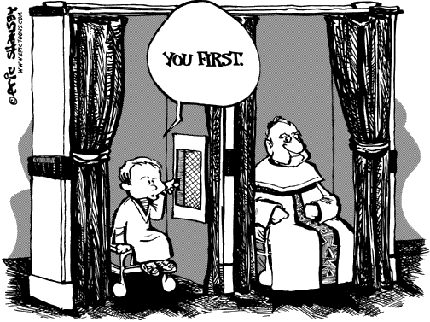
I believe we were made for God and each other. All of us. Male and female, God created us - to know and love God and to know and love one other. The sky was beautiful that day. In the tragedy of the human condition, however, we, like sheep, all went astray. The seamless garment of our humanity was ripped in two - then to pieces. A spell was cast. A deep, impenetrable darkness again returned to hover over the face of the deep and cloak the beauty of the world. We all put on masks, hewn out of fig trees. We could no longer bear the thought of anyone seeing us as we really are. We were ashamed.
Then a light turned on. The Light, really. The one Light from whence the sun got its burn and the moon its glow and the stars their twinkling wink. The Light turned on and there was a man standing at the door. His name was Jesus. It was all very surprising. He asked to come in and have dinner - with us. With me. He feasted lavishly and laughed a lot. A little too much for some. Someone asked what in the world he thought he was doing with us sinners. He looked at them incredulously, as if they had missed the whole point. "Who else would I eat with?" he asked. "I came to be with the sinners, not the righteous."
He came to other houses too. He healed people and talked about the coming of a new age. He taught with authority. He spoke with power. He was NOT boring. It was all good news. Someone asked him if he was the Messiah - the anointed one of God. He just winked. But I swear I saw the twinkle of the stars in that wink. Then they came for him. At midnight. Under the hushed cloak of darkness; the powers of a cruel world came and took him. But he did not resist. He told us to put away our swords. By that afternoon he would be dead - convicted on a bunch of false charges. He was executed as an enemy of the state.
The sun mourned. The moon cried. The stars lost all their twinkle.
Then, on the third day he rose again. From the dead. And not just his ghost. But his body. Tom touched his hands to make sure.
This changed everything. Death has been swallowed up by life. The darkness has given way to the Light. A whole new world has been born over. There is a new creation.
So what do I believe?
I believe that we are the bearers of the hope of this new creation. We have been entrusted to announce the coming of a new age where hatred gives way to love, sadness gives way to joy, strife is overcome by peace and death will one day, for all of us, give way to resurrected life. We have been graced to carry on Jesus' ministry and to be his ongoing presence in the world.
Monday, May 07, 2007
The Village Church

I love the village church. It is a sign of the faith of generations' past. I wrote an article about the history of our church for the Colchester Sun earlier this year.
Since the Sun didn't post that article online I have decided to post the text myself. It is long, but worth the read I think. . .
My wife and I are celebrating our one year anniversary as Colchester residents. We moved here last February from North Carolina when I accepted the call to be the pastor of the United Church of Colchester. Ours is the brick church in the village with the tall, spired steeple. We share the parking lot with the Burnham Memorial Library.
One of my first tasks as a pastor in a new church and a new town was to familiarize myself with both the history of the congregation and the history of the community. Joyce Sweeney, a longtime resident of Colchester and member of the United Church, handed me Ruth Wright’s book Colchester Vermont From Ice-Age to Interstate. Wright includes in her book an excerpt from the diary of Rev. Nathan Perkins, a Connecticut minister who toured the region in 1789. In those days ministers were among the most highly educated in society and their surviving journals oftentimes provide invaluable insight into the temperament of a particular people at a particular time in history. I was hoping I could glean a little insight from Reverend Perkins’ experience and parlay it into my current context. His description of the topography, terrain, and fauna was just what I expected:
Moose plenty on ye mountains over against Jericho, Essex and Colchester – people hunt them – eat them in lieu of beef - & get their Tallow. Bear and wolves, plenty – timber, beach maple, – pine, hemlock, cherry-birch & some oak and Walnut – land extra ordinary good . . .
What I had not expected was Rev. Perkins’ account of the people of this area, which was altogether shocking:
[P]eople nasty – poor – low-lived – indelicate – and miserable cooks – All sadly parsimonious – many profane –yet cheerful and contended – the women more contented than ye men turned tawney by ye smoke of ye log huts – dress coarse & mean & nasty & ragged.
I often wonder if the construction of what is now the United Church of Colchester either precipitated or resulted from the end of all that meanness and nastiness. In either case the construction of what is now the brick church must have been quite an undertaking for such a “sadly parsimonious” group. Yet despite whatever personal difficulties they might have had, the Congregationalists and Baptists pooled their resources and ingenuity in 1838 and built themselves a fine church which outlasted Rev. Perkins and several other generations of ministers after him. The church is a grand building with a picturesque New England village church steeple on top. On occasion I will slip up into the attic just below the belfry and marvel at the construction. The lumber was all hand chopped and precision fitted. Only the sturdiest of pine and hemlock was selected. It is obvious that the builders intended to craft something that would last. In commenting about the construction of the building one person in our congregation recently said to me, “You know there was probably no blueprint at all for this building, but someone sure as heck knew what they were doing.” Indeed they did.
For twenty years the Baptists and Congregationalists shared the building until the Baptists raised enough to build their own white church down the street. Sixty years later the two congregations merged to become one single congregation – the United Church of Colchester. The United Church continued to use both buildings for several decades until the white church was sold to the town in the 1990s. That building now serves as the Colchester Meeting House.
When I was officially installed as the pastor last May I began thinking about what kind of footprint I might like to make over these next few years. I again turned to Ruth Wright’s book to see what kind of legacy the ministers before me had left. What I read there shocked me once more.
According to Wright, the first minister of the United Church, Stephen Talbot, knew how to preach a serious sermon. The congregation, however, was apparently more captivated by his young son Andrew’s attempts to escape the confines of a pew – by any means necessary. Rev. Delbert Donnocker’s sermons packed a punch but he was “more remembered for his wife’s culinary skills, and for his personal love of a fast horse.” These, and the flop of a clambake he proposed. (Perhaps things would have turned out differently had he solicited the counsel of his wife in the matter.) But my favorite has to be Rev. A. Ritchie Low, whose erratic driving apparently left a real impression on the hearts, minds and yards of the congregation.
After reading these accounts I was beginning to suspect Joyce Sweeney had acted with malice of forethought in not disclosing this book to me before I answered the call to come as pastor. But then I read a little more about Rev. Low’s tenure and realized that indeed I was called as pastor of the United Church of Colchester for a very distinct purpose. According to Wright, in 1929 Rev. Low “began working out plans for interracial fellowship at the child level.” An interracial fellowship at the child level in 1929? What that would have meant I do not even know. What I do know is that my wife Irie and I are expecting a little girl sometime next month. I am white and Irie is black and when that child is born a dream that was begun way back in 1929 will finally come true. We will have interracial fellowship at the child level at the United Church of Colchester.
I suppose that is the really wonderful thing about belonging to a church as old as ours. You are always living out someone else’s dreams.
Much has changed since the Baptists and Congregationalists first dreamed of building themselves a church in the early 19th century. The moose in these parts have disappeared. And so have the log huts. The poverty, though not completely eliminated, is much diminished.
But for all that has changed about the context of our ministry, one thing remains the same. We are still working to create a place where others can come and find grace. That is what it meant to be church when the brick building went up in 1838; and that is what it continues to mean all these many years later.
In that sense you might say we are still building the “brick church.” There are still no blue prints. We only have the dreams of those who came before us. And our dreams as well. And faith that someone knows what the heck they are doing . . .
Thursday, April 05, 2007
Green Step
Our friends Annie, Michael and Sam live across the street from the church and have just begun a weekly email that lets others know what kinds of things can be done to conserve energy and reduce pollution around the house. The email is called Green Step and gives us one small step a week to make a difference.
With absolutely no permission from any of them, I am pasting a copy of step 1 below. To receive other steps email green.step.email@gmail.com.
Green Step 1: Unplug the power vampires in your house
Since a number of people read our invitation letter and asked why we
unplug our cell phone charger, we thought we'd start by passing along
what we've learned about household power drains. Many appliances that
appear to be officially "off" are actually consuming energy. Although
some folks blandly refer to these as "standby power appliances," we
prefer the more intriguing names of "vampire power" or "phantom
loads."
Any device that has a big plug (known as a wall pack or more aptly as
a "wall wart") is a power vampire, using energy when merely plugged
in. An appliance that continues showing a light or clock when off,
anything with a standby feature, or one with a remote control is too.
Here's a quick list of assorted vampires: cell phone chargers,
computer chargers, ipod chargers, Game Boys, televisions, vcrs, cd
players, battery chargers, flashlight chargers, hairdryers, power
tools, printers, baby monitors.
Although these items seem like small energy drains, they add up, both
in your electricity bill, and in their contribution to global warming
pollution. Wasted energy adds up to 10% of your bill, and as An
Inconvenient Truth's website reports, "the energy used to keep display
clocks and memory chips working accounts for 5 % of total domestic
energy consumption." While that number may seem small, it is
responsible for sending out "18 million tons of carbon into the
atmosphere every year." Or as worldwatch.org puts it: "vampire-like
standby devices…suck 26 power plants' worth of electricity every year
in the U.S. alone. That's 26 power plants spewing pollution and
disrupting our climate just so the vampires can sit at our beck and
call."
What can we do? Be vigilant about vampires at home: unplug any
appliances you aren't using right then and there; unplug chargers when
they are done; plug your tv and vcr into a power strip connected to a
wall switch and turn the switch off when you are through so the whole
unit is off; use the sleep mode on your computer and turn off your
computer and monitor when not in use.
What else can we do? Tell a friend, tell a colleague, tell your
roommate. We're taking this quote from Goethe to heart: "It is not
enough to take steps which may someday lead to a goal; each step must
be itself a goal and a step likewise." We hope this step has helped.
If it has, please pass it on or pass along our email address. Thanks
for being a part of this effort to share information. If you have any
suggestions, questions, or ideas, please let us know. We hope you'll
be in touch.
Peace,
Annie, Michael, and Sam
green.step.email@gmail.com
With absolutely no permission from any of them, I am pasting a copy of step 1 below. To receive other steps email green.step.email@gmail.com.
Green Step 1: Unplug the power vampires in your house
Since a number of people read our invitation letter and asked why we
unplug our cell phone charger, we thought we'd start by passing along
what we've learned about household power drains. Many appliances that
appear to be officially "off" are actually consuming energy. Although
some folks blandly refer to these as "standby power appliances," we
prefer the more intriguing names of "vampire power" or "phantom
loads."
Any device that has a big plug (known as a wall pack or more aptly as
a "wall wart") is a power vampire, using energy when merely plugged
in. An appliance that continues showing a light or clock when off,
anything with a standby feature, or one with a remote control is too.
Here's a quick list of assorted vampires: cell phone chargers,
computer chargers, ipod chargers, Game Boys, televisions, vcrs, cd
players, battery chargers, flashlight chargers, hairdryers, power
tools, printers, baby monitors.
Although these items seem like small energy drains, they add up, both
in your electricity bill, and in their contribution to global warming
pollution. Wasted energy adds up to 10% of your bill, and as An
Inconvenient Truth's website reports, "the energy used to keep display
clocks and memory chips working accounts for 5 % of total domestic
energy consumption." While that number may seem small, it is
responsible for sending out "18 million tons of carbon into the
atmosphere every year." Or as worldwatch.org puts it: "vampire-like
standby devices…suck 26 power plants' worth of electricity every year
in the U.S. alone. That's 26 power plants spewing pollution and
disrupting our climate just so the vampires can sit at our beck and
call."
What can we do? Be vigilant about vampires at home: unplug any
appliances you aren't using right then and there; unplug chargers when
they are done; plug your tv and vcr into a power strip connected to a
wall switch and turn the switch off when you are through so the whole
unit is off; use the sleep mode on your computer and turn off your
computer and monitor when not in use.
What else can we do? Tell a friend, tell a colleague, tell your
roommate. We're taking this quote from Goethe to heart: "It is not
enough to take steps which may someday lead to a goal; each step must
be itself a goal and a step likewise." We hope this step has helped.
If it has, please pass it on or pass along our email address. Thanks
for being a part of this effort to share information. If you have any
suggestions, questions, or ideas, please let us know. We hope you'll
be in touch.
Peace,
Annie, Michael, and Sam
green.step.email@gmail.com
Subscribe to:
Posts (Atom)


