The following is an adapted and expanded version of an article written for the children and youth of Lowe's Grove Baptist Church which will be published in our newsletter next month.
"That's not fair." Kids say that a lot. It's unfair that Julie has ice cream and Sally doesn't. It's unfair that Carrie got the lead role in the play and Mike has to play the Christmas tree again. It's unfair that Tommy made the All Star team while Judy had to settle for the same "Good Sport" everyone else got - including Tommy.
It is little wonder why kids get so bent out of shape about fairness. They are raised in a culture which trivializes justice and judges. Just look at this small survey of our TV programming: We have Judge Judy, Judge Wapner, Judge Joe Brown, Court TV, Night Court, Divorce Court, Moral Court, Curtis Court and, my personal favorite, Texas Justice. Get the picture?
But look at the Psalms. Over and over again the they beg for justice to be done, not for the sake of the Psalmist's own righteousness, but for the sake of God's. We must remember, there is a big difference between wanting what we deserve and wanting what we THINK we deserve. We don't "deserve" justice, God gives it freely.
One month after his ten-year-old daughter Laura Lue died of leukemia, John Claypool preached a meditation on the sacrifice of Isaac. John was of course questioning the fairness of what happened to him. How could God be just when Isaac survived and Laura Lue did not?
Distraught, John was at a crossroads. He could remain where he was, paralyzed by his loss, or he could seek to find a way out of his grief. John said that the only way to enter back into the world of the living after such a tragedy is to begin walking toward what he called "the road of gratitude." This is the path of remembering that all life is gift - "pure, simple, sheer gift - and that we here on earth are to relate to it accordingly" (Tracks of a Fellow Struggler, Word Books 1978, pp.73-74).
Life's not fair. Life is gift. So let's celebrate it accordingly. Today and forever.
Grace and peace and justice in God,
Ryon
Monday, October 24, 2005
Sunday, October 09, 2005
Sermon: Salvation from the Margins
October 9, 2005
The John M. Reeves All Faiths Chapel
UNC Hospital, Chapel Hill, NC
Ruth 1:6-17
Salvation in the book of Ruth comes from the margins.
The story is an old and classic tale of a family, left vulnerable by poverty and old age and the indiscriminating force of death. Ruth is also the story of a refugee family bereft of home and driven to seek help in a strange and foreign land. The themes of grief, loneliness and dislocation make Ruth a profoundly human book, and a story to be read and wrestled with as we live our lives and lament our losses in this strange and foreign land we call UNC Hospital.
Driven by hard luck and the cruelty of nature Elimelech and his wife Naomi arrive in the land of the Moabites, seeking shelter from their storm. Though beset by adversity and loss they resign to make a life for themselves in the new land. Slowly the immigrants begin to piece their lives back together again, raising their sons and marrying them away to the Moabite women. After 10 years the family is finally beginning to come out of the woods.
And then tragedy strikes again.
In a cruel litany of losses Elimelech and the boys die in an unexplained and unexplainable succession of events. One, by one, by one the men of the house die and the women, Naomi and her two Moabite daughters-in-law Orpah and Ruth, are left widowed and vulnerable.
Like so many of us, Naomi is too proud and too polite to show her vulnerability; too trained in the habit of appearing strong to admit being weak. But hidden away in the agony of her grief she begins to wonder if life is really at all worth living any more. When Naomi’s husband and sons died her own dreams and her own self-worth died with them. She now begins to see herself as a burden on the girls and a burden on the world. So she decides she can no longer go on. Naomi prepares herself to return home and die the death of a poor and broken widow in the land of her fathers where memory of better times will be her only consolation.
As she begins to go, Naomi tells her daughters-in-law to forget about her troubles and to go and make a life for themselves while they still can. And in that beautiful response which now echoes throughout literature Ruth responds by boldly confessing her commitment to her mother-in-law, “Where you go, I will go; where you lodge, I will lodge; your people shall be my people, and your God my God.”
It was a bold declaration then and, in an age where youth and fertility and beauty are worshipped and our sick and our elderly are marginalized, it remains a very bold declaration for us today. I will be present with you in your pain, Ruth says. In the brokenness of your soul I will be here.
I’ll bet you somebody way back had second thoughts about canonizing the book of Ruth. After all Ruth was a “fer’ner”. She didn’t have the right kind of blood. Not to mention the fact that Ruth was a girl. What in the world can we learn from a story about a bunch of women anyway? Saner head prevailed, however. They prevailed because somewhere along the way someone very wise recognized the fact that in her act of commitment the very character of God was being made known in and through Ruth.
I cannot pretend to have the answers to Naomi’s suffering. Nor do I have the answer to your suffering. I refuse the temptation to rationalize pain, death and loss. God may or may not lighten the yoke of your affliction and I simply cannot say which or why.
I will say this however. God commits to be present with us in the dark night of our soul. The God of Ruth is a god who does not abandon us in the twilight of our years or the midnight of our grief. The God I believe in is a god who desires to honor and comfort and endure with us the pain and loneliness of sickness and death. The God I believe in goes before us, into our pain – into our Gethsemane - that we may not have to suffer alone.
Kent Nerburn, in his book Make Me an Instrument of Your Peace tells of his former life a cab driver and the night he was called to the apartment of an old woman in the middle of the night (Nerburn, Kent "Make Me an Instrument of Your Peace" HarperSanFrancisco (San Francisco: 1999), pp 57-64). It seems that the woman was dying and in need of a ride down to the hospice home where she would soon die. After Kent had packed her small suitcase into the trunk of his cab the woman asked if he wouldn’t mind taking the long way so she could see the town one last time. Knowing this was a sacred moment at the end of this woman’s life Kent turned off the meter and for two hours the two drove around the city looking at the significant places of the woman’s bygone past. They saw where she worked as an elevator operator and where she danced as a young girl and where she and her husband lived as newlyweds in those many years past.
In the darkness of that little cab Kent graced that woman with dignity. He helped her say goodbye well. And he helped her to know that yes, even now, her life mattered.
Your life matters. Like Ruth and Kent, God too cares enough to be with you in your pain and in your loneliness. No space is off limits to God. No subject is too taboo. No sin or doubt too hidden or too dark. As the psalmist says, “even the darkness will not be dark to you, for unto you even night is like day.”
Listen. Hear the invitation, “Where you go I will go, and where you lodge I will lodge.” God desires to take the long way home with you. To listen to you. To cry with you. To love you.
No. I will not rationalize your pain. But I trust there is a God who cares for you, and loves you and is coming to you - somewhere from beyond the edge of your suffering, beyond the margins, in the realm of we call hope.
The great drama of Ruth unfolds to reveal the fact that Boaz and Ruth go on to conceive a child Obed who fathers Jesse who in turn fathers David, the future King of Israel and its salvation in time of great division. And, as we know from the tradition of the New Testament, it is from the root of Jesse, through David, that the Messiah is to be born. Even amidst the loneliness and loss of Naomi, God was coming. With salvation, God was coming.
“And in the tender mercy of our Lord the dawn from on high breaks upon us, to give light to those who sit in darkness and in the shadow of death.”
In the name of the God who is with us now, and forever more, even unto the end of the age, Amen.
The John M. Reeves All Faiths Chapel
UNC Hospital, Chapel Hill, NC
Ruth 1:6-17
Salvation in the book of Ruth comes from the margins.
The story is an old and classic tale of a family, left vulnerable by poverty and old age and the indiscriminating force of death. Ruth is also the story of a refugee family bereft of home and driven to seek help in a strange and foreign land. The themes of grief, loneliness and dislocation make Ruth a profoundly human book, and a story to be read and wrestled with as we live our lives and lament our losses in this strange and foreign land we call UNC Hospital.
Driven by hard luck and the cruelty of nature Elimelech and his wife Naomi arrive in the land of the Moabites, seeking shelter from their storm. Though beset by adversity and loss they resign to make a life for themselves in the new land. Slowly the immigrants begin to piece their lives back together again, raising their sons and marrying them away to the Moabite women. After 10 years the family is finally beginning to come out of the woods.
And then tragedy strikes again.
In a cruel litany of losses Elimelech and the boys die in an unexplained and unexplainable succession of events. One, by one, by one the men of the house die and the women, Naomi and her two Moabite daughters-in-law Orpah and Ruth, are left widowed and vulnerable.
Like so many of us, Naomi is too proud and too polite to show her vulnerability; too trained in the habit of appearing strong to admit being weak. But hidden away in the agony of her grief she begins to wonder if life is really at all worth living any more. When Naomi’s husband and sons died her own dreams and her own self-worth died with them. She now begins to see herself as a burden on the girls and a burden on the world. So she decides she can no longer go on. Naomi prepares herself to return home and die the death of a poor and broken widow in the land of her fathers where memory of better times will be her only consolation.
As she begins to go, Naomi tells her daughters-in-law to forget about her troubles and to go and make a life for themselves while they still can. And in that beautiful response which now echoes throughout literature Ruth responds by boldly confessing her commitment to her mother-in-law, “Where you go, I will go; where you lodge, I will lodge; your people shall be my people, and your God my God.”
It was a bold declaration then and, in an age where youth and fertility and beauty are worshipped and our sick and our elderly are marginalized, it remains a very bold declaration for us today. I will be present with you in your pain, Ruth says. In the brokenness of your soul I will be here.
I’ll bet you somebody way back had second thoughts about canonizing the book of Ruth. After all Ruth was a “fer’ner”. She didn’t have the right kind of blood. Not to mention the fact that Ruth was a girl. What in the world can we learn from a story about a bunch of women anyway? Saner head prevailed, however. They prevailed because somewhere along the way someone very wise recognized the fact that in her act of commitment the very character of God was being made known in and through Ruth.
I cannot pretend to have the answers to Naomi’s suffering. Nor do I have the answer to your suffering. I refuse the temptation to rationalize pain, death and loss. God may or may not lighten the yoke of your affliction and I simply cannot say which or why.
I will say this however. God commits to be present with us in the dark night of our soul. The God of Ruth is a god who does not abandon us in the twilight of our years or the midnight of our grief. The God I believe in is a god who desires to honor and comfort and endure with us the pain and loneliness of sickness and death. The God I believe in goes before us, into our pain – into our Gethsemane - that we may not have to suffer alone.
Kent Nerburn, in his book Make Me an Instrument of Your Peace tells of his former life a cab driver and the night he was called to the apartment of an old woman in the middle of the night (Nerburn, Kent "Make Me an Instrument of Your Peace" HarperSanFrancisco (San Francisco: 1999), pp 57-64). It seems that the woman was dying and in need of a ride down to the hospice home where she would soon die. After Kent had packed her small suitcase into the trunk of his cab the woman asked if he wouldn’t mind taking the long way so she could see the town one last time. Knowing this was a sacred moment at the end of this woman’s life Kent turned off the meter and for two hours the two drove around the city looking at the significant places of the woman’s bygone past. They saw where she worked as an elevator operator and where she danced as a young girl and where she and her husband lived as newlyweds in those many years past.
In the darkness of that little cab Kent graced that woman with dignity. He helped her say goodbye well. And he helped her to know that yes, even now, her life mattered.
Your life matters. Like Ruth and Kent, God too cares enough to be with you in your pain and in your loneliness. No space is off limits to God. No subject is too taboo. No sin or doubt too hidden or too dark. As the psalmist says, “even the darkness will not be dark to you, for unto you even night is like day.”
Listen. Hear the invitation, “Where you go I will go, and where you lodge I will lodge.” God desires to take the long way home with you. To listen to you. To cry with you. To love you.
No. I will not rationalize your pain. But I trust there is a God who cares for you, and loves you and is coming to you - somewhere from beyond the edge of your suffering, beyond the margins, in the realm of we call hope.
The great drama of Ruth unfolds to reveal the fact that Boaz and Ruth go on to conceive a child Obed who fathers Jesse who in turn fathers David, the future King of Israel and its salvation in time of great division. And, as we know from the tradition of the New Testament, it is from the root of Jesse, through David, that the Messiah is to be born. Even amidst the loneliness and loss of Naomi, God was coming. With salvation, God was coming.
“And in the tender mercy of our Lord the dawn from on high breaks upon us, to give light to those who sit in darkness and in the shadow of death.”
In the name of the God who is with us now, and forever more, even unto the end of the age, Amen.


Monday, September 26, 2005
The Power and the Glory
Graham Greene’s classic The Power and the Glory brilliantly, and perhaps unashamedly, unmasks the inner emotional, psychological, sexual and spiritual battles of a Catholic Priest in the muddy back hills of Mexico amidst the terror of fascist persecution. For the Vatican The Power and the Glory unmasked a little too much and the book was condemned in 1953.
But despite the seediness of Greene’s “whisky priest”, who in many ways embodies much of the corruption responsible for the poverty and lawlessness of early 20th century Mexico, the arc of the novel bends eschatalogically toward redemption. Though the whisky priest bears the constant blemishes of his manifold histories and sins, he does not lose faith. He continues on, village by village by village, administering the sacraments to the faithful and hope to the hopeless. He does not lose his faith because he knows his own doubts and sins are not the most definitive things he bears. He also bears the marks of the cross – through and in which all sins and doubts, however grievous, can be washed in the absolution of water.
On Friday night I felt a little like that old whiskey priest. Weary and tired from a busy week of travel and catchup, I hit the door at 4pm and hardly paused until nearly 4pm. Room by room, patient by patient, I came bearing hope to the hopeless. In the course of the night I would see and hold three dead babies. In the face of such terrible tragedy a chaplain’s stripes are earned. You stand there in the midst of the sadness and you look in the face of those bereaved parents and you say, “Your child was fearfully and wonderfully made. And you will see that child again some day in the hope of the resurrection.” You say it, whether you believe it or not, you damned well better say it. On Friday I believed it. The Power and the Glory were mine to behold and I believed it.
But as Friday night drifted into Saturday morning I began to grow tired. Like Moses before me, the glory began to fade slowly from my face and I was ready for some rest. And then the beeper went off again. It was the Emergency Department. Most of the time when the ED calls it means a trauma victim is coming in. The adrenaline-inducing excitement which surrounds a trauma is more than enough to keep you awake a while longer. This was not a trauma however. Instead I was called to come and sit with an 87-year old woman who was afraid and wanted me to hold her hand while she tried to sleep. As I sat there, heavy-eyed and irritated, the words of Jesus continued to come back to me, “When I was sick you visited me.” I wanted to watch and pray for this woman but my body finally gave way. When the nurse finally came to move the woman to another staging area within the ED I decided to make my break. “Arise,” Jesus said to his disciples when he found them sleeping in the garden in the dark hours before his arrest, “for the son of man is handed over to be betrayed.” I prayed to God for forgiveness.
Greene was right. The gospel is indeed entrusted in earthen vessels. The Power and the Glory are his and his alone.
But despite the seediness of Greene’s “whisky priest”, who in many ways embodies much of the corruption responsible for the poverty and lawlessness of early 20th century Mexico, the arc of the novel bends eschatalogically toward redemption. Though the whisky priest bears the constant blemishes of his manifold histories and sins, he does not lose faith. He continues on, village by village by village, administering the sacraments to the faithful and hope to the hopeless. He does not lose his faith because he knows his own doubts and sins are not the most definitive things he bears. He also bears the marks of the cross – through and in which all sins and doubts, however grievous, can be washed in the absolution of water.
On Friday night I felt a little like that old whiskey priest. Weary and tired from a busy week of travel and catchup, I hit the door at 4pm and hardly paused until nearly 4pm. Room by room, patient by patient, I came bearing hope to the hopeless. In the course of the night I would see and hold three dead babies. In the face of such terrible tragedy a chaplain’s stripes are earned. You stand there in the midst of the sadness and you look in the face of those bereaved parents and you say, “Your child was fearfully and wonderfully made. And you will see that child again some day in the hope of the resurrection.” You say it, whether you believe it or not, you damned well better say it. On Friday I believed it. The Power and the Glory were mine to behold and I believed it.
But as Friday night drifted into Saturday morning I began to grow tired. Like Moses before me, the glory began to fade slowly from my face and I was ready for some rest. And then the beeper went off again. It was the Emergency Department. Most of the time when the ED calls it means a trauma victim is coming in. The adrenaline-inducing excitement which surrounds a trauma is more than enough to keep you awake a while longer. This was not a trauma however. Instead I was called to come and sit with an 87-year old woman who was afraid and wanted me to hold her hand while she tried to sleep. As I sat there, heavy-eyed and irritated, the words of Jesus continued to come back to me, “When I was sick you visited me.” I wanted to watch and pray for this woman but my body finally gave way. When the nurse finally came to move the woman to another staging area within the ED I decided to make my break. “Arise,” Jesus said to his disciples when he found them sleeping in the garden in the dark hours before his arrest, “for the son of man is handed over to be betrayed.” I prayed to God for forgiveness.
Greene was right. The gospel is indeed entrusted in earthen vessels. The Power and the Glory are his and his alone.
Thursday, September 22, 2005
The Right Side of History

Photo by Robert Barker
On September 20 I enjoyed the great privelege of hearing Dr. Gardner C. Taylor preach before a small crowd of Baptist ministers. Dr. Taylor is a very famous preacher and was awarded the Presidential Medal of Freedom for his lifelong work in the pulpit and in the Civil Rights Movement. For us preacher geeks and wanna-be preacher geeks being there was equivalent to attending a private concert by someone like Willie Nelson. Without the crazy history and pigtails.
The Baptists who gathered to hear Dr. Taylor have been through a lot. As there is in a lot of groups and clubs, there is often a lot of bickering in Baptist churches about who should be in and who should be left out of the Baptist world. Just like teenagers, adults can be pretty mean-spirited when trying to keep certain people outside the fold. When kids do this it is called be cliquish or catty; when adults do it it is called politics.
Dr. Taylor said that when all things are said and done (I suppose this means when Jesus comes back to make things right) he thinks those who did not close the door in the face of those outside will be found on the right side of history. In other words, Jesus is going to reward those who chose to reach out to the less cool, less funny, less desirable, and even less religious.
Jesus said, "Woe to you, teachers of the law and Pharisees, you hypocrites! You shut the kingdom of heaven in men's faces. You yourselves do not enter, nor will you let those enter who are trying to" (Matthew 23:13,14). Apparently Jesus thought we that when we try to discern who is in and who is out of God's kingdom we run the risk of jeopardizing our own membership.
As you walk the halls this next month take a little time to pause. Who is it that needs you to say yes, rather than no, to? Yes I will be your friend. Yes I will walk with you into God's kingdom. Who is it that needs you to stand with them on the right side of history?
-The above essay will be included in the October 2005 Lowe's Grove newsletter-
Monday, September 05, 2005
Baby Jesus
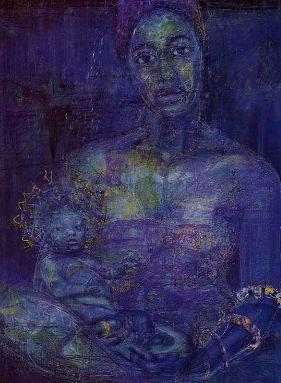
Artwork by Nelson Stevens
Irie and I have just returned from Houston. We visited some friends outside of the city whose church is serving as a Red Cross shelter to accomodate victims of Hurricane Katrina.
Saturday was an intense day of heightened expectation as we anticipated a busload of some 100 people to arrive throughout the day. A series of logistical hurdles and miscommunication left church volunteers anxiously twiddling thumbs all Saturday afternoon. Everyone was mobilized and ready to offer compassionate assistance. But the bus was nowhere to be found. Saturday night we got word that the bus was finally on its way. Two hours later, however, we were instead met by an exhausted Red Cross volunteer coordinator who told us no bus would come. She explained that she had been the one to sound the false alarm and she felt compelled to come and ask us face to face not to loose faith in the efforts of the Red Cross. With a remarkable amount of warmth the people responded by affirming her efforts and expressing their appreciation for her kind heart. It was truly a moment of much needed grace for this wounded healer.
The logistical snafus were a constant reminder of the difficulties inherently associated with rendering aid to people on a large-scale basis. Anyone who has ever dealt with the social services department in any city knows exactly what I mean. Assistance get bogged down in the dark minutia of beaucratic details. Policies and rules replace simple acts of compassion as open hospitality gives way to the practical necessities of doing things efficiently and securely. As we gathered on Saturday night a sheriff's officer trained us in the crude and embarrassing procedure of body searching - something the church was required to do of every shelter guest under Red Cross policy.
Some families did arrive overnight by car. On Sunday afternoon, just before Irie and I were to make our way back to the airport, we stopped by to visit some of the guests. Who we saw was no surprise. Invariably they were either poor, black, sick or mentally ill. The most vulnerable of the most vulnerable. We visited with Richard and his one-month-old son "Little Richard". As we listened to their story and doted over the beauty of the little child, I remembered that Jesus too had been a newborn babe with no place to call home. Jesus' family knew the pain of seeking refuge in a foreign land and with a foreign people. As Irie and I held the tiny pinkish fingers of Little Richard I began to sing,
Away in a Manger, no crib for a bed
The little Lord Jesus lay down his sweet head
Rest tight little baby Richard. For Jesus is with you.
Thursday, September 01, 2005
Nightmare
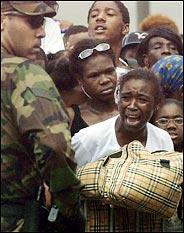 What we have witnessed the devolution of our humanity in the streets of New Orleans over the past 24 hours. Hunger, thirst, fear, anxiety and anger have melded to strip us of our natural dignity and plunge us into the subhuman realms of violence and chaos.
 My fear is that the rest of America viewing these horrific events from their living rooms will demonize the people of New Orleans. My particular fear is that whites will see the preponderance of blacks among the angry and increasingly hostile crowds and begin to loose empathy. I fear many will begin to see the tragedy which struck New Orleans as a moral failure endemic only to black society - a moral failure the rest of us are immune to.
But even those of us disconnected from the immediate devastation of Katrina are experiencing some very understandable anxieties ourselves. Gas lines stretch for blocks in some places "just in case" something were to happen. I am willing to bet local army surplus and gun stores from Oxford, Mississippi all the way to Portland, Oregon have enjoyed a marked rise in sales since Tuesday. No doubt duck tape is a hot item. We rationalize these kinds of reactionary purchases and preparations as natural responses to the uncontrollable. But part of me has to wonder, when we go ahead and get a little more gas and a little more ducktape "just in case" is something dark in each of us peaking beyond the veil?
Our own inclinations toward self-preservation remind us that the gang violence and mob hysteria now plaguing much of New Orleans could very well happen in the Midwest or the Triangle area or anywhere else if the right pressures were exerted. None of us is immune to acting out of fear and desperation. And when isolated from a stable and well-functioning community, each of us could very well act out in violent and essentially sub-human ways.
Our call as people of faith is to remind the world that we are not sub-human. We are fearfully and wonderfully made - created in the image of God. As such our call is to recognize our deep inter-connectedness with one another. If a silver lining can found amidst the dark clouds it may be the fact that our rising gas prices and own sense of insecurity might get us thinking about the communal nature of our own createdness. Once the confusion and chaos end we will begin to reflect upon all that happened to fuel these terrible events. What will be most clear is the fact that those on the margins of society - the "least" among us - were the ones least prepared when catastrophe struck.
Perhaps many who would not otherwise have given pause to consider the plight of the poor will begin to think more broadly about how interconnected our economic, social and environmental choices are. And perhaps those of us not directly affected by the tragedy will recognize that our call as the people of faith is to side with the most vulnerable because our human destiny is intrinsically linked with those on the margins of society. When they fall, we fall too.
We were created in God's image. It is a communal image of three in one - Father, the Son and Holy Spirit. I pray that we might reclaim our own communal image, and see the beauty and deep inter-connectedness between us, our God and the rest of humanity and nature.
Monday, August 29, 2005
Catholic Worker Visit

Two fridays ago Irie and I took the three youngest members of our youth group to the Raleigh Catholic Worker House. The house is run by Sheila Stumph and her husband Scott Langley. They are living out their faith in very radical ways.
After living in a Catholic Worker house in Boston they decided they were being called by God to serve people on death row and their families. They loaded everything they owned in the back of Scott's pickup and headed to Raleigh - just beyond the walls of the North Carolina Central Prison. In the spirit of Christian hospitality Scott and Sheila have opened their homes to any families visiting prisoners and death row. They have also opened something of an unofficial after-school hangout place to the dozens of kids in the neighborhood.
I have to admit this was not your typical lockin. No spaghetti up the nose. Instead the girls heard the compelling story of a family seeking to live humbly and faithfully in the call of Christian discipleship and ministry. Sheila also gave us the privelege of taking part in that ministry by writing cards to some of the inmates on death row. All this while sitting around a table full of eight, nine and ten-year olds who have nothing better to do than come and help Sheila out with cards - in exchange for cookies of course. What else could be better anyway?
Tuesday, August 23, 2005
Xtra Xtra

The following is an article I wrote for this month's newsletter at Lowes Grove Baptist Church. I have to confess the article was inspired by another article I read here.
If you look in my church mailbox everything is extreme. I mean everything is "Xtreme". Everyone everywhere wants to give you kids the most Xtreme Xperience you have ever had. You wouldn't believe the kinds of Xtravaganzas that are being put together in order to Xcite your faith. Almost everyday I receive mail from spike-haired Christian rockers, weight-lifters, magicians, skiers, comedians, motivational coaches and skateboarders who want to fill you full of their Xtremely Xpressoed Gospel Xpression.
Xasperating.
Don't be duped by the hype. Jesus Christ is not an Xtreme sport. The life of faith is not about tricks and gimmicks. Authentic discipleship is about doing justly, loving mercy and walking humbly with our God.
On Friday Aug. 19th the new members of our youth had the opportunity to meet a woman doing just that. As a part of our strategic youth plan to be more attentive to service and spirituality in the coming months, we traveled to Raleigh and visited the home of Sheila Stumph and her husband Scott Langley. Answering a call God placed upon their hearts, the couple began opening their home to family members of death row inmates visiting loved ones at Central Prison. In the spirit of Christian hospitality they are providing, free of charge, a place of "safety, peace, unconditional love, support and friendship" to whoever shows up at their door. Our time with Sheila was challenging to us all as we saw Christian faith being lived out in a very deep and life-affirming way.
Welcome Katie, Kourtney and Myra. We are all very excited to have your talents and spunk among us! I pray deeply that you will also grow deep in your faith. And I pray you come to realize the most Xtreme thing you can do in this world is learn to love your God and your neighbor likewise.
Your brother,
Ryon
Sunday, August 21, 2005
Sermon: The Confessing Movement
The Confessing Movement
Ryon L Price
21 August 2005
Mtt. 16:13-20
What is the church?
Well, it depends on who you ask of course. From the very beginning of Israel’s storied history with God on down through the centuries there has always been some dispute about this most fundamental of matters. Where is the church? What is the church? Who is the church?
Early Christians saw the church as the gathering of the holy in Christ’s name. Wherever two or three were gathered, there was Christ, and there was the church also. Somewhere along the way, however, we have devolved from these theological conceptions of the church and have begun to settle for merely pragmatic conceptions. In fact, with the rise in our hyper-individualized understanding of faith as merely personal salvation, the question itself has become irrelevant in some minds. The church is whatever hook or gimmick we can use to get people in and then get them on to heaven.
Because the church is just a hook for getting people inside the doors, it tends to look a lot like world outside the doors. We live in a high-intensity consumer-driven society and many of our churches are high-intensity consumer-driven churches. You can have it your way in today’s church. The more bells and whistles the better. We have churches with Starbucks for the latte-sipping adults and X-Boxes for the media and entertainment crazed kids. And for all ages, some churches now even have MacDonald’s restaurants inside. Would you like to Jesus size that? Our sensate churches are beginning to look a lot like our sensate society, and very few Christians are pausing to reflect theologically upon what it really means to be the church.
The cultural historians can point a finger to a very definitive moment in history when Christians began to marginalize the church. Armed with philosophical presuppositions about individual autonomy, rights, and self-determination, the liberals of the 17th and 18th centuries, Western culture began to reconceptualize itself. People began seeing themselves through a more individual than communal light. And the church fell in line. The church, like the state or any other massing of people, such as the American Legion down the street, became merely associating of like-minded individuals. In political terms this is called a social contract. People who think a lot alike freely associate together and enjoy ice cream socials, casserole dinners and occasional worship, then freely disassociate from one another when they get their feelings hurt, or disagree with the pastor or the church down the street offers better casseroles. Under this kind of philosophical presumption it is no secret why we live in an era of church shopping and church hopping. Our commitment to the church is shallow because our self-understanding of the church is shallow.
But the true church is more than casserole dinners and, with all due respect to the organization and its members present, the church is something different from the American Legion down the street. The church is not merely a social or civic or political coming together of like-minded individuals. The church is the gathered communal body of those confessing Jesus Christ as Lord.
In response to the decline of the church’s role in society, a lot of faithful Christians are all lathered up about what needs to be done to fix a world gone secular. We are no longer a Christian nation. The good ole days when shops were closed on Sundays and no one had a problem with school led prayer are gone. The old days when everyone thought like we do, or at least professed to, are sorely missed and what we need to do is go back and fix things by contacting our congressman and electing our kind of judges to prominent benches. But today’s text tells us squarely that the foundation of God’s kingdom is not predicated upon what our senators and congressmen say or don’t say about Jesus Christ. What is of most fundamental importance, instead, is what you and I say about him.
After a rather heated exchange with the Pharisees and Sadducees, those most certain that instituting stricter religious control would reform society’s ills, Jesus begins to lament the how easily the people are fooled by empty religious words and practices. Jesus warns the disciples not to believe the pious posturing of the religious establishment. The Pharisees profess to love God with their lips, but Jesus thinks their hearts are far astray. It is not enough to claim to love scripture and the laws while at the same time neglecting the acts of mercy and justice which are prerequisites for the building of God’s kingdom.
I can imagine Jesus, as he walks quietly in line amongst his followers, thinking deeply, perhaps even angrily, to himself, “Who do these people expect the Son of Man to be if he is not the one who restores sight to the blind, heals the deaf and makes the lame to walk?”
As the frustration mounts, Jesus finally has to know: “Guys, who do the people think the Son of Man is?” Their answers are evasive, indirect. Anonymous sources are appealed to. “Well, they say he’s…”
“No, guys, who do YOU think I am?”
Silence. Heavy, dense silence. Finally, Peter, nervous, ambivalent perhaps, can’t hold out any longer. He gets out of the boat. He listens to to what God is telling him and finally he blurts out, “You are Christ, the Son of the Living God.”
Stunned silence again. He said it. Did he say it? He really said it! I imagine being there was like being present when a little baby utters the word “Mama” for the first time. Or perhaps it was like a teenager who, on the last leg of a whirlwind, cross-country trip to visit all the major professional sports halls of fame, says quietly from the passenger seat, “You know Dad, you’re pretty cool.”
I mean this was a big step for Peter and the rest of the disciples. Peter said what all the others were thinking, but not quite ready to say. He expressed what everyone else was hoping for but was not quite ready to admit because doing so would have such dramatic consequences. Once they admitted Jesus was the Messiah their lives could never be the same.
What we say about Jesus says a lot about who we are and how we intend to live our lives. Saying is in fact a kind of doing. When Peter confessed Jesus as the messiah, the Son of Man, he does something with his words; When Peter says “You are the Messiah, the Christos, the Annointed One, he submits himself to Jesus’ leadership. With the confession of Jesus as the Messiah, Peter admits that he is no longer master of his own domain. Jesus is Lord.
J.L. Austin called this kind of saying as doing a “speech act.” You can probably think of some other speech acts. The first was uttered by God. “Let there be light.” There are others with less cosmological consequences. “Tag. You’re it.” “I bet.” And there are still some with great consequence to us: “I now pronounce you husband and wife.” Or, one closely related, “I now sentence you to life.”
Speech sometimes falls short of action however. I cannot make you my sweetheart just by telling you you are my sweetheart. Certain conditions must be met before words can both say and do. Otherwise, as JL Austin notes, we end up a lot like Don Quixote, challenging windmills to duels (How To Do Things With Words, p.27). To challenge a windmill to a duel is more an act of folly than it is an act of speech.
As baptists we do not expect windmills to accept a challenge to fight. Nor do we expect an unconfessing, secular world to believe just as we believe, pray just as we pray and act on the Sabbath just as we act on the Sabbath. This was the error of Christendom. And it is the error radical Islam is making in these grave times as well. As Baptists, though, we affirm the separation of church and state and so we know the church is not synonymous with the world. The church is, instead, the gathered body of those who confess Jesus as the Son of God and choose to live their lives accordingly. And on that confession, the very bedrock of our faith as baptists, Jesus builds his kingdom.
What does “kingdom” mean? Simply put it is where the king reigns. Clarence Jordan, in the Cotton Patch Gospels, his down on the farm, colloquial translation of the gospel texts, called it, “the God movement” (The Cotton Patch Gospels, xiv). For Jordan the kingdom was where God is moving in the hearts and lives of people living in community with one another.
In 1942, after graduating from seminary with a PhD in New Testament Greek in addition to his agricultural science undergraduate degree, Clarence and his wife Florence along with another couple moved to Americus, Georgia seeking to live in radical Christian community with one another. There they founded Koinonia Farms. Intent upon embodying the ethics of the Sermon on the Mount, they committed themselves to the radical qualities of koinonia – meaning fellowship. On Koinonia Farms Clarence and the other members of the fellowship practiced equality for all peoples, the rejection of violence, and the sharing of all possessions. In short, they were seeking to live as the book of Acts tells us the first generation of Christians lived – in radical fidelity to the making of the kingdom of God among them.
For Clarence Jordan and that brave band of saints, the gospel was not something merely to be passively received. To confess Christ was to become a part of the making of the new community. It meant to bring the kingdom come. The church was not a place where like-minded people come merely to eat casseroles and reminisce about the old days. Instead, what gathers and binds the people of God is their common future. Their common destiny to be made new in the resurrection of Christ. Death has been defeated and all its power robbed. Our future is peaceable life with one another and God forever and eternity.
With the church the waves of human destiny break upon the shores of the earth. Whoosh. Whoosh. Whoosh. The God movement, rolls, bathing the earth in love and peace and the reconciliation of peoples. Wave by wave by wave the gospel baptizes our course, jagged edges and remakes us into the very image of God. The barriers of bigotry, hatred and greed are broken down and we are reconstituted in the new humanity, which is the body of Christ.
The kingdom of God is a radical, tidal movement indeed.
Not long ago I made the mistake of telling a man at a social function that Irie and I had been married for three months. He was later informed by my wife Irie that no, we had in fact been married only two months. Yikes! I learned then and there that exaggerating the duration of one’s marriage is not the best way to curry favor in the eyes of one’s wife. The gentleman later introduced us as the couple which had been married five months – I three and Irie only two.
As a man, who TODAY marks his three-month anniversary, I am no expert in marriage. But I do know marriage is a reflection of Christ’s marriage to the church. Marriage is a promise sealed in the act of speech. “I do.” Marriage is not merely a social contract between individuals who may disassociate when things are no longer convenient. Likewise, when we say Jesus is Lord, we jump into the wave and commit ourselves to the God movement.
The problem with waves is that they are often unpredictable. We cannot control where the rush will take us.
Peter had no idea what he was getting into. (And I know that some of you hearing this are thinking the same about me and my three-month long marriage!) I suppose that is the point. With the confession of Peter the gospel story begins to take a serious turn. Jesus begins to challenge the very concept of what Peter thought it meant to believe in and follow the Messiah. Jesus would not be the political insurrectionist the people wanted. He would not save the Jews through coercive violence. He was not establishing a political dictatorship, nor a theocracy. Sacrifice and self-emptying would instead be the hallmarks of Jesus’ God Movement. And Peter himself would later be called to go and do the unthinkable. He would be called to eat with unclean gentiles and would, we are told, finally himself be called to give even his very life for the sake of the one he calls Lord.
What is the church? The church is the movement of God on earth. It is the movement of the Holy Spirit marching onward throughout the world beckoning us, just as Christ himself beckoned the disciples, to “come and follow.” The church is the movement of God, which stirs the hearts of those who confess Jesus Christ as their Lord and bids us to take up our crosses and follow him.
For as the apostle Paul compels us in the second chapter of Philippians, we are all to have the same mind of Christ Jesus, who did not see equality with God as something to be robbed, but humbled himself and became obedient to death, even death on a cross. Therefore God gave him the name that is above all names; that at the name of Jesus one day every knee shall bow, on earth and under the earth, and tongue confess, that Jesus Christ is Lord.
The Movement has been set into motion. The tide is upon us. The kingdom of God is breaking upon our shores. Are you prepared to dive in?
In the name of the Father, the Son and the Holy Ghost.
Ryon L Price
21 August 2005
Mtt. 16:13-20
What is the church?
Well, it depends on who you ask of course. From the very beginning of Israel’s storied history with God on down through the centuries there has always been some dispute about this most fundamental of matters. Where is the church? What is the church? Who is the church?
Early Christians saw the church as the gathering of the holy in Christ’s name. Wherever two or three were gathered, there was Christ, and there was the church also. Somewhere along the way, however, we have devolved from these theological conceptions of the church and have begun to settle for merely pragmatic conceptions. In fact, with the rise in our hyper-individualized understanding of faith as merely personal salvation, the question itself has become irrelevant in some minds. The church is whatever hook or gimmick we can use to get people in and then get them on to heaven.
Because the church is just a hook for getting people inside the doors, it tends to look a lot like world outside the doors. We live in a high-intensity consumer-driven society and many of our churches are high-intensity consumer-driven churches. You can have it your way in today’s church. The more bells and whistles the better. We have churches with Starbucks for the latte-sipping adults and X-Boxes for the media and entertainment crazed kids. And for all ages, some churches now even have MacDonald’s restaurants inside. Would you like to Jesus size that? Our sensate churches are beginning to look a lot like our sensate society, and very few Christians are pausing to reflect theologically upon what it really means to be the church.
The cultural historians can point a finger to a very definitive moment in history when Christians began to marginalize the church. Armed with philosophical presuppositions about individual autonomy, rights, and self-determination, the liberals of the 17th and 18th centuries, Western culture began to reconceptualize itself. People began seeing themselves through a more individual than communal light. And the church fell in line. The church, like the state or any other massing of people, such as the American Legion down the street, became merely associating of like-minded individuals. In political terms this is called a social contract. People who think a lot alike freely associate together and enjoy ice cream socials, casserole dinners and occasional worship, then freely disassociate from one another when they get their feelings hurt, or disagree with the pastor or the church down the street offers better casseroles. Under this kind of philosophical presumption it is no secret why we live in an era of church shopping and church hopping. Our commitment to the church is shallow because our self-understanding of the church is shallow.
But the true church is more than casserole dinners and, with all due respect to the organization and its members present, the church is something different from the American Legion down the street. The church is not merely a social or civic or political coming together of like-minded individuals. The church is the gathered communal body of those confessing Jesus Christ as Lord.
In response to the decline of the church’s role in society, a lot of faithful Christians are all lathered up about what needs to be done to fix a world gone secular. We are no longer a Christian nation. The good ole days when shops were closed on Sundays and no one had a problem with school led prayer are gone. The old days when everyone thought like we do, or at least professed to, are sorely missed and what we need to do is go back and fix things by contacting our congressman and electing our kind of judges to prominent benches. But today’s text tells us squarely that the foundation of God’s kingdom is not predicated upon what our senators and congressmen say or don’t say about Jesus Christ. What is of most fundamental importance, instead, is what you and I say about him.
After a rather heated exchange with the Pharisees and Sadducees, those most certain that instituting stricter religious control would reform society’s ills, Jesus begins to lament the how easily the people are fooled by empty religious words and practices. Jesus warns the disciples not to believe the pious posturing of the religious establishment. The Pharisees profess to love God with their lips, but Jesus thinks their hearts are far astray. It is not enough to claim to love scripture and the laws while at the same time neglecting the acts of mercy and justice which are prerequisites for the building of God’s kingdom.
I can imagine Jesus, as he walks quietly in line amongst his followers, thinking deeply, perhaps even angrily, to himself, “Who do these people expect the Son of Man to be if he is not the one who restores sight to the blind, heals the deaf and makes the lame to walk?”
As the frustration mounts, Jesus finally has to know: “Guys, who do the people think the Son of Man is?” Their answers are evasive, indirect. Anonymous sources are appealed to. “Well, they say he’s…”
“No, guys, who do YOU think I am?”
Silence. Heavy, dense silence. Finally, Peter, nervous, ambivalent perhaps, can’t hold out any longer. He gets out of the boat. He listens to to what God is telling him and finally he blurts out, “You are Christ, the Son of the Living God.”
Stunned silence again. He said it. Did he say it? He really said it! I imagine being there was like being present when a little baby utters the word “Mama” for the first time. Or perhaps it was like a teenager who, on the last leg of a whirlwind, cross-country trip to visit all the major professional sports halls of fame, says quietly from the passenger seat, “You know Dad, you’re pretty cool.”
I mean this was a big step for Peter and the rest of the disciples. Peter said what all the others were thinking, but not quite ready to say. He expressed what everyone else was hoping for but was not quite ready to admit because doing so would have such dramatic consequences. Once they admitted Jesus was the Messiah their lives could never be the same.
What we say about Jesus says a lot about who we are and how we intend to live our lives. Saying is in fact a kind of doing. When Peter confessed Jesus as the messiah, the Son of Man, he does something with his words; When Peter says “You are the Messiah, the Christos, the Annointed One, he submits himself to Jesus’ leadership. With the confession of Jesus as the Messiah, Peter admits that he is no longer master of his own domain. Jesus is Lord.
J.L. Austin called this kind of saying as doing a “speech act.” You can probably think of some other speech acts. The first was uttered by God. “Let there be light.” There are others with less cosmological consequences. “Tag. You’re it.” “I bet.” And there are still some with great consequence to us: “I now pronounce you husband and wife.” Or, one closely related, “I now sentence you to life.”
Speech sometimes falls short of action however. I cannot make you my sweetheart just by telling you you are my sweetheart. Certain conditions must be met before words can both say and do. Otherwise, as JL Austin notes, we end up a lot like Don Quixote, challenging windmills to duels (How To Do Things With Words, p.27). To challenge a windmill to a duel is more an act of folly than it is an act of speech.
As baptists we do not expect windmills to accept a challenge to fight. Nor do we expect an unconfessing, secular world to believe just as we believe, pray just as we pray and act on the Sabbath just as we act on the Sabbath. This was the error of Christendom. And it is the error radical Islam is making in these grave times as well. As Baptists, though, we affirm the separation of church and state and so we know the church is not synonymous with the world. The church is, instead, the gathered body of those who confess Jesus as the Son of God and choose to live their lives accordingly. And on that confession, the very bedrock of our faith as baptists, Jesus builds his kingdom.
What does “kingdom” mean? Simply put it is where the king reigns. Clarence Jordan, in the Cotton Patch Gospels, his down on the farm, colloquial translation of the gospel texts, called it, “the God movement” (The Cotton Patch Gospels, xiv). For Jordan the kingdom was where God is moving in the hearts and lives of people living in community with one another.
In 1942, after graduating from seminary with a PhD in New Testament Greek in addition to his agricultural science undergraduate degree, Clarence and his wife Florence along with another couple moved to Americus, Georgia seeking to live in radical Christian community with one another. There they founded Koinonia Farms. Intent upon embodying the ethics of the Sermon on the Mount, they committed themselves to the radical qualities of koinonia – meaning fellowship. On Koinonia Farms Clarence and the other members of the fellowship practiced equality for all peoples, the rejection of violence, and the sharing of all possessions. In short, they were seeking to live as the book of Acts tells us the first generation of Christians lived – in radical fidelity to the making of the kingdom of God among them.
For Clarence Jordan and that brave band of saints, the gospel was not something merely to be passively received. To confess Christ was to become a part of the making of the new community. It meant to bring the kingdom come. The church was not a place where like-minded people come merely to eat casseroles and reminisce about the old days. Instead, what gathers and binds the people of God is their common future. Their common destiny to be made new in the resurrection of Christ. Death has been defeated and all its power robbed. Our future is peaceable life with one another and God forever and eternity.
With the church the waves of human destiny break upon the shores of the earth. Whoosh. Whoosh. Whoosh. The God movement, rolls, bathing the earth in love and peace and the reconciliation of peoples. Wave by wave by wave the gospel baptizes our course, jagged edges and remakes us into the very image of God. The barriers of bigotry, hatred and greed are broken down and we are reconstituted in the new humanity, which is the body of Christ.
The kingdom of God is a radical, tidal movement indeed.
Not long ago I made the mistake of telling a man at a social function that Irie and I had been married for three months. He was later informed by my wife Irie that no, we had in fact been married only two months. Yikes! I learned then and there that exaggerating the duration of one’s marriage is not the best way to curry favor in the eyes of one’s wife. The gentleman later introduced us as the couple which had been married five months – I three and Irie only two.
As a man, who TODAY marks his three-month anniversary, I am no expert in marriage. But I do know marriage is a reflection of Christ’s marriage to the church. Marriage is a promise sealed in the act of speech. “I do.” Marriage is not merely a social contract between individuals who may disassociate when things are no longer convenient. Likewise, when we say Jesus is Lord, we jump into the wave and commit ourselves to the God movement.
The problem with waves is that they are often unpredictable. We cannot control where the rush will take us.
Peter had no idea what he was getting into. (And I know that some of you hearing this are thinking the same about me and my three-month long marriage!) I suppose that is the point. With the confession of Peter the gospel story begins to take a serious turn. Jesus begins to challenge the very concept of what Peter thought it meant to believe in and follow the Messiah. Jesus would not be the political insurrectionist the people wanted. He would not save the Jews through coercive violence. He was not establishing a political dictatorship, nor a theocracy. Sacrifice and self-emptying would instead be the hallmarks of Jesus’ God Movement. And Peter himself would later be called to go and do the unthinkable. He would be called to eat with unclean gentiles and would, we are told, finally himself be called to give even his very life for the sake of the one he calls Lord.
What is the church? The church is the movement of God on earth. It is the movement of the Holy Spirit marching onward throughout the world beckoning us, just as Christ himself beckoned the disciples, to “come and follow.” The church is the movement of God, which stirs the hearts of those who confess Jesus Christ as their Lord and bids us to take up our crosses and follow him.
For as the apostle Paul compels us in the second chapter of Philippians, we are all to have the same mind of Christ Jesus, who did not see equality with God as something to be robbed, but humbled himself and became obedient to death, even death on a cross. Therefore God gave him the name that is above all names; that at the name of Jesus one day every knee shall bow, on earth and under the earth, and tongue confess, that Jesus Christ is Lord.
The Movement has been set into motion. The tide is upon us. The kingdom of God is breaking upon our shores. Are you prepared to dive in?
In the name of the Father, the Son and the Holy Ghost.
Saturday, August 20, 2005
First Funeral
Earlier in the week I officiated my first funeral. Mrs. Ludella Evans died on Sunday evening and Forest and I performed both the memorial and graveside services.
As I thought through what I would say I remembered a Charlie Johnson, now pastor at Trinity Baptist in San Antonio, telling about his first funeral in a sermon a few years back. I thumbed through my Charlie Johnson tape collection and found the one I was looking for. "The Death of Death" was the title. I drove around all Wednesday morning listening to Charlie tell about going to his seminary professor's office and sobbing belligerently in the face of such a humbling task. My eyes teared up and a lump filled my throat. What was I going to say to that family?
Instead of tenderly encouraging Charlie as might have been expected, that seminary professor got up from his chair, walked over to Charlie and sternly said, "Listen here young man. Stop your crying. You are going to go and tell that family that Jesus Christ is raised from the dead because that is the ministry and the message that we have been entrusted with and that is the message we must proclaim."
Indeed it is the message we have been entrusted with. And for that trust I am deeply humbled...
As I thought through what I would say I remembered a Charlie Johnson, now pastor at Trinity Baptist in San Antonio, telling about his first funeral in a sermon a few years back. I thumbed through my Charlie Johnson tape collection and found the one I was looking for. "The Death of Death" was the title. I drove around all Wednesday morning listening to Charlie tell about going to his seminary professor's office and sobbing belligerently in the face of such a humbling task. My eyes teared up and a lump filled my throat. What was I going to say to that family?
Instead of tenderly encouraging Charlie as might have been expected, that seminary professor got up from his chair, walked over to Charlie and sternly said, "Listen here young man. Stop your crying. You are going to go and tell that family that Jesus Christ is raised from the dead because that is the ministry and the message that we have been entrusted with and that is the message we must proclaim."
Indeed it is the message we have been entrusted with. And for that trust I am deeply humbled...
Sunday, July 31, 2005
(In?)Famously-Named Wrestlers
Today's lectionary reading was the story of Jacob wrestling with the angel and along the way being renamed Israel (which means "Wrestles with God"). Apparently God was not the only one to assign strange names to wrestlers. Here are just a few names listed in the encyclopedia of professional wrestling:
Sid Vicious
Thom Thumb
Big John Studd (notice the two 'd's)
Erich Von Erich
Big Black Dog
Junkyard Dog
Pit Bull #1
Pit Bull #2
The Professional
The Thing
Kazuo Yamakazi
Mikey Whipwreck
Chief Thundercloud
Flyboy Rocco Rock
Hercules
Brutus the Barber Beefcake who also wrestled as Eddi Boulder, Eddie Hogan the brother of Hulk Hogan, Dizzy Golden, Dizzie Eddie Hogan, Brother Bruti, The Butcher and, finally, The Man with No Name
The Headshrinkers
The Heartbreakers
and, last but not least, for all you wome folk out there...Lady X
Fun stuff, I swear.
Sid Vicious
Thom Thumb
Big John Studd (notice the two 'd's)
Erich Von Erich
Big Black Dog
Junkyard Dog
Pit Bull #1
Pit Bull #2
The Professional
The Thing
Kazuo Yamakazi
Mikey Whipwreck
Chief Thundercloud
Flyboy Rocco Rock
Hercules
Brutus the Barber Beefcake who also wrestled as Eddi Boulder, Eddie Hogan the brother of Hulk Hogan, Dizzy Golden, Dizzie Eddie Hogan, Brother Bruti, The Butcher and, finally, The Man with No Name
The Headshrinkers
The Heartbreakers
and, last but not least, for all you wome folk out there...Lady X
Fun stuff, I swear.
Tuesday, July 26, 2005
A Pastoral Calling
I am applying for a chaplaincy intern position at several hospitals in the area. If accepted into the program, I will receive a Certified Pastoral Education credit unit and perhaps be eligible for a year-long chaplaincy residency. I thought I would share a brief excerpt from my application:
Frederick Buechner says that vocation is the point at which our greatest joy intersects with the world’s greatest need. If he is right - and I think he is as right as anyone - then I feel confident about my calling to the ministry. I can think of no greater joy than standing with the people of God, in the midst of the world’s pain, suffering and brokenness, as we witness in word and in deed to the kingdom which is now at hand. For what is so remarkable about Buechner’s statement is the fact that our greatest joy IS in fact the world’s greatest need. It is Christ who stands in the crossroads; and I believe I am called to stand with him.
On March 20, 2005 I was ordained into the gospel ministry by Lowe’s Grove Baptist Church – a church I was assigned to serve in while a student at Duke Divinity, and the church I choose to remain in because in serving the people there I found my self. Soon after ordination I began as an adjunct chaplain at Durham Regional Hospital. As a newly ordained person, I am discovering that my philosophical and theological investigations, while important, will ultimately fail to minister to the deepest needs of those whom I serve if I do not have the ability to listen well, and comfort well, and be the presence of Christ well.
In the future I hope to pastor a church. I would also like to work toward a PhD along the way. My wife also has plans for furthering her education. I think we are both gifted in many ways. We both love to read and write. We enjoy inviting others into the deep world we see around us. We call this community building. In biblical language I suppose it is called kingdom making.
I am the dreamer and she is the organizer. She is a better dreamer than I am an organizer. One day she will be a great scholar. One day I will be a great preacher. Naturally, we both want to change the world. This makes it all the more frustrating that this world wants so badly to remain the same. As an interracial couple (she is black, I am white) we feel the world dragging its feet over issues like race and culture everyday. It is difficult to turn dreams into reality. It is even more difficult to love something you are trying to change.
I suppose this is why I am applying for the CPE internship. I am applying because I am beginning to realize changing the world isn’t necessarily my job. My job is to remain faithful. Like Jesus upon the pediment outside Jerusalem, we too are tempted toward making an eschatological jump. We want to end all suffering, end all pain, end all death. We want to be effective. We want to play God. But the truth is it is in the shadows of our deepest doubts that God’s grace is most present and most real.
The call to minister to the world’s greatest need does not mean we will always solve all its problems and eliminate all its sufferings. The call to ministry is simply the call to be present with our gifts in times of need. I want to begin chaplaincy education, not because I need to be a more “effective” minister, but because I want to be a truer one.
Frederick Buechner says that vocation is the point at which our greatest joy intersects with the world’s greatest need. If he is right - and I think he is as right as anyone - then I feel confident about my calling to the ministry. I can think of no greater joy than standing with the people of God, in the midst of the world’s pain, suffering and brokenness, as we witness in word and in deed to the kingdom which is now at hand. For what is so remarkable about Buechner’s statement is the fact that our greatest joy IS in fact the world’s greatest need. It is Christ who stands in the crossroads; and I believe I am called to stand with him.
On March 20, 2005 I was ordained into the gospel ministry by Lowe’s Grove Baptist Church – a church I was assigned to serve in while a student at Duke Divinity, and the church I choose to remain in because in serving the people there I found my self. Soon after ordination I began as an adjunct chaplain at Durham Regional Hospital. As a newly ordained person, I am discovering that my philosophical and theological investigations, while important, will ultimately fail to minister to the deepest needs of those whom I serve if I do not have the ability to listen well, and comfort well, and be the presence of Christ well.
In the future I hope to pastor a church. I would also like to work toward a PhD along the way. My wife also has plans for furthering her education. I think we are both gifted in many ways. We both love to read and write. We enjoy inviting others into the deep world we see around us. We call this community building. In biblical language I suppose it is called kingdom making.
I am the dreamer and she is the organizer. She is a better dreamer than I am an organizer. One day she will be a great scholar. One day I will be a great preacher. Naturally, we both want to change the world. This makes it all the more frustrating that this world wants so badly to remain the same. As an interracial couple (she is black, I am white) we feel the world dragging its feet over issues like race and culture everyday. It is difficult to turn dreams into reality. It is even more difficult to love something you are trying to change.
I suppose this is why I am applying for the CPE internship. I am applying because I am beginning to realize changing the world isn’t necessarily my job. My job is to remain faithful. Like Jesus upon the pediment outside Jerusalem, we too are tempted toward making an eschatological jump. We want to end all suffering, end all pain, end all death. We want to be effective. We want to play God. But the truth is it is in the shadows of our deepest doubts that God’s grace is most present and most real.
The call to minister to the world’s greatest need does not mean we will always solve all its problems and eliminate all its sufferings. The call to ministry is simply the call to be present with our gifts in times of need. I want to begin chaplaincy education, not because I need to be a more “effective” minister, but because I want to be a truer one.
Monday, July 25, 2005
Baptist World Alliance
Despite the recent act of terror carried out in England this month, later this week some friends of mine and thousands of other Baptists will converge on Birmingham, England to celebrate the Baptist World Conference. Below is an email I sent to one of those friends and his wife...
Grace and peace to you!
Irie and I are so very disappointed that we were unable to attend the Baptist World Congress with you, Ardelle and our many friends in the Baptist world. In these times of conflict, terror, war and rumors of war I am confident that the hope of the world rests in the coming together of believers for the purposes of promoting peace, justice, fellowship and reconciliation among the nations.
Two weeks ago I sat on the bed with Irie as she wept for the sons and daughters of England. I too was moved with shock, fear and anger. I was at first impressed with the level of calm Tony Blair and the rest of the British people displayed in their reaction to the bombings. However, on the heals of this week's innocent shooting of an apparently innocent Brazilian suspect and the purported "shoot to kill" policy now under effect in Britain, my hopes for a peacable end to these crimes has dimmed. I fear that we are now truly living in a state of suspended ethics - just what the terrorists want.
But, as BWA officials have again and again declared over these past two weeks, it is in God that we trust! For it is in God that we have our hope, our peace and even our very being.
I preached the Sunday after the first set of London bombings. It was the first time in my young career in which I have had to step into the pulpit following an event of national or international horror. The lectionary text for the day was the Parable of the Sower. The parable of a farmer, who in spite of all common sense, goes out to scatter his seed even in the most unlikely of places. On the road, on the hard surface, amongst the thistles. Perhaps Christ will do just this in Birmingham. Perhaps he will indeed be just crazy enough to sow the kingdom of God into the hearts and minds of a violent world. And perhaps he might be just crazy enough to grow it also...
In preparation I recalled that wonderful prayer of Saint Francis:
Lord, make me an instrument of your peace,
Where there is hatred, let me sow love,
Where there is injury, pardon
Where there is doubt, faith,
Where there is despair, hope
Where there is darkness, light
Where there is sadness, joy...
Hardy, I am thankful you, Ardelle and the rest of our Baptist friends have not lost the courage to sow the kingdom of God. And I pray your works will bear fruit some one hundred, some sixty and some thirty fold.
I am glad to be your partner and look forward to the pickin'.
Peace in Christ and love to you both,
Ryon
Grace and peace to you!
Irie and I are so very disappointed that we were unable to attend the Baptist World Congress with you, Ardelle and our many friends in the Baptist world. In these times of conflict, terror, war and rumors of war I am confident that the hope of the world rests in the coming together of believers for the purposes of promoting peace, justice, fellowship and reconciliation among the nations.
Two weeks ago I sat on the bed with Irie as she wept for the sons and daughters of England. I too was moved with shock, fear and anger. I was at first impressed with the level of calm Tony Blair and the rest of the British people displayed in their reaction to the bombings. However, on the heals of this week's innocent shooting of an apparently innocent Brazilian suspect and the purported "shoot to kill" policy now under effect in Britain, my hopes for a peacable end to these crimes has dimmed. I fear that we are now truly living in a state of suspended ethics - just what the terrorists want.
But, as BWA officials have again and again declared over these past two weeks, it is in God that we trust! For it is in God that we have our hope, our peace and even our very being.
I preached the Sunday after the first set of London bombings. It was the first time in my young career in which I have had to step into the pulpit following an event of national or international horror. The lectionary text for the day was the Parable of the Sower. The parable of a farmer, who in spite of all common sense, goes out to scatter his seed even in the most unlikely of places. On the road, on the hard surface, amongst the thistles. Perhaps Christ will do just this in Birmingham. Perhaps he will indeed be just crazy enough to sow the kingdom of God into the hearts and minds of a violent world. And perhaps he might be just crazy enough to grow it also...
In preparation I recalled that wonderful prayer of Saint Francis:
Lord, make me an instrument of your peace,
Where there is hatred, let me sow love,
Where there is injury, pardon
Where there is doubt, faith,
Where there is despair, hope
Where there is darkness, light
Where there is sadness, joy...
Hardy, I am thankful you, Ardelle and the rest of our Baptist friends have not lost the courage to sow the kingdom of God. And I pray your works will bear fruit some one hundred, some sixty and some thirty fold.
I am glad to be your partner and look forward to the pickin'.
Peace in Christ and love to you both,
Ryon
Sunday, July 24, 2005
"Family Values": An Original Sin?
In The City of God Augustine states his belief that Eve was the only one deceived by the serpent's promise that partaking of the fruit of the Tree of Knowledge of Good and Evil would indeed make her like God. Adam's sin, however, was of a less credulous and more conscious kind.
"For not without the significance did the apostle [Paul] say, 'And Adam was not decieved, but the woman being deceived was in the transgression ;' but he speaks thus, because the woman accepted as true what the serpent told her, but the man could not bear to be severed from his only companion, even though this involved a partnership in sin. He was not on this account less culpable, but sinned with his eyes open."
City of God, xiv.11
According to Augustine the choice for Adam was a choice between two goods. More exactly, it was a choice between a good "thing" and true good. Eve or God. In Augustine's view, Eve tasted of the fruit in order that she would be like God. Adam, on the other hand, tasted of the fruit in order that he might be like Eve.
And therein lies the rub for the family values camp and all others who feel that things or people or whatever else can be good in and of themselves. The family is a great thing. But Jesus' message is promised to turn men against their fathers and women against their mothers (Matt 10:35). Sobering words.
On Augustine's view, it was the desire for intimacy which was Adam's undoing. His desire for community superseded all else. Adam was the first victim of peer pressure. I think this may have tremendous implications for our sexual ethics as well as the way we live our public and communal lives in general.
In Genesis, Adam and Eve do not feel ashamed of their nakedness until the fruit is devoured. Augustine thinks Adam's and Eve's shame at their nakedness was caused by a sudden loss of control over their members (xiv.24). What was once under our contol is now beyond their power. NON POSSE NON PECCARE. No power not to sin. The first sign of original sin.
Why only their sexual members and not more mundane things like arms, hands, fingers and toes (though toes can indeed be sexy)? Probably because it is with our sex organs that we find the greatest bodily intimacy with others. Adam and Eve lost control of their sex organs because they lost control of their selves. Their bodies were no longer their own. They now belonged to a fallen community.
What bothers me about Augustine is the fact that his theology fails to thoroughly shape his politics inside of his own fallen community. Certainly his thoughts on the fallenness of humanity did much (for better or worse) to inform his ideas about our sexuality. According to Augustine it is best to remain celebate in order to avoid being mired in the corruption of our fallen and lustful members. But he is unwilling to employ that same strict hermeneutic when addressing other areas of our social being.
In book nineteen of City he is willing to justify the use of (measured?) torture aimed at securing the state. Why? Is the desire to belong to an ordered state not very much like Adam's desire to remain in (a now sinful) union with Eve? Why is Augustine willing to suspend normal ethics for the preservation of a corrupted polis?
In conclusion, whether it be families, the security of the state or whatever else is perceived to be good, nothing should be "valued" in and of itself. Our desire to belong is a dangerous gift, and one which we must always temper with degree of circumspection. What good goes awry it can be terribly corrupting.
"For not without the significance did the apostle [Paul] say, 'And Adam was not decieved, but the woman being deceived was in the transgression ;' but he speaks thus, because the woman accepted as true what the serpent told her, but the man could not bear to be severed from his only companion, even though this involved a partnership in sin. He was not on this account less culpable, but sinned with his eyes open."
City of God, xiv.11
According to Augustine the choice for Adam was a choice between two goods. More exactly, it was a choice between a good "thing" and true good. Eve or God. In Augustine's view, Eve tasted of the fruit in order that she would be like God. Adam, on the other hand, tasted of the fruit in order that he might be like Eve.
And therein lies the rub for the family values camp and all others who feel that things or people or whatever else can be good in and of themselves. The family is a great thing. But Jesus' message is promised to turn men against their fathers and women against their mothers (Matt 10:35). Sobering words.
On Augustine's view, it was the desire for intimacy which was Adam's undoing. His desire for community superseded all else. Adam was the first victim of peer pressure. I think this may have tremendous implications for our sexual ethics as well as the way we live our public and communal lives in general.
In Genesis, Adam and Eve do not feel ashamed of their nakedness until the fruit is devoured. Augustine thinks Adam's and Eve's shame at their nakedness was caused by a sudden loss of control over their members (xiv.24). What was once under our contol is now beyond their power. NON POSSE NON PECCARE. No power not to sin. The first sign of original sin.
Why only their sexual members and not more mundane things like arms, hands, fingers and toes (though toes can indeed be sexy)? Probably because it is with our sex organs that we find the greatest bodily intimacy with others. Adam and Eve lost control of their sex organs because they lost control of their selves. Their bodies were no longer their own. They now belonged to a fallen community.
What bothers me about Augustine is the fact that his theology fails to thoroughly shape his politics inside of his own fallen community. Certainly his thoughts on the fallenness of humanity did much (for better or worse) to inform his ideas about our sexuality. According to Augustine it is best to remain celebate in order to avoid being mired in the corruption of our fallen and lustful members. But he is unwilling to employ that same strict hermeneutic when addressing other areas of our social being.
In book nineteen of City he is willing to justify the use of (measured?) torture aimed at securing the state. Why? Is the desire to belong to an ordered state not very much like Adam's desire to remain in (a now sinful) union with Eve? Why is Augustine willing to suspend normal ethics for the preservation of a corrupted polis?
In conclusion, whether it be families, the security of the state or whatever else is perceived to be good, nothing should be "valued" in and of itself. Our desire to belong is a dangerous gift, and one which we must always temper with degree of circumspection. What good goes awry it can be terribly corrupting.
Wednesday, July 20, 2005
Curvatus
Yesterday an old friend from the past asked me over email how my relationship with the "big guy" is. I almost declined to answer because something about the "big guy" language bothers me. It is sort of like being asked how you are gettin along with God, your co-pilot.
Nevertheless I answered. And I am glad I did because somehow in talking about God I learned something about myself and my relationship with, well, you know. Here was my answer...
"I think my relationship with God has grown much deeper. Much more authentic throughout the past year...perhaps throughout the past four. After so much time wrestling within myself - with doubt, and rebellion - I have come to know God in and through service to others. Augustine believed the root of evil to be no "thing" but instead a turning from God to self. I think that is where I was - consumed with my self. Giving my "self" away somehow turned me back. In fact, now that I think about it, the Cross was exactly that - a self-emptying (kenosis). This is most keenly seen in Philippians 2:5-11, but other places as well."
The ironic thing is that the answer obverts the question itself. Of course taking time to reflect upon where we are with God is important. But Augustine's thoughts on the nature of sin do challenge some of the assumptions I think we make about what it means to be in relationship with God. Religion worth its salt is never merely a private matter. True religion is always communal. Trinitarian even. It's not just about me and God. It's about me and God and the rest of creation also.
I suppose the point of all this is that there are times when we look at the mess we have made of our lives and it is obvious that we have somehow failed to love and enjoy God. Rather than despairing, however, the cure may be for us to say, "Screw it. I know I'm a bag of shit. Now, who needs my love?"
Nevertheless I answered. And I am glad I did because somehow in talking about God I learned something about myself and my relationship with, well, you know. Here was my answer...
"I think my relationship with God has grown much deeper. Much more authentic throughout the past year...perhaps throughout the past four. After so much time wrestling within myself - with doubt, and rebellion - I have come to know God in and through service to others. Augustine believed the root of evil to be no "thing" but instead a turning from God to self. I think that is where I was - consumed with my self. Giving my "self" away somehow turned me back. In fact, now that I think about it, the Cross was exactly that - a self-emptying (kenosis). This is most keenly seen in Philippians 2:5-11, but other places as well."
The ironic thing is that the answer obverts the question itself. Of course taking time to reflect upon where we are with God is important. But Augustine's thoughts on the nature of sin do challenge some of the assumptions I think we make about what it means to be in relationship with God. Religion worth its salt is never merely a private matter. True religion is always communal. Trinitarian even. It's not just about me and God. It's about me and God and the rest of creation also.
I suppose the point of all this is that there are times when we look at the mess we have made of our lives and it is obvious that we have somehow failed to love and enjoy God. Rather than despairing, however, the cure may be for us to say, "Screw it. I know I'm a bag of shit. Now, who needs my love?"
Thursday, July 07, 2005
Sermon: "A Kingdom Sown"
Matthew 13: 1-9, 18-23
Just inside the southern stretch of the East Campus wall at Duke University there is a lonely statue in what very well may be one of the least visited lawns of that beautiful campus. By least visited I of course mean there is no sorority house or bathroom within 400 yards. The statue is that of a sower gone out to sow. The bronze is marvelous, a timeless depiction of that most ancient human ritual. I cannot, therefore, for the life of me imagine why the powers that be decided to place that statue in such a remote place. The only conclusion I can make from this is that somewhere along the way a real-live farmer must have been involved, because as any farmer will tell you, unpredictability is the only thing that can be predicted. Someone on that landscape committee had the presence of mind to know that a seed will take root where it will - sometimes even in the most unlikely of places.
Jesus must have had something like this in mind when he told the crowd gathered around him the parable of the sower. Through his bold teachings and rumored miracle working, has amassed a sizeable group of people around him. Some are followers, some are simply spectators. Like any church, some have come to hear good old fashioned preaching, some have come to find healing and some, without naming any names, have come to find something to get mad about. Jesus is of course willing to oblige all of these in some way.
Jesus throws the kernel right at the crowd, “Here is the seed of the kingdom of God, scattered and sown among you; now what kind of soil are you made of?”
II. Do you remember when the seed of the kingdom was first cast upon you? I’ll bet you were ecstatic. [If you are Pentecostal then I know you were ecstatic, or else it didn’t count]. Some of you were right here in this very sanctuary when the seed of the kingdom was cast upon you. The Spirit moved you to repent of your sins and model your life after Jesus. Somehow you unglued yourself from the pew and unlocked your knees and kinda’ queasily you waddled down this aisle and stood green before this cloud of witnesses. You waited expectantly for Joe Lowe to make a motion that you be received and with one accord all the voices in this community of faith affirmed your decision. WHEW!!! A sigh of relief you hoped no one else could hear. And then Forest Gale extended to you the right arm of fellowship. And all you wanted to do was follow Christ. Even unto the cross. The kingdom was born…
I too remember when the good news of the kingdom was first cast upon me. I was 16 and at summer camp and that preacher was making the most audacious claims about Jesus Christ. He said he ate with prostitutes and tax collectors. He said he cared about the sinners as much as the saved. He said it wasn’t the healthy who needed a doctor but the sick, and well my my mother owned a beer store and my dad dipped snuff and sometimes I did too and so you know…
Do you remember that time in your life? When the seed took root in the most unlikely of places and in the most unlikely of people? When the seed of the kingdom of God took root in you?
What happened to that seed? What happened to that marvelous idea that the kingdom of God had drawn near? Somewhere along the way reality probably set in. The birds flew by. Nothing really seemed to change. The sun came up. It got a little hot in the kitchen and you melted. The thorns grew up and sucked the very life out of that little seed. And no matter how sincere we thought we were, we realize that no amount of irrigation or fertilizer or luck can cure bad dirt. [Of course, I know I’m preaching to the choir here].
III. You would think it would have taken my grandfather less than thirty some-odd years to figure out that he was on bad dirt. After all it was West Texas, near New Mexico, after the Dust Bowl and the town he grew up outside was named “Brownfield”! He finally moved off the farm in the 1950s and ended up in that thriving metropolis of Lubbock. After he moved to town and opened up a retail store catering to farmers and ranchers needs. Gloves, hats boots…you know the store. Funny thing about running a farm supply store…you never really get too far off the farm. No matter that he no longer farmed himself, he was still dependent upon the yield of that soil. When the cotton was high, so was he. When the cotton was low, he was, well, busted.
In our highly individualized society we have somehow come to think that faith is merely a private matter. Make no mistake faith is a private matter. But newsflash: faith is not merely a private matter. If we paused for a moment we can think of others in our world who need desperately for our seeds to be born and to grow and to flourish and to help theirs grow too. This is why we need to move beyond the idea that you don’t need the church to know God. That may be true. But someone else might need you in order to know God. Someone else, perhaps it is your daughter or your son or your neighbor, or perhaps even your enemy, needs you to be here bearing fruit for the Lord that a harvest might take place in them.
This was the great story of Eric Liddell in the movie “Chariots of Fire” which many of us watched earlier this week as a part of our faith and film series. Eric, an Olympic athlete and Scottish national hero, who refused to have his seed choked out by the thorns. Swift afoot, he was also a man of God. When pressured by the Prince of Wales to represent his country and run on the Sabbath, a day Eric believed was to be dedicated to the Lord alone, Eric refused to run the Olympic 100 yard dash. Eric stood by his conviction, telling his sovereign that he indeed loved his country, but he loved his God more. And for that he is today remembered not only for being a heroic runner, but also for being a hero of faith.
IV. This world needs our faith right now. On the heels of such tragic events in London this week; the world needs us to our flowers to bloom. It needs us to be heroes of faith.
Our hearts break at the tragic loss of life. I sat with my wife on the bed Thursday as she wept for England and the loss of its sons and daughters. Some of you cried wept also. Some of you felt the fear and the anger that I felt as I listened to the radio. What are we to do with this sadness, this fear and this anger?
Like Eric Liddell we will seek to be true to our mission as Christians. We will cling to our promise in Christ and we will bear witness to the coming of the final age. We will seek to conform our lives to the prayer of Saint Francis who petitioned his God,
Lord, make me an instrument of your peace.
Where there is hatred, let me sow love;
where there is injury,pardon;
where there is doubt, faith;
where there is despair, hope;
where there is darkness, light;
and where there is sadness, joy.
For the sake of this world we will see that this seed is not only sown, but that it is given birth. And that it grows strong.
V. I have yet to perform a baptism. Forest and I have done quite a lot of talking about baptism and he informs me that 100% of all those he has dunked have come back up. No fatalities whatsoever. Imagine that.
The point is simple. You did not stay buried beneath the waters of your baptism. Nor was your faith meant to stay buried beneath the burdens and concerns of this world. Nor even its tragedies. The kingdom was cast upon you and was meant to grow tall and strong. We were meant to bear fruit. For as the Apostle Paul tells us, creation its very self, is in the throes of childbirth, struggling and yearning for the children of God to be made known. The world is longing for our seed to bear fruit and for the kingdom of God to be born among us.
VI. Listen. A sower went out to sow. And as he sowed some seeds fell along the path and the birds came and ate them up. Other seeds fell along the rocky ground where they did not have much soil, and sprang up quickly because there was no depth of soil. But when the sun rose they were scorched, and because they had no root, they withered. Other seeds fell among the thorns. And as the thorns grew up they choked the seeds. Still other seeds fell in good soil and they brought forth grain, some one hundredfold, some sixty and some thirty.
Now what kind of soil are you made of?
In the name of the Father, the Son and the Holy Spirit. Amen.
Just inside the southern stretch of the East Campus wall at Duke University there is a lonely statue in what very well may be one of the least visited lawns of that beautiful campus. By least visited I of course mean there is no sorority house or bathroom within 400 yards. The statue is that of a sower gone out to sow. The bronze is marvelous, a timeless depiction of that most ancient human ritual. I cannot, therefore, for the life of me imagine why the powers that be decided to place that statue in such a remote place. The only conclusion I can make from this is that somewhere along the way a real-live farmer must have been involved, because as any farmer will tell you, unpredictability is the only thing that can be predicted. Someone on that landscape committee had the presence of mind to know that a seed will take root where it will - sometimes even in the most unlikely of places.
Jesus must have had something like this in mind when he told the crowd gathered around him the parable of the sower. Through his bold teachings and rumored miracle working, has amassed a sizeable group of people around him. Some are followers, some are simply spectators. Like any church, some have come to hear good old fashioned preaching, some have come to find healing and some, without naming any names, have come to find something to get mad about. Jesus is of course willing to oblige all of these in some way.
Jesus throws the kernel right at the crowd, “Here is the seed of the kingdom of God, scattered and sown among you; now what kind of soil are you made of?”
II. Do you remember when the seed of the kingdom was first cast upon you? I’ll bet you were ecstatic. [If you are Pentecostal then I know you were ecstatic, or else it didn’t count]. Some of you were right here in this very sanctuary when the seed of the kingdom was cast upon you. The Spirit moved you to repent of your sins and model your life after Jesus. Somehow you unglued yourself from the pew and unlocked your knees and kinda’ queasily you waddled down this aisle and stood green before this cloud of witnesses. You waited expectantly for Joe Lowe to make a motion that you be received and with one accord all the voices in this community of faith affirmed your decision. WHEW!!! A sigh of relief you hoped no one else could hear. And then Forest Gale extended to you the right arm of fellowship. And all you wanted to do was follow Christ. Even unto the cross. The kingdom was born…
I too remember when the good news of the kingdom was first cast upon me. I was 16 and at summer camp and that preacher was making the most audacious claims about Jesus Christ. He said he ate with prostitutes and tax collectors. He said he cared about the sinners as much as the saved. He said it wasn’t the healthy who needed a doctor but the sick, and well my my mother owned a beer store and my dad dipped snuff and sometimes I did too and so you know…
Do you remember that time in your life? When the seed took root in the most unlikely of places and in the most unlikely of people? When the seed of the kingdom of God took root in you?
What happened to that seed? What happened to that marvelous idea that the kingdom of God had drawn near? Somewhere along the way reality probably set in. The birds flew by. Nothing really seemed to change. The sun came up. It got a little hot in the kitchen and you melted. The thorns grew up and sucked the very life out of that little seed. And no matter how sincere we thought we were, we realize that no amount of irrigation or fertilizer or luck can cure bad dirt. [Of course, I know I’m preaching to the choir here].
III. You would think it would have taken my grandfather less than thirty some-odd years to figure out that he was on bad dirt. After all it was West Texas, near New Mexico, after the Dust Bowl and the town he grew up outside was named “Brownfield”! He finally moved off the farm in the 1950s and ended up in that thriving metropolis of Lubbock. After he moved to town and opened up a retail store catering to farmers and ranchers needs. Gloves, hats boots…you know the store. Funny thing about running a farm supply store…you never really get too far off the farm. No matter that he no longer farmed himself, he was still dependent upon the yield of that soil. When the cotton was high, so was he. When the cotton was low, he was, well, busted.
In our highly individualized society we have somehow come to think that faith is merely a private matter. Make no mistake faith is a private matter. But newsflash: faith is not merely a private matter. If we paused for a moment we can think of others in our world who need desperately for our seeds to be born and to grow and to flourish and to help theirs grow too. This is why we need to move beyond the idea that you don’t need the church to know God. That may be true. But someone else might need you in order to know God. Someone else, perhaps it is your daughter or your son or your neighbor, or perhaps even your enemy, needs you to be here bearing fruit for the Lord that a harvest might take place in them.
This was the great story of Eric Liddell in the movie “Chariots of Fire” which many of us watched earlier this week as a part of our faith and film series. Eric, an Olympic athlete and Scottish national hero, who refused to have his seed choked out by the thorns. Swift afoot, he was also a man of God. When pressured by the Prince of Wales to represent his country and run on the Sabbath, a day Eric believed was to be dedicated to the Lord alone, Eric refused to run the Olympic 100 yard dash. Eric stood by his conviction, telling his sovereign that he indeed loved his country, but he loved his God more. And for that he is today remembered not only for being a heroic runner, but also for being a hero of faith.
IV. This world needs our faith right now. On the heels of such tragic events in London this week; the world needs us to our flowers to bloom. It needs us to be heroes of faith.
Our hearts break at the tragic loss of life. I sat with my wife on the bed Thursday as she wept for England and the loss of its sons and daughters. Some of you cried wept also. Some of you felt the fear and the anger that I felt as I listened to the radio. What are we to do with this sadness, this fear and this anger?
Like Eric Liddell we will seek to be true to our mission as Christians. We will cling to our promise in Christ and we will bear witness to the coming of the final age. We will seek to conform our lives to the prayer of Saint Francis who petitioned his God,
Lord, make me an instrument of your peace.
Where there is hatred, let me sow love;
where there is injury,pardon;
where there is doubt, faith;
where there is despair, hope;
where there is darkness, light;
and where there is sadness, joy.
For the sake of this world we will see that this seed is not only sown, but that it is given birth. And that it grows strong.
V. I have yet to perform a baptism. Forest and I have done quite a lot of talking about baptism and he informs me that 100% of all those he has dunked have come back up. No fatalities whatsoever. Imagine that.
The point is simple. You did not stay buried beneath the waters of your baptism. Nor was your faith meant to stay buried beneath the burdens and concerns of this world. Nor even its tragedies. The kingdom was cast upon you and was meant to grow tall and strong. We were meant to bear fruit. For as the Apostle Paul tells us, creation its very self, is in the throes of childbirth, struggling and yearning for the children of God to be made known. The world is longing for our seed to bear fruit and for the kingdom of God to be born among us.
VI. Listen. A sower went out to sow. And as he sowed some seeds fell along the path and the birds came and ate them up. Other seeds fell along the rocky ground where they did not have much soil, and sprang up quickly because there was no depth of soil. But when the sun rose they were scorched, and because they had no root, they withered. Other seeds fell among the thorns. And as the thorns grew up they choked the seeds. Still other seeds fell in good soil and they brought forth grain, some one hundredfold, some sixty and some thirty.
Now what kind of soil are you made of?
In the name of the Father, the Son and the Holy Spirit. Amen.
Saturday, May 28, 2005
Zipporah (for Irie)
Daughter of the priest,
she invited him to break bread
In those many days she made a home for him,
the alien in a foreign land
She rescued Moses,
from Pharoah and the Egyptians
From himself
With Zipporah he learned to be a shepherd
He learned to be a Reuel
O Zipporah
Blessed be your name
she invited him to break bread
In those many days she made a home for him,
the alien in a foreign land
She rescued Moses,
from Pharoah and the Egyptians
From himself
With Zipporah he learned to be a shepherd
He learned to be a Reuel
O Zipporah
Blessed be your name
Thursday, May 26, 2005
Sermon: "Downward Mobility"
Genesis 2:15-17; 3:1-7
Romans 5:12-19
Matthew 4:1-11
Today’s Gospel reading follows immediately upon the heels of Jesus’ baptism. Having left Galilee, Jesus arrives on the banks of the Jordan River and presents himself to his cousin John the Baptist. Jesus persuades the wiry preacher it is both fitting and right that Jesus should submit himself to the waters of baptism. After some disputation John agrees and calls for Jesus into the water. As Jesus is being raised up out of the water we are told at once the heavens open and the Spirit of God descends upon him like a dove. “And a voice from heaven was heard saying, ‘This is my Son, my Beloved, on whom my favor rests’” (Matt 3:16-17). Here begins ministry of Jesus Christ of Nazareth. This is the conferring of his messianic mission. It is a charge given to Jesus to live into his baptism and to walk obediently in the path toward his own destiny.
Immediately, we are told, Jesus is led away into the wilderness and to have that charge put to the test. With ears to hear, listen to the Gospel account of Jesus’ temptation:
"Then Jesus was led up by the Spirit into the wilderness to be tempted by the devil. 2 He fasted forty days and forty nights, and afterwards he was famished. 3 The tempter came and said to him, "If you are the Son of God, command these stones to become loaves of bread." 4 But he answered, "It is written, 'One does not live by bread alone, but by every word that comes from the mouth of God.'"5 Then the devil took him to the holy city and placed him on the pinnacle of the temple, 6 saying to him, "If you are the Son of God, throw yourself down; for it is written, "He will command his angels concerning you,' and "On their hands they will bear you up, so that you will not dash your foot against a stone.'" 7 Jesus said to him, "Again it is written, "Do not put the Lord your God to the test.'" 8 Again, the devil took him to a very high mountain and showed him all the kingdoms of the world and their splendor; 9 and he said to him, "All these I will give you, if you will fall down and worship me." 10 Jesus said to him, "Away with you, Satan! For it is written, 'Worship the Lord your God, and serve only him.' Then the devil left him, and suddenly angels came and waited on him."
(Matthew 4:1-11)
One central question binds all of these temptations: What kind of son will Jesus be? Will he conform to the image we might expect of one worthy to be called son of God by exercising his dominion over man and nature? Will he set up his throne on Zion and rule the world? Will he subdue all the nations and align them, through force if necessary, with the will and the way of his Father? This is certainly what we might expect from a son of God. I suggest to you, however, that here we may be being set up for the unexpected.
Jesus’ first temptation is an economic one. Jesus has gone into the wilderness to fast. This is not out of the ordinary for someone plotting revolution. Che Guevera retreated to the hills of Bolivia. Pancho Villa to the deserts of Mexico. Robin Hood to Sherwood Forest. Revolutionaries go to the deserts and to the wildnernesses of the world in order to know and suffer the pains of the common people. To, in the words of Bill Clinton, “feel their pain.” Revolutionaries live the plight of the poor and then seek to do something radical – something big – to change things. It is here that they end up subverting nature in their quest to right the wrongs of the world. In order to feed the poor they rob from the rich. In order to fight fascism they incite mass tyranny. For Jesus the temptation is to subvert nature by turning the stones to bread.
Satan then takes Jesus to the Holy City of Jerusalem. Standing atop the high walls that surrounded the City of David, Satan asks Jesus to prove his importance by casting himself over the ledge. The temptation is not a matter of trusting God to break his fall. Jesus is not afraid of death. What is instead being tested is Jesus’ willingness to dazzle the people of Israel by exploiting the miraculous – something we’ve all seen done in certain contexts. Satan wants the new preacher in town to make a big-to-do of all that is going on in his church.
Finally, Satan leads Jesus to a mountaintop and unfolds to him all the kingdoms of the world. “All these,” Satan says, “will be yours if you will just fall prostrate and worship me.” Here the temptation is to join forces with the Prince of the World and rule the nations.
Story Two
Henri Nouwen, in a short but very powerful book he wrote on Christian leadership, reflects upon each of these temptations Jesus suffered. According to Nouwen these are temptations we all face as we seek to live obediently as children of God. First, we want to be relevant. We want to meet the physical needs of the world we belong to by whatever means might be necessary. Secondly, we want to be spectacular. We want to show our own spiritual dynamism and uniqueness. We want people in Durham to say this church really means something. And, finally, we want to be powerful. We want the power to conform the world to the way we think God would have it ordered. This was the temptation the church gave into as thousands of Christian soldiers marched onward in the name of God during the Crusades. Holy wars, whether Christian, Islamic or Judaic, almost always involve people earnestly desiring to do big things for the kingdom.
Nouwen himself was no stranger to big things. Born in Holland, he became a Catholic priest, moved to the States and went on to become one of the true spiritual masters of the 20th century. A prolific writer, Nouwen enjoyed a vast readership from both Catholic and evangelical Protestant ranks throughout the world. In the academy his credentials were even more impressive. He rose to what is thought by many to be the crowning achievement of scholastic success – enjoying distinguished teaching appointments at Notre Dame, Yale and Harvard universities. Henri Nouwen had reached a pinnacle of spiritual influence shared by only a few other modern writers.
At mid-life, however, Nouwen began to travel down what he called the “descending way of Christ.” The descending journey took Nouwen to some of the poorest places in Central and South America. Deeply affected by the horrors of war, famine and disease Nouwen returned to North America with a shaken conscience. Unable to rid himself of the disturbing memory of the afflicted faces he had come in contact with, Nouwen resigned his teaching appointement. He accepted a position as pastor in the L’Arche Daybreak community – a place dedicated to serving and ministering to the needs of its mentally handicapped residents.
L’Arche Daybreak is a long way from the laurelled halls of Harvard University. In fact, as I was preparing for this sermon I happened to meet a young woman now at Duke Divinity School who spent time as an intern at L’Arche after college. This young lady put into perspective for me the incredible challenges being faced by the people of L’Arche when she described what a dilemma it is for most residents to simply put socks upon their feet each morning. Ivy League credentials mean nothing in places like L’Arche. The descending way of Christ upends the entire social pyramid, defying all our assumptions of what it means to be relevant, spectacular and powerful.
Perhaps one of my professors at Duke, Richard Lischer, captured well the descending way of Christ when he quipped that after spending several years contemplating the metaphysical riddles of God, sin, theodicy and redemption, young preachers soon find out that all the church really wants is someone who can play the guitar. To be relevant is seldom to be famous or brilliant or even very popular. To be relevant is to help another change her socks.
Story Three
Of course the world’s ideas are different. The world tells us that ascent, not descent, is the hallmark of human endeavor. It’s up the corporate ladder, on to the next big thing, toward whatever else might make us seem more relevant, more spectacular and more well-respected to our friends, our neighbors and our selves. We are being lied to. These are the lies of the deceiver and we are in grave danger of being taken by them – hook, line and sinker.
Adam bit. Satan came to Adam promising more than he had and more than he was. Adam too could have the knowledge of good and evil. It was his destiny. If only Adam would reach up, high into the branches of that tree he too could be like God. Adam did just that. He reached up, extended his arm and then lifted himself upon his tiptoes and plucked himself the sweetest, ripest, juiciest Georgia peach that has ever been tasted.
In today’s age we are often brought to the point of asking if this story really happened. That is a valid question, but no the best question. The best question to ask is whether or not that story is really true. I think, if we are candid with ourselves, we have to admit that there is no truer story we’ve ever told about ourselves than the story of our fall.
Paul’s letter to the Romans tells us that the story of Adam is a typology (typos) of our own story. What Adam did is what we all do when buy into the lies. This, Paul tells us, it the path to perdition. Through one man’s trespass – through one man’s ascent of heaven- sin comes into the world, jumps on our backs and wraps its chokehold around our necks. For it is through Adam that death enters into the human story. When Paul says Adam is a typology Paul is saying Adam’s story is our own story.
Story Four
It was Saint Augustine who, in reading Paul’s epistle to the Romans we heard earlier, first formally developed the doctrine of original sin. When Paul writes that in Adam we have all been given over to death, Augustine took him to mean that we were all literally “in” Adam when he sinned, and we are all therefore inescapably doomed to repeat his mistake. Scientists and philosophers have by and large reaffirmed this rather negative view of humanity, though they have been sophisticated enough to shake Augustine’s archaic views about God, sin and salvation. Now we are all merely products of force meeting force – the sons and daughters of those who happened to win out in a cosmic, winner-take-all game. This is the game wherein we deceive in order to achieve, walk all over whoever gets in our way as we climb the corporate ladder, and kill in order to eat. Only the fittest will survive. The rest will be voted off the island.
This is the game Adam was hustled into playing. This is the story Adam bought when the Serpent came a calling. “You have to do this if you expect to survive.”
Story Five
There is another story. It is the story we find in the life, death and resurrection of Jesus Christ. He is the other typology. When presented with the vast array of wealth and political might this world has to offer he would not be duped. When offered the chance to be spectacular and powerful he would not bite. Though born with the beauty and wonder of divine-likeness he would not storm heaven’s gates. Though tempted to be a leader who would provide for his people’s needs, he refused to subvert nature– knowing that man cannot live on bread alone. When taken to the very summit of Mt. Sinai, as we read last week, he refused to stay. For he knew that downward is the path to salvation.
In Adam sin and death came into the world. In Adam we have one story of our humanity – the story of our fall. But in Christ we have another fundamentally human story – the story of resurrection. With the resurrection we have a new setting and a new stage. The old curtain has been rent asunder and a new backdrop has come down. The kingdom has come. The story of Jesus Christ of Nazareth is the story we were all created to live. It is the story we are destined to partake in. We were made to live lives like Jesus, to follow him as disciples to his cross, sharing with him in his sufferings and so, somehow, attain to the resurrection. We too were made to lives as sons of God.
Story Six
This is the first Sunday of Lent. This is the beginning of a season of reflection and repentance for us all. The Greek word for repentance is metanoia. It literally means to turn around. We have to ask ourselves today, what is it that we are being called to do in order to turn this thing around. In order to mend our estranged relationship with our creator and live into our baptism; to reclaim our call to live as sons and daughters of God.
There are people turning around all over the world right now. People like Nouwen with plans for bigger and better things instead choosing to live alongside the poor. People of pedigree foregoing the road to success and instead choosing to live as another fortunate Son lived – as a servant to the meek and cranky. People of great political ambition and ability choosing to serve rather than be served. It is happening in places like New Deli and L’Arche, where putting on socks is a daily chore. Even places in this very city like Walltown or East Durham or right across the field behind us – where people are choosing to give up their Saturday mornings in order to volunteer with kids who don’t know how to read.
What would it mean for us to turn around this morning? As the whole world is reaching up, with Adam, toward the heavens to pluck that peace of fruit off the very top limb and be like God, what would it mean to simply be who we were made to be – human? What would it mean to go with Jesus, to look from the heights of the tallest mountain of the world, upon all the kings and kingdoms and then say no – choosing to instead turn and walk down the mountain, and into the lives of our friends and neighbors who need a hand changing their socks. We will not meet all their needs – we have to realize that. We will be tempted to subvert nature in order to accomplish, but we will refuse. We will learn to follow in the way of our Lord who knew it was less important to be glorious than it was to be faithful.
What would it mean to be like Christ who we are told was in the very nature like God but did not consider equality with God something to be robbed but humbled himself and became obedient to death? What would it mean to turn away from our worship of the world and all its false grandeur and false promise and false securities and follow Jesus in whose name every knee will one day bow down to and every tongue confess as Lord.
As we repent of our sins this Lenten Season let us remember that a new age is now upon us. Humanity’s story has been re-authored in the life, death and resurrection of Jesus Christ. The heavens have been rent apart. The kingdom of God is at hand. Let us submit to our own mission as sons and daughters of God. Let us conform ourselves to the call of discipleship. Let us follow down the descending way of Christ.
In the name of the Father, the Son and the Holy Spirit. Amen.
Romans 5:12-19
Matthew 4:1-11
Today’s Gospel reading follows immediately upon the heels of Jesus’ baptism. Having left Galilee, Jesus arrives on the banks of the Jordan River and presents himself to his cousin John the Baptist. Jesus persuades the wiry preacher it is both fitting and right that Jesus should submit himself to the waters of baptism. After some disputation John agrees and calls for Jesus into the water. As Jesus is being raised up out of the water we are told at once the heavens open and the Spirit of God descends upon him like a dove. “And a voice from heaven was heard saying, ‘This is my Son, my Beloved, on whom my favor rests’” (Matt 3:16-17). Here begins ministry of Jesus Christ of Nazareth. This is the conferring of his messianic mission. It is a charge given to Jesus to live into his baptism and to walk obediently in the path toward his own destiny.
Immediately, we are told, Jesus is led away into the wilderness and to have that charge put to the test. With ears to hear, listen to the Gospel account of Jesus’ temptation:
"Then Jesus was led up by the Spirit into the wilderness to be tempted by the devil. 2 He fasted forty days and forty nights, and afterwards he was famished. 3 The tempter came and said to him, "If you are the Son of God, command these stones to become loaves of bread." 4 But he answered, "It is written, 'One does not live by bread alone, but by every word that comes from the mouth of God.'"5 Then the devil took him to the holy city and placed him on the pinnacle of the temple, 6 saying to him, "If you are the Son of God, throw yourself down; for it is written, "He will command his angels concerning you,' and "On their hands they will bear you up, so that you will not dash your foot against a stone.'" 7 Jesus said to him, "Again it is written, "Do not put the Lord your God to the test.'" 8 Again, the devil took him to a very high mountain and showed him all the kingdoms of the world and their splendor; 9 and he said to him, "All these I will give you, if you will fall down and worship me." 10 Jesus said to him, "Away with you, Satan! For it is written, 'Worship the Lord your God, and serve only him.' Then the devil left him, and suddenly angels came and waited on him."
(Matthew 4:1-11)
One central question binds all of these temptations: What kind of son will Jesus be? Will he conform to the image we might expect of one worthy to be called son of God by exercising his dominion over man and nature? Will he set up his throne on Zion and rule the world? Will he subdue all the nations and align them, through force if necessary, with the will and the way of his Father? This is certainly what we might expect from a son of God. I suggest to you, however, that here we may be being set up for the unexpected.
Jesus’ first temptation is an economic one. Jesus has gone into the wilderness to fast. This is not out of the ordinary for someone plotting revolution. Che Guevera retreated to the hills of Bolivia. Pancho Villa to the deserts of Mexico. Robin Hood to Sherwood Forest. Revolutionaries go to the deserts and to the wildnernesses of the world in order to know and suffer the pains of the common people. To, in the words of Bill Clinton, “feel their pain.” Revolutionaries live the plight of the poor and then seek to do something radical – something big – to change things. It is here that they end up subverting nature in their quest to right the wrongs of the world. In order to feed the poor they rob from the rich. In order to fight fascism they incite mass tyranny. For Jesus the temptation is to subvert nature by turning the stones to bread.
Satan then takes Jesus to the Holy City of Jerusalem. Standing atop the high walls that surrounded the City of David, Satan asks Jesus to prove his importance by casting himself over the ledge. The temptation is not a matter of trusting God to break his fall. Jesus is not afraid of death. What is instead being tested is Jesus’ willingness to dazzle the people of Israel by exploiting the miraculous – something we’ve all seen done in certain contexts. Satan wants the new preacher in town to make a big-to-do of all that is going on in his church.
Finally, Satan leads Jesus to a mountaintop and unfolds to him all the kingdoms of the world. “All these,” Satan says, “will be yours if you will just fall prostrate and worship me.” Here the temptation is to join forces with the Prince of the World and rule the nations.
Story Two
Henri Nouwen, in a short but very powerful book he wrote on Christian leadership, reflects upon each of these temptations Jesus suffered. According to Nouwen these are temptations we all face as we seek to live obediently as children of God. First, we want to be relevant. We want to meet the physical needs of the world we belong to by whatever means might be necessary. Secondly, we want to be spectacular. We want to show our own spiritual dynamism and uniqueness. We want people in Durham to say this church really means something. And, finally, we want to be powerful. We want the power to conform the world to the way we think God would have it ordered. This was the temptation the church gave into as thousands of Christian soldiers marched onward in the name of God during the Crusades. Holy wars, whether Christian, Islamic or Judaic, almost always involve people earnestly desiring to do big things for the kingdom.
Nouwen himself was no stranger to big things. Born in Holland, he became a Catholic priest, moved to the States and went on to become one of the true spiritual masters of the 20th century. A prolific writer, Nouwen enjoyed a vast readership from both Catholic and evangelical Protestant ranks throughout the world. In the academy his credentials were even more impressive. He rose to what is thought by many to be the crowning achievement of scholastic success – enjoying distinguished teaching appointments at Notre Dame, Yale and Harvard universities. Henri Nouwen had reached a pinnacle of spiritual influence shared by only a few other modern writers.
At mid-life, however, Nouwen began to travel down what he called the “descending way of Christ.” The descending journey took Nouwen to some of the poorest places in Central and South America. Deeply affected by the horrors of war, famine and disease Nouwen returned to North America with a shaken conscience. Unable to rid himself of the disturbing memory of the afflicted faces he had come in contact with, Nouwen resigned his teaching appointement. He accepted a position as pastor in the L’Arche Daybreak community – a place dedicated to serving and ministering to the needs of its mentally handicapped residents.
L’Arche Daybreak is a long way from the laurelled halls of Harvard University. In fact, as I was preparing for this sermon I happened to meet a young woman now at Duke Divinity School who spent time as an intern at L’Arche after college. This young lady put into perspective for me the incredible challenges being faced by the people of L’Arche when she described what a dilemma it is for most residents to simply put socks upon their feet each morning. Ivy League credentials mean nothing in places like L’Arche. The descending way of Christ upends the entire social pyramid, defying all our assumptions of what it means to be relevant, spectacular and powerful.
Perhaps one of my professors at Duke, Richard Lischer, captured well the descending way of Christ when he quipped that after spending several years contemplating the metaphysical riddles of God, sin, theodicy and redemption, young preachers soon find out that all the church really wants is someone who can play the guitar. To be relevant is seldom to be famous or brilliant or even very popular. To be relevant is to help another change her socks.
Story Three
Of course the world’s ideas are different. The world tells us that ascent, not descent, is the hallmark of human endeavor. It’s up the corporate ladder, on to the next big thing, toward whatever else might make us seem more relevant, more spectacular and more well-respected to our friends, our neighbors and our selves. We are being lied to. These are the lies of the deceiver and we are in grave danger of being taken by them – hook, line and sinker.
Adam bit. Satan came to Adam promising more than he had and more than he was. Adam too could have the knowledge of good and evil. It was his destiny. If only Adam would reach up, high into the branches of that tree he too could be like God. Adam did just that. He reached up, extended his arm and then lifted himself upon his tiptoes and plucked himself the sweetest, ripest, juiciest Georgia peach that has ever been tasted.
In today’s age we are often brought to the point of asking if this story really happened. That is a valid question, but no the best question. The best question to ask is whether or not that story is really true. I think, if we are candid with ourselves, we have to admit that there is no truer story we’ve ever told about ourselves than the story of our fall.
Paul’s letter to the Romans tells us that the story of Adam is a typology (typos) of our own story. What Adam did is what we all do when buy into the lies. This, Paul tells us, it the path to perdition. Through one man’s trespass – through one man’s ascent of heaven- sin comes into the world, jumps on our backs and wraps its chokehold around our necks. For it is through Adam that death enters into the human story. When Paul says Adam is a typology Paul is saying Adam’s story is our own story.
Story Four
It was Saint Augustine who, in reading Paul’s epistle to the Romans we heard earlier, first formally developed the doctrine of original sin. When Paul writes that in Adam we have all been given over to death, Augustine took him to mean that we were all literally “in” Adam when he sinned, and we are all therefore inescapably doomed to repeat his mistake. Scientists and philosophers have by and large reaffirmed this rather negative view of humanity, though they have been sophisticated enough to shake Augustine’s archaic views about God, sin and salvation. Now we are all merely products of force meeting force – the sons and daughters of those who happened to win out in a cosmic, winner-take-all game. This is the game wherein we deceive in order to achieve, walk all over whoever gets in our way as we climb the corporate ladder, and kill in order to eat. Only the fittest will survive. The rest will be voted off the island.
This is the game Adam was hustled into playing. This is the story Adam bought when the Serpent came a calling. “You have to do this if you expect to survive.”
Story Five
There is another story. It is the story we find in the life, death and resurrection of Jesus Christ. He is the other typology. When presented with the vast array of wealth and political might this world has to offer he would not be duped. When offered the chance to be spectacular and powerful he would not bite. Though born with the beauty and wonder of divine-likeness he would not storm heaven’s gates. Though tempted to be a leader who would provide for his people’s needs, he refused to subvert nature– knowing that man cannot live on bread alone. When taken to the very summit of Mt. Sinai, as we read last week, he refused to stay. For he knew that downward is the path to salvation.
In Adam sin and death came into the world. In Adam we have one story of our humanity – the story of our fall. But in Christ we have another fundamentally human story – the story of resurrection. With the resurrection we have a new setting and a new stage. The old curtain has been rent asunder and a new backdrop has come down. The kingdom has come. The story of Jesus Christ of Nazareth is the story we were all created to live. It is the story we are destined to partake in. We were made to live lives like Jesus, to follow him as disciples to his cross, sharing with him in his sufferings and so, somehow, attain to the resurrection. We too were made to lives as sons of God.
Story Six
This is the first Sunday of Lent. This is the beginning of a season of reflection and repentance for us all. The Greek word for repentance is metanoia. It literally means to turn around. We have to ask ourselves today, what is it that we are being called to do in order to turn this thing around. In order to mend our estranged relationship with our creator and live into our baptism; to reclaim our call to live as sons and daughters of God.
There are people turning around all over the world right now. People like Nouwen with plans for bigger and better things instead choosing to live alongside the poor. People of pedigree foregoing the road to success and instead choosing to live as another fortunate Son lived – as a servant to the meek and cranky. People of great political ambition and ability choosing to serve rather than be served. It is happening in places like New Deli and L’Arche, where putting on socks is a daily chore. Even places in this very city like Walltown or East Durham or right across the field behind us – where people are choosing to give up their Saturday mornings in order to volunteer with kids who don’t know how to read.
What would it mean for us to turn around this morning? As the whole world is reaching up, with Adam, toward the heavens to pluck that peace of fruit off the very top limb and be like God, what would it mean to simply be who we were made to be – human? What would it mean to go with Jesus, to look from the heights of the tallest mountain of the world, upon all the kings and kingdoms and then say no – choosing to instead turn and walk down the mountain, and into the lives of our friends and neighbors who need a hand changing their socks. We will not meet all their needs – we have to realize that. We will be tempted to subvert nature in order to accomplish, but we will refuse. We will learn to follow in the way of our Lord who knew it was less important to be glorious than it was to be faithful.
What would it mean to be like Christ who we are told was in the very nature like God but did not consider equality with God something to be robbed but humbled himself and became obedient to death? What would it mean to turn away from our worship of the world and all its false grandeur and false promise and false securities and follow Jesus in whose name every knee will one day bow down to and every tongue confess as Lord.
As we repent of our sins this Lenten Season let us remember that a new age is now upon us. Humanity’s story has been re-authored in the life, death and resurrection of Jesus Christ. The heavens have been rent apart. The kingdom of God is at hand. Let us submit to our own mission as sons and daughters of God. Let us conform ourselves to the call of discipleship. Let us follow down the descending way of Christ.
In the name of the Father, the Son and the Holy Spirit. Amen.
Ordination Council Paper (My Story)
Scope and Purpose
In what follows I have attempted two things. First, I have tried to tell my story as accurately and as truthfully as I, or anyone else, can bear. Secondly, I have tried to reflect theologically upon various stages in that story in order to better understand and articulate who it is that I am today and who it is that I want to be. In that respect my story, like all good stories, is arched by force toward some end. We might call this force, as the Hebrews did, “wind” or “spirit”. And we might call this end Christ. It is my belief that I have read the winds rightly and they point me toward an end which is hoped for, yet unseen. It is my hope that you, this Ordaining Council, will read the winds with me, confirm my interpretation, and point in The Way.
First Foundations
Baptism is the sign through which we freely confess Jesus the Christ as Lord and covenant ourselves to live as faithful and obedient disciples in life, in death and into the resurrection.
As any good Baptist would, I have begun with baptism. My own baptism took place in a backyard pool in Lubbock, TX in the presence of the people of Live Oak Community Church. The blue water glistened, cool and refreshing, beneath the hot West Texas sun. The skies were not rent asunder; there was no booming voice from heaven. But I have to think the Lord was nevertheless well pleased. I was baptized by the Reverend Scott Travis, a friend and mentor from whom I first (with ears to hear) heard the gospel of Jesus Christ and responded. I was 20 years old.
Growing up, church was not a significant part of my family’s life. My parents were (and still are) salt of the earth kinds of people. They worked hard and did their best to instill the values of right and wrong in us kids. Faith was important to them; church was also an important - but not quite necessary. Jesus Christ died for their sins and that was what mattered most. God would judge us by what was in our hearts.
I came to Christ through the evangelical high school mission Young Life. Scott was the Young Life area director for Lubbock and I gravitated toward him and his message. He presented a Jesus far more exciting and attractive than anything I had ever heard. All the other Jesuses had been about religion. The Jesus Scott preached was about relationship. I fell in love with the new Jesus and wanted to follow him.
I was on fire and that fire was all consuming. I became significantly involved in my church and in Young Life where I served as both a volunteer leader and later as intern during college. Jesus Christ had changed my heart and I was eager to tell others of the peace he had given me.
That peace was a curious one however. While on the one hand I was profoundly moved by a sense of tranquility and rest, I also harbored a deep anger and hostility toward those who could or would not share with me in this new life. My relationship with those closest to me suffered most. I failed to make the same kinds of connections with my family that I could make with those I mentored and ministered to. It was difficult for me to understand how my sister and parents could not feel what I felt and know what I knew about Jesus Christ. It was impossible for me to imagine how people could be so lukewarm about something I found so exciting and so right. I can see now how pious and condemning I often was. I had become a zealot, not out of malicious intent or hatred, but out of a distorted image of what it means to do and be good in this world.
Jesus told us faith in Him would put a wedge between father and son and bring a sword rather than peace to the world (Matt. 10:34). Somehow I had missed his point. The sword was supposed to be in the hands of those who hated Christ, not those who loved him. It was a lesson I learned early in life and one which will shape my own worldview for the rest of my life. It is less important to be right than it is to be loving. Our God is a god of mercy, not of sacrifice.
I graduated from college and took a year’s sabbatical – determined (only half-jokingly now) to “find myself” and listen for God’s gentle whisper. As I searched scripture I could not shake the sense that I was called to seminary. I lived with the Apostle Paul’s charge that our love for Christ should overflow with knowledge and depth of insight (Phil 1:9). The foundation of my faith was laid solid, it was time to build upon it. Charles Johnson, a Baptist preacher I respected a great deal from my hometown, put me onto Duke Divinity School. It didn’t take much arm-twisting. I wanted a place that would grow me both spiritually and intellectually. In researching schools I read that the Dean of the Divinity School, Greg Jones, boasted that Duke’s goal was to cultivate in its students what Jean LeClerc called “a love of learning and a desire for God.” I was sold.
Beyond Foundations
“What is crucial is not that Christians know the truth,
but that they be the truth.”
Stanley Hauerwas
When I arrived at seminary I was startled to discover that the foundation I thought my faith so solidly rested on began to sink quickly. Confronted with challenges like the historical-critical method, the problem of history’s violence (especially Christian history’s violence), the high burden of “proving” anything (especially the burden of proving the existence of an all-powerful and all-loving God) and the fact that the fire that had once burned so fiercely could no longer be seen or felt, I began to doubt the reality of my faith. At times I even doubted the reality of reality. All this, mixed together and thrown into the pressurized cooker of a rigorous academic curriculum and cranked up to 500 degrees was enough to make me crack. At the beginning of my second year of school I suffered a crisis of faith.
This was a dark period in my life; yet I now consider it a necessary part of my journey, just as the desert wandering was for Israel. My former foundations having given way, I looked to new rock for manna. In contrast to what one might expect from theologians trained in communicating Christian truth, the professors at Duke Divinity School did not begin afresh with what could be proven about the Christian faith. They began with what could be practiced.
Up until that time I had understood Jesus was the one through whom all my needs would be met. The emptiness I now suffered called that into question. I began to find solace, however, in reflecting upon the book of Job. In the story Job, a righteous man, suffers affliction beyond comprehension and is left to wrestle with the terrorizing thought of a god who allows pain and evil to persist in the world. As readers we are privy to something Job is not. Though the problem of evil is never resolved for us, we learn, from God’s own conversation with Satan, that Job’s suffering (and by inference all human suffering) is bound up with the human freedom to love or reject God. The capacity to love and follow God is contingent upon an analogous capacity to “curse God and die.” The question put before God by Satan, “Does Job fear God for nothing?” (Job 1:9), remarkably resembled the question being asked of me in my trial of faith, “Can you love and obey God selflessly?” To love and obey God selflessly is to love a god who sometimes remains quiet amidst heartache and tragedy. To love the Lord is to risk loving a god who will not always give us what we want.
I think this is the lesson of John 6. After Jesus fed the five thousand, the people were so overcome that they were willing to resort to violence in order to make him king. Jesus instead withdrew to a mountaintop. The people had fallen in love with the miracle and had missed what that miracle was pointing toward – a new economy of abundance being established on earth. To love God selflessly is to worship a king who will not always work miracles.
At the same time I was reflecting upon Job I began a class on Baptist polity and history. The central question put to us throughout the course was “What does it mean to confess Christ as Lord?” It was this question that fundamentally changed the entire course of my seminary education and perhaps my life.
For early Christians, the confession “Christ is Lord” did not rest upon a set of doctrinal statements about the truth and divinity of Jesus which could be isolated from the story of God’s ongoing work in the people Israel. Instead, as Baptist theologian Jim McClendon notes, in Jesus we have two stories – God’s story and the story of his people – weaved together. The good news for the early Christian witnesses was the proclamation of a new world being ushered in upon them in the faithful life, death and resurrection of Christ. The earliest meaning of “Christ is Lord” was that Jesus, a man, obediently chose to live the self-giving life God chose for him and was raised from death that all might follow his path and be reconciled in “the way, the truth, and the life.” The flame which would set the world afire was the good news that the kingdom of God had drawn near. The stranglehold of suffering and death had ended. Humanity had been born anew in Jesus Christ.
What was so liberating about this discovery? On the one hand it was terribly frightening - I might not ever regain the certainty I at one time thought I possessed. But at the same time, this new discovery was freeing. God called me to live as a disciple, to follow the pattern Jesus set in giving his life away, and to submit (literally “to put under”) my own humanity to the call of the cross – to live as humans were made to live by renouncing power and glory and affirming service to our neighbor as the way to loving and obeying God selflessly. The lesson of Job – to love God and serve him without regard to self-interest - was fulfilled in the life of Christ.
God had given me the freedom to either accept or reject that life. In reflection I realized my baptism – the baptism I had undergone so many years before – was a promise I had already made to follow in the life of Christ. Believer’s baptism was a pledge to accept my place in the cosmos - an affirmation that Christ’s way is indeed the Way to new life and Christ himself is indeed Lord. The ball was now in my court. It was up to me to either break or keep that pledge.
The Church…The Body of Christ
Looking back now I can see that the first two years of seminary had been a terribly selfish period in my life. I am ashamed of this. I rejected most forms of legitimate Christian community, choosing instead to turn inward and wrestle with my demons in isolation. Though I joined a local church I disengaged from its communal life - perhaps fearful that my faithlessness would be exposed. Darkness always fears the light. Up until divinity school I located the truth of my faith in my own private, experience of Jesus Christ. In layman’s terms, “I knew Jesus as my personal Lord and Savior.” What I had failed to consider, however, was the ways in which my fellow community of believers had helped me sustain and make sense of my faith throughout the journey. What I thought was a strictly private matter had in fact been a community affair!
Sadly, modern assumptions about the self and the primacy of the individual have done much to diminish our understanding of what the church is. The church has become something like a club where like-minded peoples gather and worship and then freely disassociate themselves from the fellowship when times and circumstances warrant. It was this kind of misconception on my part which allowed me to break from the church when doubt began to cast its long shadow over my life.
But the church is something more than a coming together of peoples. The church is the community of fellowship wherein the very constitution of peoplehood is remade into the likeness and body of Christ. This body is a living body – an organic expression and embodiment of God’s kingdom being made on earth. When we separate ourselves from the body of Christ we lose more than casserole dinners. We forfeit our very selves – who and what we were made to be. When I disconnected myself from the church I lost touch with the fact that I was designed to live in community with others. This loss was the loss of what McClendon calls the “baptist vision” for church. With the “baptist vision” we come to see the waves of human destiny already breaking upon us. With the “baptist vision” we come to realize that the kingdom of God dwells – already - in the resurrected and Spirit-filled lives of Christ’s disciples.
When I returned to the church I found myself once again. Yet here is the mystery…I found myself in letting go. By acknowledging the fact that in baptism I had buried the old body and all its claims to self-determinism I, by process of logic, could not deny the fact that my life was no longer my own. It had been born again; and this not merely in the age that is to come, but born to God here and now, as a member in Christ’s living body.
As I began to engage in the practices of gathering, worshipping, storytelling and fellowshipping, I began to once again find my self and my God. I began also to recover the summons to share in the self-emptying of Christ’s cross. I was beginning to discover my gift and my call to serve Christ’s body as a minister of the gospel.
The Priesthood of Believers and the Call to Ministry
There is no provision for ordination in the New Testament. Baptists rightly reject the hierarchal priesthood in favor of what Martin Luther called the “priesthood of all believers.” This does not, however, mean that every person is a priest unto him or herself. Instead it is the fullness of the communal body (Eph 1) in its abundance which points us toward the consummation of all things in and under Christ. It was not merely one person, but the people of Lowe’s Grove Baptist Church that ministered to me in my need. The people had become one person, Christ, who drew me near.
Given this fact it may seem somewhat anomalous to seek ordination into the gospel ministry. For are we not all then commissioned to proclaim the gospel in baptism? I take this point quite seriously and answer with two points of my own. First, some members of the body are called to be pastors, and some teachers, and some apostles, and some are called to bake casseroles (not because their place is in the kitchen but so that all might share in equally in the fellowship of Christ). No one calling is greater or more exalted than another. In point of fact, we know from our Lord himself that those who will lead must in turn become low and give themselves as servants. The call of ordination is then not a call to glory but is instead the call to set oneself apart for extraordinary (more than might be ordinarily expected of or possible for a faithful disciple) sacrifice and service to his or her (yes, “her”) brothers and sisters.
My second argument is somewhat more pragmatic, but no less important. We live in a world of diverse opinions and perspectives. Not all Christians share the same ecclesiological views as us baptists. Nor are all non-baptists familiar with the nuances of what priesthood means. Therefore I believe it is incumbent upon us as we seek reconciliation with other Christian communities to single out particular members who can speak on our behalf with some degree of credibility. In the eyes of other Christian communions, faith traditions and the State ordination serves this purpose and is beneficial in doing so. In any case, the call to lead is exactly that - a call. It is our call to hear the call of the Lord and respond in sacrifice and in service. I can truly say I have heard the call and want faithfully to respond.
I have not shared the following with many people, but believe it is pertinent for the exercise at hand. I had delusions of being a lawyer after Divinity School. I call them delusions because I think they were part of a last-ditch effort at what the world sees as beautiful. A final attempt to be like God. Yet the nagging feeling I had through all of it – the feeling that certain people like Forest Gale, Hardy Clemons, my fiancée Irie and my Mom wouldn’t allow me to put to rest – told me that I was born to be a minister. To do otherwise would be to deny my own humanity – the humanity we are called to submit to in service of God and neighbor. I had a terrible fear that somehow my world would one day come to an end and I would realize that at a very definitive moment in my life I had counted the cost of eternal life and, like the rich young ruler, turned and walked away in sadness. The cost of eternal life is the cost of giving everything away when called to do so. It is the cost of putting away all our ambitions and plans and securities and upon the altar. The cost of living into one’s baptism is the cost of setting aside who we want to be in life and submitting ourselves to what God desires and calls us to be. Now is the critical time in my life. I stand at the crossroads.
Frederick Buechner says that vocation is the point at which our greatest joy intersects with the world’s greatest need. If he is right - and I think he is as right as anyone - then I feel confident about my calling to the ministry. I can think of no greater joy than standing with the people of God, in the midst of the world’s pain and suffering and brokenness, as we witness in word and in deed to the kingdom which is now at hand. For what is so remarkable about Buechner’s statement is the fact that our greatest joy IS in fact the world’s greatest need. It is Christ who stands in this intersection and we, as baptized members of his body, are called to stand with him.
After Words: The Journey Begins
Very truly, I tell you, when you were younger, you used to fasten your own belt and to go wherever you wished. But when you grow old, you will stretch out your hands, and someone else will fasten a belt around you and take you where you do not wish to go.
John 21
Oh Lord, you have made us for yourself, our hearts
know no rest until they rest in you.
Saint Augustine
I confess I have been, in the immortal words of Bob Dylan, a “slow train comin’.” I sometimes kicked and sometimes screamed, but there was nothing I could do to alter the course of life’s motion. Now I can say it is time to stop swimming upstream, and give myself to the current. Give myself to the living water, which not only sustains us but will also deliver us, when the times will have reached their fulfillment, unto the safe harbor of God himself.
I cannot say I know where the path will take me; I can only say I am committed to the voyage and I am committed to the ship. And I am willing to fish.
In what follows I have attempted two things. First, I have tried to tell my story as accurately and as truthfully as I, or anyone else, can bear. Secondly, I have tried to reflect theologically upon various stages in that story in order to better understand and articulate who it is that I am today and who it is that I want to be. In that respect my story, like all good stories, is arched by force toward some end. We might call this force, as the Hebrews did, “wind” or “spirit”. And we might call this end Christ. It is my belief that I have read the winds rightly and they point me toward an end which is hoped for, yet unseen. It is my hope that you, this Ordaining Council, will read the winds with me, confirm my interpretation, and point in The Way.
First Foundations
Baptism is the sign through which we freely confess Jesus the Christ as Lord and covenant ourselves to live as faithful and obedient disciples in life, in death and into the resurrection.
As any good Baptist would, I have begun with baptism. My own baptism took place in a backyard pool in Lubbock, TX in the presence of the people of Live Oak Community Church. The blue water glistened, cool and refreshing, beneath the hot West Texas sun. The skies were not rent asunder; there was no booming voice from heaven. But I have to think the Lord was nevertheless well pleased. I was baptized by the Reverend Scott Travis, a friend and mentor from whom I first (with ears to hear) heard the gospel of Jesus Christ and responded. I was 20 years old.
Growing up, church was not a significant part of my family’s life. My parents were (and still are) salt of the earth kinds of people. They worked hard and did their best to instill the values of right and wrong in us kids. Faith was important to them; church was also an important - but not quite necessary. Jesus Christ died for their sins and that was what mattered most. God would judge us by what was in our hearts.
I came to Christ through the evangelical high school mission Young Life. Scott was the Young Life area director for Lubbock and I gravitated toward him and his message. He presented a Jesus far more exciting and attractive than anything I had ever heard. All the other Jesuses had been about religion. The Jesus Scott preached was about relationship. I fell in love with the new Jesus and wanted to follow him.
I was on fire and that fire was all consuming. I became significantly involved in my church and in Young Life where I served as both a volunteer leader and later as intern during college. Jesus Christ had changed my heart and I was eager to tell others of the peace he had given me.
That peace was a curious one however. While on the one hand I was profoundly moved by a sense of tranquility and rest, I also harbored a deep anger and hostility toward those who could or would not share with me in this new life. My relationship with those closest to me suffered most. I failed to make the same kinds of connections with my family that I could make with those I mentored and ministered to. It was difficult for me to understand how my sister and parents could not feel what I felt and know what I knew about Jesus Christ. It was impossible for me to imagine how people could be so lukewarm about something I found so exciting and so right. I can see now how pious and condemning I often was. I had become a zealot, not out of malicious intent or hatred, but out of a distorted image of what it means to do and be good in this world.
Jesus told us faith in Him would put a wedge between father and son and bring a sword rather than peace to the world (Matt. 10:34). Somehow I had missed his point. The sword was supposed to be in the hands of those who hated Christ, not those who loved him. It was a lesson I learned early in life and one which will shape my own worldview for the rest of my life. It is less important to be right than it is to be loving. Our God is a god of mercy, not of sacrifice.
I graduated from college and took a year’s sabbatical – determined (only half-jokingly now) to “find myself” and listen for God’s gentle whisper. As I searched scripture I could not shake the sense that I was called to seminary. I lived with the Apostle Paul’s charge that our love for Christ should overflow with knowledge and depth of insight (Phil 1:9). The foundation of my faith was laid solid, it was time to build upon it. Charles Johnson, a Baptist preacher I respected a great deal from my hometown, put me onto Duke Divinity School. It didn’t take much arm-twisting. I wanted a place that would grow me both spiritually and intellectually. In researching schools I read that the Dean of the Divinity School, Greg Jones, boasted that Duke’s goal was to cultivate in its students what Jean LeClerc called “a love of learning and a desire for God.” I was sold.
Beyond Foundations
“What is crucial is not that Christians know the truth,
but that they be the truth.”
Stanley Hauerwas
When I arrived at seminary I was startled to discover that the foundation I thought my faith so solidly rested on began to sink quickly. Confronted with challenges like the historical-critical method, the problem of history’s violence (especially Christian history’s violence), the high burden of “proving” anything (especially the burden of proving the existence of an all-powerful and all-loving God) and the fact that the fire that had once burned so fiercely could no longer be seen or felt, I began to doubt the reality of my faith. At times I even doubted the reality of reality. All this, mixed together and thrown into the pressurized cooker of a rigorous academic curriculum and cranked up to 500 degrees was enough to make me crack. At the beginning of my second year of school I suffered a crisis of faith.
This was a dark period in my life; yet I now consider it a necessary part of my journey, just as the desert wandering was for Israel. My former foundations having given way, I looked to new rock for manna. In contrast to what one might expect from theologians trained in communicating Christian truth, the professors at Duke Divinity School did not begin afresh with what could be proven about the Christian faith. They began with what could be practiced.
Up until that time I had understood Jesus was the one through whom all my needs would be met. The emptiness I now suffered called that into question. I began to find solace, however, in reflecting upon the book of Job. In the story Job, a righteous man, suffers affliction beyond comprehension and is left to wrestle with the terrorizing thought of a god who allows pain and evil to persist in the world. As readers we are privy to something Job is not. Though the problem of evil is never resolved for us, we learn, from God’s own conversation with Satan, that Job’s suffering (and by inference all human suffering) is bound up with the human freedom to love or reject God. The capacity to love and follow God is contingent upon an analogous capacity to “curse God and die.” The question put before God by Satan, “Does Job fear God for nothing?” (Job 1:9), remarkably resembled the question being asked of me in my trial of faith, “Can you love and obey God selflessly?” To love and obey God selflessly is to love a god who sometimes remains quiet amidst heartache and tragedy. To love the Lord is to risk loving a god who will not always give us what we want.
I think this is the lesson of John 6. After Jesus fed the five thousand, the people were so overcome that they were willing to resort to violence in order to make him king. Jesus instead withdrew to a mountaintop. The people had fallen in love with the miracle and had missed what that miracle was pointing toward – a new economy of abundance being established on earth. To love God selflessly is to worship a king who will not always work miracles.
At the same time I was reflecting upon Job I began a class on Baptist polity and history. The central question put to us throughout the course was “What does it mean to confess Christ as Lord?” It was this question that fundamentally changed the entire course of my seminary education and perhaps my life.
For early Christians, the confession “Christ is Lord” did not rest upon a set of doctrinal statements about the truth and divinity of Jesus which could be isolated from the story of God’s ongoing work in the people Israel. Instead, as Baptist theologian Jim McClendon notes, in Jesus we have two stories – God’s story and the story of his people – weaved together. The good news for the early Christian witnesses was the proclamation of a new world being ushered in upon them in the faithful life, death and resurrection of Christ. The earliest meaning of “Christ is Lord” was that Jesus, a man, obediently chose to live the self-giving life God chose for him and was raised from death that all might follow his path and be reconciled in “the way, the truth, and the life.” The flame which would set the world afire was the good news that the kingdom of God had drawn near. The stranglehold of suffering and death had ended. Humanity had been born anew in Jesus Christ.
What was so liberating about this discovery? On the one hand it was terribly frightening - I might not ever regain the certainty I at one time thought I possessed. But at the same time, this new discovery was freeing. God called me to live as a disciple, to follow the pattern Jesus set in giving his life away, and to submit (literally “to put under”) my own humanity to the call of the cross – to live as humans were made to live by renouncing power and glory and affirming service to our neighbor as the way to loving and obeying God selflessly. The lesson of Job – to love God and serve him without regard to self-interest - was fulfilled in the life of Christ.
God had given me the freedom to either accept or reject that life. In reflection I realized my baptism – the baptism I had undergone so many years before – was a promise I had already made to follow in the life of Christ. Believer’s baptism was a pledge to accept my place in the cosmos - an affirmation that Christ’s way is indeed the Way to new life and Christ himself is indeed Lord. The ball was now in my court. It was up to me to either break or keep that pledge.
The Church…The Body of Christ
Looking back now I can see that the first two years of seminary had been a terribly selfish period in my life. I am ashamed of this. I rejected most forms of legitimate Christian community, choosing instead to turn inward and wrestle with my demons in isolation. Though I joined a local church I disengaged from its communal life - perhaps fearful that my faithlessness would be exposed. Darkness always fears the light. Up until divinity school I located the truth of my faith in my own private, experience of Jesus Christ. In layman’s terms, “I knew Jesus as my personal Lord and Savior.” What I had failed to consider, however, was the ways in which my fellow community of believers had helped me sustain and make sense of my faith throughout the journey. What I thought was a strictly private matter had in fact been a community affair!
Sadly, modern assumptions about the self and the primacy of the individual have done much to diminish our understanding of what the church is. The church has become something like a club where like-minded peoples gather and worship and then freely disassociate themselves from the fellowship when times and circumstances warrant. It was this kind of misconception on my part which allowed me to break from the church when doubt began to cast its long shadow over my life.
But the church is something more than a coming together of peoples. The church is the community of fellowship wherein the very constitution of peoplehood is remade into the likeness and body of Christ. This body is a living body – an organic expression and embodiment of God’s kingdom being made on earth. When we separate ourselves from the body of Christ we lose more than casserole dinners. We forfeit our very selves – who and what we were made to be. When I disconnected myself from the church I lost touch with the fact that I was designed to live in community with others. This loss was the loss of what McClendon calls the “baptist vision” for church. With the “baptist vision” we come to see the waves of human destiny already breaking upon us. With the “baptist vision” we come to realize that the kingdom of God dwells – already - in the resurrected and Spirit-filled lives of Christ’s disciples.
When I returned to the church I found myself once again. Yet here is the mystery…I found myself in letting go. By acknowledging the fact that in baptism I had buried the old body and all its claims to self-determinism I, by process of logic, could not deny the fact that my life was no longer my own. It had been born again; and this not merely in the age that is to come, but born to God here and now, as a member in Christ’s living body.
As I began to engage in the practices of gathering, worshipping, storytelling and fellowshipping, I began to once again find my self and my God. I began also to recover the summons to share in the self-emptying of Christ’s cross. I was beginning to discover my gift and my call to serve Christ’s body as a minister of the gospel.
The Priesthood of Believers and the Call to Ministry
There is no provision for ordination in the New Testament. Baptists rightly reject the hierarchal priesthood in favor of what Martin Luther called the “priesthood of all believers.” This does not, however, mean that every person is a priest unto him or herself. Instead it is the fullness of the communal body (Eph 1) in its abundance which points us toward the consummation of all things in and under Christ. It was not merely one person, but the people of Lowe’s Grove Baptist Church that ministered to me in my need. The people had become one person, Christ, who drew me near.
Given this fact it may seem somewhat anomalous to seek ordination into the gospel ministry. For are we not all then commissioned to proclaim the gospel in baptism? I take this point quite seriously and answer with two points of my own. First, some members of the body are called to be pastors, and some teachers, and some apostles, and some are called to bake casseroles (not because their place is in the kitchen but so that all might share in equally in the fellowship of Christ). No one calling is greater or more exalted than another. In point of fact, we know from our Lord himself that those who will lead must in turn become low and give themselves as servants. The call of ordination is then not a call to glory but is instead the call to set oneself apart for extraordinary (more than might be ordinarily expected of or possible for a faithful disciple) sacrifice and service to his or her (yes, “her”) brothers and sisters.
My second argument is somewhat more pragmatic, but no less important. We live in a world of diverse opinions and perspectives. Not all Christians share the same ecclesiological views as us baptists. Nor are all non-baptists familiar with the nuances of what priesthood means. Therefore I believe it is incumbent upon us as we seek reconciliation with other Christian communities to single out particular members who can speak on our behalf with some degree of credibility. In the eyes of other Christian communions, faith traditions and the State ordination serves this purpose and is beneficial in doing so. In any case, the call to lead is exactly that - a call. It is our call to hear the call of the Lord and respond in sacrifice and in service. I can truly say I have heard the call and want faithfully to respond.
I have not shared the following with many people, but believe it is pertinent for the exercise at hand. I had delusions of being a lawyer after Divinity School. I call them delusions because I think they were part of a last-ditch effort at what the world sees as beautiful. A final attempt to be like God. Yet the nagging feeling I had through all of it – the feeling that certain people like Forest Gale, Hardy Clemons, my fiancée Irie and my Mom wouldn’t allow me to put to rest – told me that I was born to be a minister. To do otherwise would be to deny my own humanity – the humanity we are called to submit to in service of God and neighbor. I had a terrible fear that somehow my world would one day come to an end and I would realize that at a very definitive moment in my life I had counted the cost of eternal life and, like the rich young ruler, turned and walked away in sadness. The cost of eternal life is the cost of giving everything away when called to do so. It is the cost of putting away all our ambitions and plans and securities and upon the altar. The cost of living into one’s baptism is the cost of setting aside who we want to be in life and submitting ourselves to what God desires and calls us to be. Now is the critical time in my life. I stand at the crossroads.
Frederick Buechner says that vocation is the point at which our greatest joy intersects with the world’s greatest need. If he is right - and I think he is as right as anyone - then I feel confident about my calling to the ministry. I can think of no greater joy than standing with the people of God, in the midst of the world’s pain and suffering and brokenness, as we witness in word and in deed to the kingdom which is now at hand. For what is so remarkable about Buechner’s statement is the fact that our greatest joy IS in fact the world’s greatest need. It is Christ who stands in this intersection and we, as baptized members of his body, are called to stand with him.
After Words: The Journey Begins
Very truly, I tell you, when you were younger, you used to fasten your own belt and to go wherever you wished. But when you grow old, you will stretch out your hands, and someone else will fasten a belt around you and take you where you do not wish to go.
John 21
Oh Lord, you have made us for yourself, our hearts
know no rest until they rest in you.
Saint Augustine
I confess I have been, in the immortal words of Bob Dylan, a “slow train comin’.” I sometimes kicked and sometimes screamed, but there was nothing I could do to alter the course of life’s motion. Now I can say it is time to stop swimming upstream, and give myself to the current. Give myself to the living water, which not only sustains us but will also deliver us, when the times will have reached their fulfillment, unto the safe harbor of God himself.
I cannot say I know where the path will take me; I can only say I am committed to the voyage and I am committed to the ship. And I am willing to fish.
Subscribe to:
Posts (Atom)


